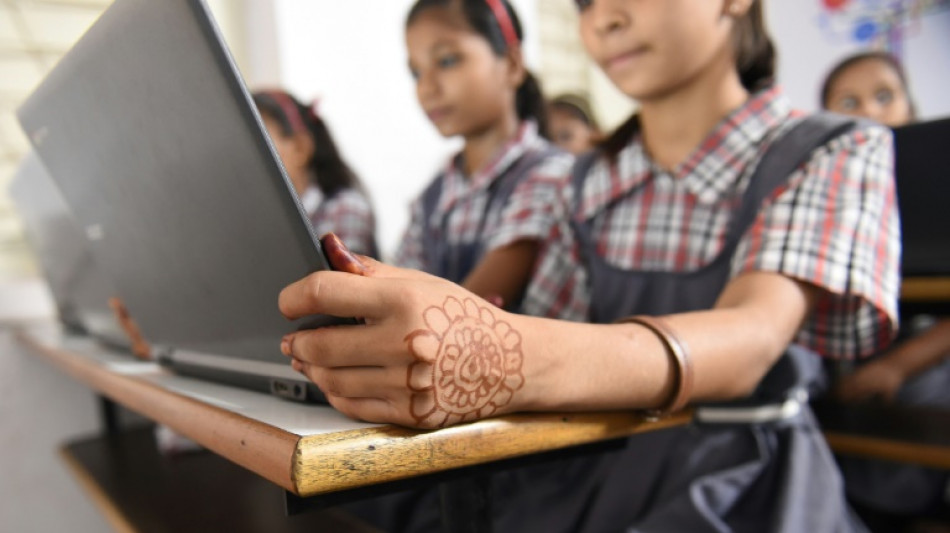
UN warns against 'excessive' tech use in classrooms / Photo: SAM PANTHAKY - AFP
 Eastside Jazz Festival Returns to Birmingham for Three-Day Event in February 2027

 Experts Warn Social Security Crisis Looms After Decades of Congressional Inaction

 Dar Global and Trump Organization Launch $700M Luxury Resort in Qatar

 Former Iowa State Women's Basketball Players Accuse Coach Bill Fennelly of Abuse

 New to The Street Show #781 Premieres Tonight on Bloomberg Television with Roadzen, Robo.ai, PureCipher and American Fusion

 How Families Budget for Youth Sports Travel Seasons
Heavy reliance on technology in education may be unproductive, or even detrimental, if it interferes with the acquisition of basic skills such as reading, the UN warned on Wednesday.
The body's education, culture and science agency UNESCO said in a report that while students should learn about technology in the world, teachers should beware of overusing "fancy technological" means in the classroom.
"There is little robust evidence on digital technology's added value in education," the report said.
Technology in the classroom "can have detrimental impact if inappropriate or excessive", it said. "It should focus on learning outcomes, not on digital inputs."
Manos Antoninis, who directed the UNESCO report, said 20 years after laptops began to be rolled out in schools, it was clear that such policies only worked if they were combined with a solid pedagogical framework.
But only a "few countries have had the patience and energy to move into that direction", he said.
"It's not enough to just distribute devices," he said.
UNESCO had observed a rising trend of banning smartphones in classrooms, with "one in four countries" passing laws and regulations to that effect.
"The presence of a phone in a classroom can be very distracting," Antoninis said.
He said smartphone bans in schools, including by liberal countries like The Netherlands, were "an interesting and surprising finding" for the UNESCO researchers.
"People are thinking a little bit more through what the consequences and the distractions in schools are," he said.
The report warned strongly against substituting technology for the acquisition of traditional key skills which could actually help children avoid some of the pitfalls of the digital world.
Students with strong reading skills, for example, were much less likely to be deceived by phishing mail, Antoninis said.
"If you are taught to read well, read for meaning, that makes you also better prepared to navigate the digital world and that's a reality that we often forget," Antoninis said.
P.M.Smith--AMWN


