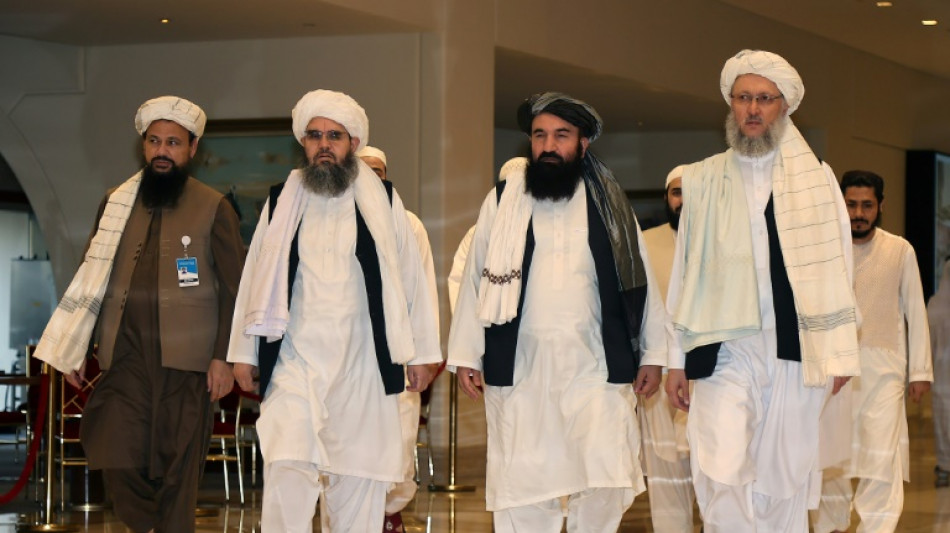
Neckties are a sign of the cross, says Taliban official / Photo: KARIM JAAFAR - AFP/File
 Eastside Jazz Festival Returns to Birmingham for Three-Day Event in February 2027

 Experts Warn Social Security Crisis Looms After Decades of Congressional Inaction
 Dar Global and Trump Organization Launch $700M Luxury Resort in Qatar

 Former Iowa State Women's Basketball Players Accuse Coach Bill Fennelly of Abuse

 New to The Street Show #781 Premieres Tonight on Bloomberg Television with Roadzen, Robo.ai, PureCipher and American Fusion

 How Families Budget for Youth Sports Travel Seasons
Neckties worn by men were a sign of the Christian cross, a senior Afghan Taliban official said Wednesday, adding they should be eliminated.
"Sometimes, when I go to hospitals and other areas, an Afghan Muslim engineer or doctor uses a necktie," said Mohammad Hashim Shaheed Wror, head of the Invitation and Guidance Directorate, a department that seeks to guide people along proper Islamic lines.
He said in a speech broadcast by Tolo TV that the symbolism of the tie "is obvious in Islam".
"What is a tie? It is the cross. It is ordered in Sharia that you should break it and eliminate it," he said.
Taliban authorities have not imposed any dress rules on men since taking over in August 2021, but women must cover up with a hijab when out in public.
Afghan Taliban officials almost all dress the same -- shalwar kameez, a waistcoat, and turban.
Casual Western clothes became less common after the Taliban takeover but some professionals -- as well as newsreaders on TV channels -- still don a collar and tie.
The tie is widely believed to have emerged in the 17th century and was made a fashion staple by the French.
Previous Afghan administrations have also tried to impose dress regulations on the population, or on officials at least.
During the decade-long Soviet occupation starting in 1979, government workers were discouraged from wearing traditional attire and told to wear suits.
Former president Ashraf Ghani -- who fled the country as the Taliban took over in 2021 -- favoured Western suits when abroad and traditional attire at home.
During their two-decade insurgency the Taliban's fighters wore shalwar kameez, but since taking power have introduced modern military uniforms for the armed services.
S.F.Warren--AMWN


