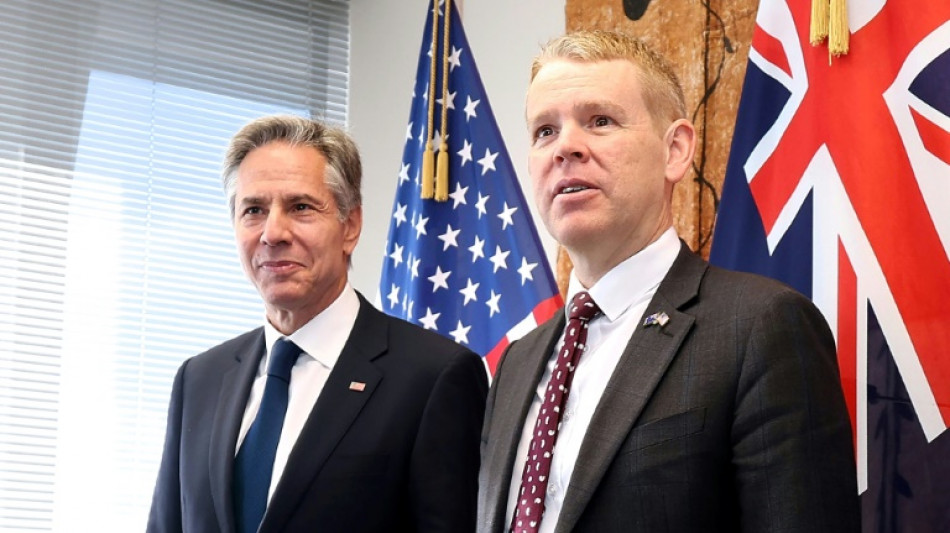
US says New Zealand welcome to 'engage' in AUKUS / Photo: Marty MELVILLE - POOL/AFP
 Eastside Jazz Festival Returns to Birmingham for Three-Day Event in February 2027

 Experts Warn Social Security Crisis Looms After Decades of Congressional Inaction

 Dar Global and Trump Organization Launch $700M Luxury Resort in Qatar

 Former Iowa State Women's Basketball Players Accuse Coach Bill Fennelly of Abuse

 New to The Street Show #781 Premieres Tonight on Bloomberg Television with Roadzen, Robo.ai, PureCipher and American Fusion

 How Families Budget for Youth Sports Travel Seasons
US Secretary of State Antony Blinken said Thursday that New Zealand would be welcome to engage in the AUKUS alliance, a landmark pact aimed at counterbalancing China's rise in the Pacific.
"The door's very much open for New Zealand and other partners to engage as they see appropriate going forward," Blinken said as he visited Wellington, a trip aimed at shoring-up Washington's alliances in the contested Pacific region.
AUKUS is a pact between Australia, the United Kingdom and the United States that includes ambitious plans to supply Canberra with nuclear-powered submarines.
New Zealand has been treading carefully around involvement, hoping to avoid angering its largest trading partner Beijing.
China vehemently opposes the pact, saying it ignores "the concerns of the international community" and plunges the region "further down the path of error and danger".
But Prime Minister Chris Hipkins said Wednesday he was "open to conversations" about limited participation.
New Zealand has ruled out any involvement in nuclear-related projects, so-called "pillar one" of the AUKUS deal.
Nuclear submarines are banned from entering New Zealand's waters under a widely popular anti-nuclear policy adopted in the mid-1980s.
But high-level talks about New Zealand's role in AUKUS have been heating up in recent months.
Any New Zealand involvement is likely to centre on "pillar two" of the accord, which covers cyber warfare, artificial intelligence and the development of long-range hypersonic missiles.
- 'Nothing agreed' -
New Zealand Foreign Minister Nanaia Mahuta on Thursday cautioned that "nothing has been agreed to" yet, and that any AUKUS proposal would first need to be approved by the country's cabinet.
New Zealand and Australia are the main allies of the United States in the South Pacific.
But New Zealand has recently been accused of putting its relationship with China ahead of its friendships with fellow Five Eyes spy group members the United States, Britain, Canada and Australia.
Hipkins travelled to China late last month, where he met with President Xi Jinping and signed a string of trade agreements.
Sidestepping issues such as China's human rights record and tensions over Taiwan, the Kiwi prime minister hailed the trip as a reaffirmation of "important economic connections" between the countries.
Blinken and Pentagon chief Lloyd Austin will now prepare to meet with their Australian counterparts, in discussions which are expected to focus on military cooperation and bedding down the details of AUKUS.
Following a similar meeting in Washington last year, Australia agreed to ramp up the presence of US armed forces at its northern bases, including the rotation of bomber aircraft.
F.Dubois--AMWN


