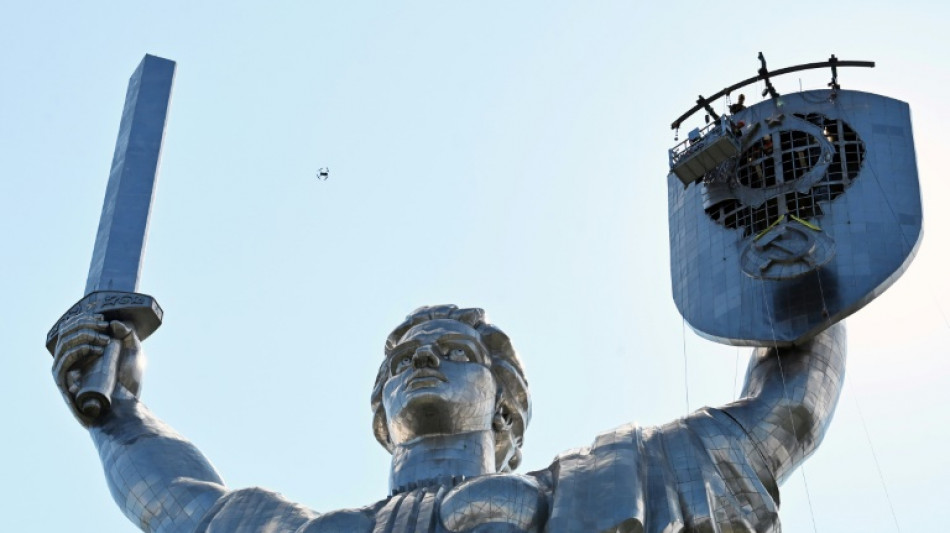
Ukraine removes hammer and sickle from giant Kyiv statue / Photo: Sergei SUPINSKY - AFP
 Eastside Jazz Festival Returns to Birmingham for Three-Day Event in February 2027

 Experts Warn Social Security Crisis Looms After Decades of Congressional Inaction

 Dar Global and Trump Organization Launch $700M Luxury Resort in Qatar

 Former Iowa State Women's Basketball Players Accuse Coach Bill Fennelly of Abuse

 New to The Street Show #781 Premieres Tonight on Bloomberg Television with Roadzen, Robo.ai, PureCipher and American Fusion

 How Families Budget for Youth Sports Travel Seasons
Workers on Tuesday lowered a hammer and sickle from a gigantic sculptural figure that watches over the Ukrainian capital, as part of a campaign to remove Soviet symbols which has ramped up since Moscow invaded last year.
The 62-metre-high steel figure of a woman holding a shield with the hammer and sickle and a sword, was opened in 1981 as a memorial to Soviet victory in World War II.
Standing on top of a war museum building, it is known in Ukrainian as Batkivshchyna Maty, literally "Fatherland Mother".
Ukraine's culture ministry has backed a plan to give the figure a new shield bearing the country's trident emblem.
Since last month, workers in a cradle suspended from a rail on top of the shield have been gradually cutting off grain and ribbon elements of the Soviet emblem and lowering them on ropes.
The whole shield will be replaced with a new one bearing the trident.
The statue is part of the National Museum of the History of Ukraine in the Second World War.
The museum director, Yuriy Savchuk, has called for the statue to be renamed Ukraine Mother.
The project to replace the shield is set to cost 28 million hryvnias ($758,000), although Ukrainian officials stress it will be paid for by corporate donations, not state funds.
The arts minister who had backed the project resigned last month amid official criticism of the cost of arts projects in wartime.
A survey commissioned by the culture ministry last year found 85 percent of Ukrainians backed removing the hammer and sickle, however.
Since Russia's invasion, Ukraine has speeded up a process of removing references to Soviet history and Russian culture from geographical names and a law on decolonisation came into force this summer.
There are similar huge sculptural figures at Soviet-era war memorials in other cities, including Volgograd in Russia and Brest in Belarus.
L.Miller--AMWN


