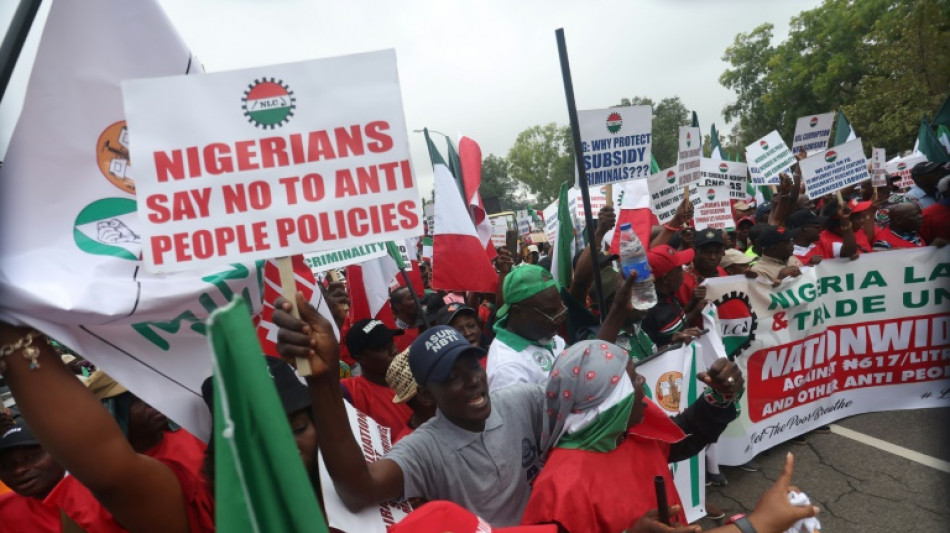
Nigerian workers strike over cost of living crisis / Photo: Kola SULAIMON - AFP
 Eastside Jazz Festival Returns to Birmingham for Three-Day Event in February 2027

 Experts Warn Social Security Crisis Looms After Decades of Congressional Inaction

 Dar Global and Trump Organization Launch $700M Luxury Resort in Qatar

 Former Iowa State Women's Basketball Players Accuse Coach Bill Fennelly of Abuse

 New to The Street Show #781 Premieres Tonight on Bloomberg Television with Roadzen, Robo.ai, PureCipher and American Fusion

 How Families Budget for Youth Sports Travel Seasons
Nigerian workers across numerous sectors went on strike Wednesday over the rising cost of living following the removal of a petrol subsidy.
The nationwide walkout was called Tuesday by the two main workers unions --the Nigerian Labour Congress (NLC) and the Trade Union Congress (TUC) -- after talks with the government to extend the subsidy broke down.
President Bola Tinubu on May 29, during his inauguration as the new leader of Africa's most populous nation, ended a fuel subsidy scheme, pushing up prices of food, transportation and other services.
In Abuja on Wednesday, about 400 protesters led by NLC president Joe Ajaero and his TUC counterpart Festus Osifo, marched through the capital carrying placards and chanting slogans.
They denounced low wages, lack of social amenities and adequate welfare as well as mass poverty.
The protesters stormed the parliament and smashed one of the gates before presenting their petitions. They were received by the Senate leaders who promised to look into their demands.
The protesters were accompanied by armed police and soldiers.
Ajaero told reporters demonstrations will continue until the government gives back the petrol subsidy.
Many businesses, including government offices, banks and markets were closed. Only a few vehicles were on the roads as the workers marched towards the city centre.
-Decrepit refineries -
But in Lagos and other cities across the country of some 210 million people, the strike action was mixed. Some markets and shops remained opened although some commercial banks were closed.
Commercial buses were operating in Lagos while a few government offices opened for business in the sprawling city of over 20 million people.
In the southern states of Abia, Ebonyi and Cross River striking workers took to major roads and headed to government offices to present their demands.
The oil-rich country, imports the bulk of its petroleum products due to problems at four domestic oil refineries.
Under the subsidy, the government covered the difference between the cost of import and prices at the pump.
Last week both unions gave the government until Wednesday to restore the subsidy or faced nationwide action.
The unions are also asking government to fix the decrepit refineries in order to end fuel imports, which has been a huge drain on foreign reserves and resources.
The strikes were called despite Tinubu announcing Monday a raft of packages to cushion against the higher cost of petrol.
Some of the measures included provision of 3,000 buses for the 36 states and Abuja to ease transport problems.
Tinubu also announced low interest loans to small businesses as well as loans for needy students.
D.Moore--AMWN


