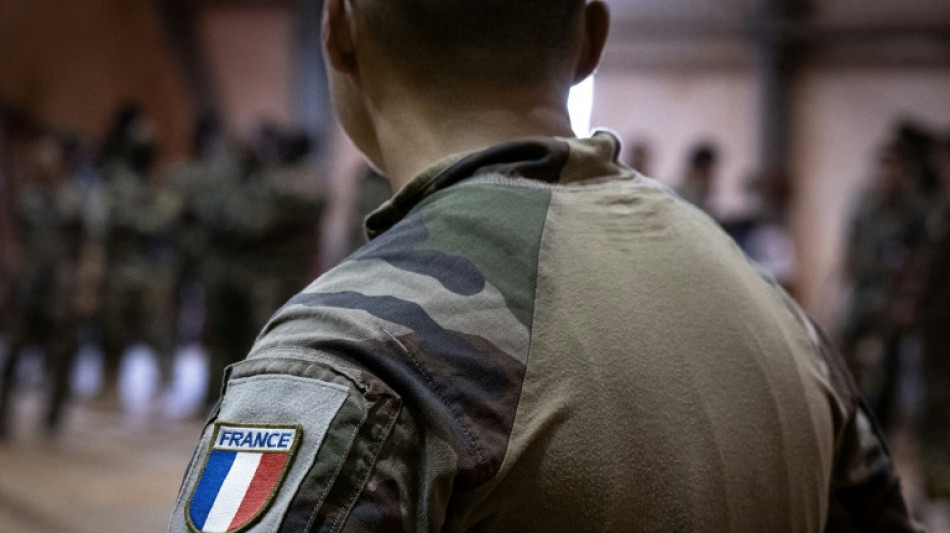
France softens tone on Niger coup / Photo: ALAIN JOCARD - AFP
 Eastside Jazz Festival Returns to Birmingham for Three-Day Event in February 2027

 Experts Warn Social Security Crisis Looms After Decades of Congressional Inaction

 Dar Global and Trump Organization Launch $700M Luxury Resort in Qatar

 Former Iowa State Women's Basketball Players Accuse Coach Bill Fennelly of Abuse

 New to The Street Show #781 Premieres Tonight on Bloomberg Television with Roadzen, Robo.ai, PureCipher and American Fusion

 How Families Budget for Youth Sports Travel Seasons
Two weeks after the coup in Niger, France has abandoned its tough tone on the crisis and is now inclining towards diplomatic solutions, with military action seemingly ruled out for now, experts said.
West Africa's regional bloc ECOWAS had given coup leaders a deadline of last Sunday to reinstate elected president Mohamed Bazoum, or face potential use of force.
But the Niger's new rulers defied the ultimatum and it elapsed with no action being taken. The leaders of ECOWAS -- the Economic Community of West African States -- meet again on Thursday in the Nigerian capital of Abuja.
On the eve of the deadline, France loudly showed its support for ECOWAS, saying it "firmly and resolutely" backed the bloc's efforts to restore Bazoum.
But Paris' latest declaration on Tuesday was cautious and measured, marking a clear shift from the earlier, more combative stance.
France stands by its policy of backing efforts to "restore democracy" in Niger, but believes it is up to ECOWAS "to take a decision on how to restore the constitutional order in Niger, whatever that decision may be," said a diplomatic source, asking not to be named.
The statement came after US acting deputy secretary of state Victoria Nuland went to Niamey to speak with coup leaders.
But she acknowledged her talks made no headway and was unable to meet the new strongman, General Abdourahamane Tiani, or the detained Bazoum.
- 'About diplomacy now' -
Bertrand Badie, a professor at the Sciences-Po university, said France's early belligerent tone was gone.
"It's no longer about military intervention, it's no longer about denying this government all legitimacy, it's about diplomacy now," Badie told AFP.
"They're backing away from what they said at the start."
Niger's new government has accused France repeatedly of planning military action, a charge that Paris denies.
France's more hawkish tone at the weekend notable contrasted to calls for dialogue by Germany, Italy and the United States.
Respective coups in Mali and Burkina Faso in 2020 and 2022 had forced the pullout of French troops from those countries deployed to fight a jihadist insurgency in the Sahel region.
President Emmanuel Macron has since staked a lot on the relationship with Bazoum.
Paris has 1,500 troops in Niger, most of whom are deployed at a major air base neary Niamey. The United States also has around 1,000 military base, also at a key base.
Badie at Science-Po said that France's early stance had been "abnormally confident and aggressive" and Paris was now on the back foot.
"There is no doubt that France is losing the diplomatic initiative here," Badie said.
- 'A little freewheeling' -
"Silence and restraint are not necessarily bad things," observed Jean-Herve Jezequel, director of the Sahel project at the International Crisis Group (ICG).
France "is not the best-placed (country) to lead this dialogue" with Niger's new rulers, he said.
France may have erred tactically by rejecting the right of Niger's coup leaders to cancel bilateral military agreements, Jezequel argued.
"By being intransigent, France prompted the military to harden their position" and enabled them to build up support among the public, he said.
There have been anti-French protests in Niamey, with signs outside the French embassy trampled on, although Paris warns against exaggerating the extent of anti-French feeling and suggests Russian disinformation is to blame.
Thousands also gathered on Niamey on Sunday in a show of popular support for the coup.
France may have boxed itself into a diplomatic corner, said Francois Gaulme, a researcher at the French Institute of International Relations (IFRI), a think tank.
He said it was a "contradiction" that France, having accepted previously to pull its troops out of Mali and Burkina Faso following military takeovers there, was now denying Niger the right to the same treatment.
"I find French diplomacy a little freewheeling," he said.
This could become painfully obvious if ECOWAS does indeed find a diplomatic solution to the crisis.
"French diplomacy would find itself deeply humiliated," Badie warned.
Such an outcome would be seen across the region as an indication of France's "structural inability... to emerge from a post-colonial attitude," he said.
The Niger crisis is a sign that "the times of a strong French military presence in the Sahel is over," said Jezequel.
There is "now also a question mark over its future in West Africa," he said.
Th.Berger--AMWN


