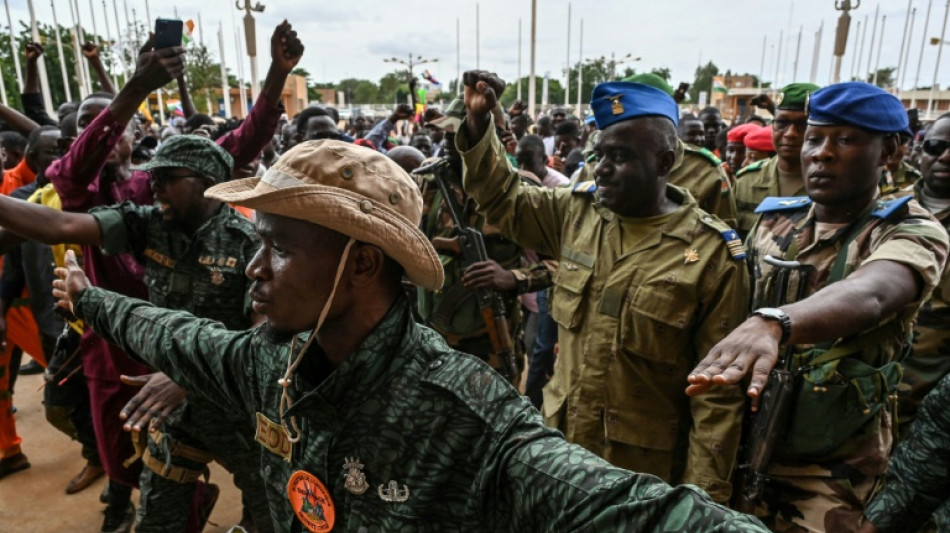
Diplomacy centre-stage on eve of W.Africa summit on Niger / Photo: - - AFP
 Eastside Jazz Festival Returns to Birmingham for Three-Day Event in February 2027

 Experts Warn Social Security Crisis Looms After Decades of Congressional Inaction

 Dar Global and Trump Organization Launch $700M Luxury Resort in Qatar

 Former Iowa State Women's Basketball Players Accuse Coach Bill Fennelly of Abuse

 New to The Street Show #781 Premieres Tonight on Bloomberg Television with Roadzen, Robo.ai, PureCipher and American Fusion

 How Families Budget for Youth Sports Travel Seasons
West African nations and the United States gave priority to diplomacy to end the crisis in coup-stricken Niger ahead of a regional summit on Thursday to consider options that include military intervention.
The summit of the Economic Community of West African States (ECOWAS) takes place under the chairmanship of Nigeria, the regional superpower and advocate of a hard line.
Struggling to stem a cascade of putsches among its members, the bloc gave Niger's military rulers until last Sunday to reinstate the elected president, Mohamed Bazoum, or face potential use of force.
But the coup leaders remained defiant, and the ultimatum passed without action.
On Tuesday, a bid to send a joint team of ECOWAS, UN and African Union (AU) representatives to the capital Niamey ran into the ground.
The coup leaders said they could not guarantee the mission's "safety" in the light of what they said was public anger to sanctions imposed by ECOWAS.
Despite the failure, ECOWAS and Nigeria said they would pursue all options to resolve the crisis, and the United States emphasised a "peaceful" outcome even though it too had been rebuffed.
ECOWAS said it would "continue to deploy all measures in order to restore constitutional order" in Niger.
Nigerian President Bola Tinubu said through his spokesman that "no options have been taken off of the table" but diplomacy was the "best way forward."
- 'Peaceful resolution' -
The United States sent veteran envoy Victoria Nuland to Niamey on Monday, but she came away empty-handed, being unable to meet Bazoum or even the new strongman, General Abdourahamane Tiani.
Despite this, US Secretary of State Antony Blinken said Wednesday he had spoken to Bazoum "to express our continued efforts to find a peaceful resolution" to the "current constitutional crisis".
France, which had adopted a combative tone as the ECOWAS ultimatum loomed, also signalled a softer line.
A French diplomat said it was "up to ECOWAS to take a decision, of whatever kind, on restoring constitutional order in Niger."
Bazoum, 63, was detained on July 26 by members of his presidential guard.
It is the fifth coup in Niger's history since independence from France in 1960 -- and the fourth in the ranks of the 15-nation ECOWAS since 2020.
Bazoum's election in 2021 had helped Niger to cement close ties with France and the United States, which have major bases and troop deployments in the country.
The new military rulers have appointed a civilian prime minister, Ali Mahaman Lamine Zeine, in what appears to be the first step towards setting up a transitional government -- a path also taken by army-run Mali and Burkina Faso.
They have also arrested several former ministers, as well as the son of Niger's ambassador to France, Aichatou Boulama Kane, who had refused to step down after the takeover.
- Sahel crisis -
Countries in the fragile Sahel are battling with a jihadist insurgency that erupted in northern Mali in 2012, spread to Niger and Burkina Faso in 2015 and now is causing jitters in states on the Gulf of Guinea.
The bloody campaign has been devastating for those three countries, which have a long history of turbulence and are among the poorest nations in the world.
Since their coups, Mali and Burkina Faso have fallen out with France, the region's former colonial power and its traditional ally.
France last year withdrew its forces from those countries and refocussed its anti-jihadist strategy on Niger.
Mali and Burkina Faso have voiced solidarity with their counterparts in Niger, saying that any ECOWAS military intervention would be considered a "declaration of war" against them.
D.Cunningha--AMWN


