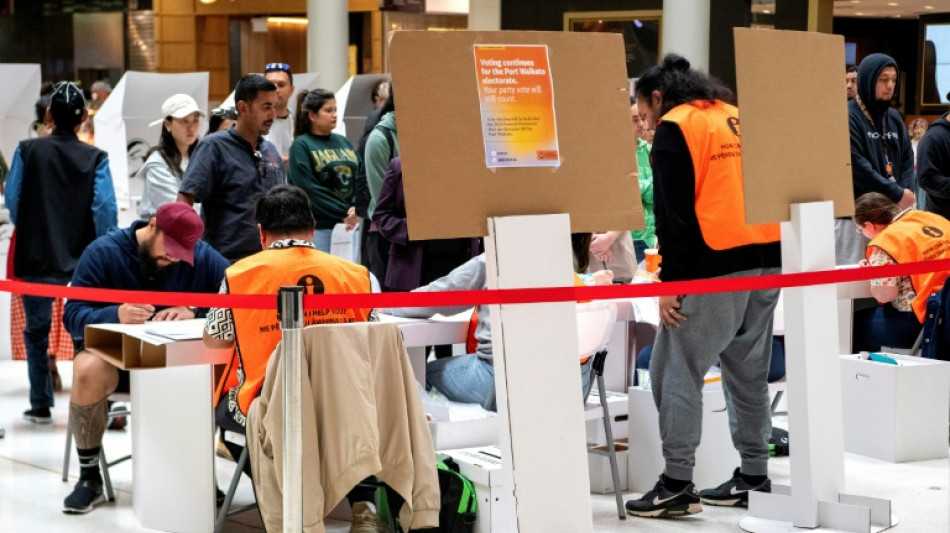
Conservative parties surge to victory in New Zealand election / Photo: Ivan Tarlton - AFP
 Premier Doerkson Names Surrey MLA to TransLink Role Citing SkyTrain Commitment

 Mikal Bridges Hits Buzzer-Beater to Defeat Trail Blazers 97-96

 Lotto Results for Saturday, November 21, 2026

 PSU Bank Stocks Surge Up to 27% in November Amid FPI Inflows

 Manchester City vs Fulham Live: Haaland Disallowed Goal and Muniz Strike

New Zealanders resoundingly elected a new conservative government Saturday, with incumbent Prime Minister Chris Hipkins conceding his centre-left Labour party's six years in power were over.
Hipkins, who replaced charismatic two-term leader Jacinda Ardern in January, said he was "not in a position to form a government" and had already congratulated premier-in-waiting Christopher Luxon.
"The result tonight is not one that any of us wanted, but I want you to be proud of what we achieved over the last six years," Hipkins told Labour supporters in Wellington.
The National Party and its coalition partner ACT were projected to win 62 seats with 85 percent of the vote tallied -- enough to secure a majority in New Zealand's 120-seat parliament.
Luxon, a former airline executive, said New Zealanders had "reached for hope and voted for change".
The election campaign had been dominated by an increasingly difficult economic situation and a spike in the cost of living that had hit New Zealanders hard.
"My pledge to you is that National will deliver for every New Zealander," Luxon said, promising to "build the economy and deliver tax relief".
"We will bring down the cost of living. We will restore law and order. We will deliver better health care and we will educate our children so that they can grow up to live the lives they dream of."
In the small town of Waikanae, about an hour's drive north of Wellington, butcher Terry McKee said the spiralling cost of living was the single most important election issue.
"Things are tight for everyone. Interest rates, fuel costs all drive costs up, but I don't know what another government is going to do," he told AFP.
Both Luxon and Hipkins had tried to woo voters with promises to ease surging petrol prices, fix chronic housing shortages, and halt the skyrocketing prices of staple foods.
The Labour party, which secured a landslide victory under Ardern in 2020, was on track to suffer one of its heaviest election defeats with forecasts pointing to 34 seats.
"Following on from my good friend Jacinda, it was not going to be an easy task," Hipkins admitted.
"I did know when I took on this job that it was going to be an uphill battle."
P.Mathewson--AMWN

