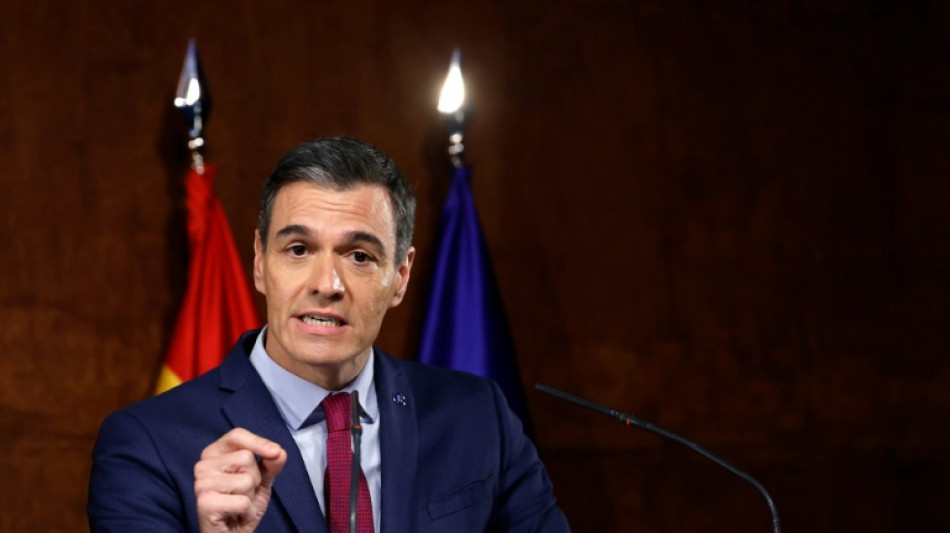
Spain PM offers amnesty to Catalan separatists in controversial deal / Photo: OSCAR DEL POZO - AFP/File
 Premier Doerkson Names Surrey MLA to TransLink Role Citing SkyTrain Commitment

 Mikal Bridges Hits Buzzer-Beater to Defeat Trail Blazers 97-96
 Lotto Results for Saturday, November 21, 2026

 PSU Bank Stocks Surge Up to 27% in November Amid FPI Inflows

 Manchester City vs Fulham Live: Haaland Disallowed Goal and Muniz Strike
Spanish Prime Minister Pedro Sanchez has clinched a controversial deal to remain in power by offering amnesty to Catalan separatists, raising tensions across the country.
The accord is aimed at "giving stability to the four-year legislature," Spanish Socialist Party (PSOE) official Santos Cerdan told a news conference in Brussels Thursday after negotiations with Catalan separatist leader Carles Puigdemont, who is based there.
Sanchez's PSOE finished second in the July 23 parliamentary elections. After the first-place centre-right Popular Party (PP) failed to form a government, Sanchez was given until November 27 to cobble together a working coalition, or face fresh elections.
Sanchez needs the support of Catalan independence parties, and has accepted their demands to offer amnesty to all those being pursued for their role in a failed secession attempt in 2017.
He had already secured the backing of more moderate Catalan separatist parties and Thursday nailed down the support of Puigdemont's more radical Junts per Catalunya party, or JxCat.
The amnesty law would cover events back to 2012, Cerdan said.
It would need to be approved by parliament to take effect.
Puigdemont was due to speak in Brussels later today.
In recent days, conservative opposition parties and members of Spain's judiciary have stepped up criticism of the amnesty plan, with some accusing Sanchez of corruption and abandoning the rule of law.
The proposed bill has sparked several days of tense protests in the country this week, with thousands rallying against it in the capital Madrid.
Puigdemont is currently based in Brussels, having left Spain for Belgium following the failed secession bid to avoid prosecution.
- Protests -
Nearly 7,000 protesters gathered in Madrid on Tuesday, according to authorities, carrying placards emblazoned with the words "No to amnesty" and "Spain does not pay traitors".
On Monday evening, several thousand demonstrators gathered outside the headquarters of the Spanish Socialist Workers' Party in Madrid, Barcelona and Valencia.
On Saturday, Alberto Nunez Feijoo, head of the PP, said at a meeting that "exchanging votes for impunity is corruption" and vowed at a rally in Valencia a day later: "We will defend Spain."
The opposition accuses Sanchez, who once opposed amnesty, to be willing to do anything to stay in power.
Sanchez has remained defiant in the face of the demonstrations.
In a message on X, formerly Twitter, on Monday he criticised "harassment" by the protesters and said their behaviour was akin to "attacking democracy".
- Judiciary concerns -
Members of the judiciary have also stepped up their criticism.
The Professional Association of Magistrates, a conservative body that represents the majority of the country's judges, last week issued a statement calling the measures "the beginning of the end of democracy" that would "destroy the rule of law".
After a failed Catalan secession attempt in 2017, hundreds of people were pursued by Spanish prosecutors, sparking claims of repression.
The main leaders of the movement fled abroad, including Puigdemont, or were given jail sentences of up to 13 years.
Sanchez was elected to power just a month after the secession attempt, with the support of separatists. He has made reducing tensions in Catalonia a priority.
In 2021, he pardoned the nine jailed separatists and the following year his government reformed the Spanish legal code to remove the crime of sedition, under which they had been condemned.
Ch.Kahalev--AMWN

