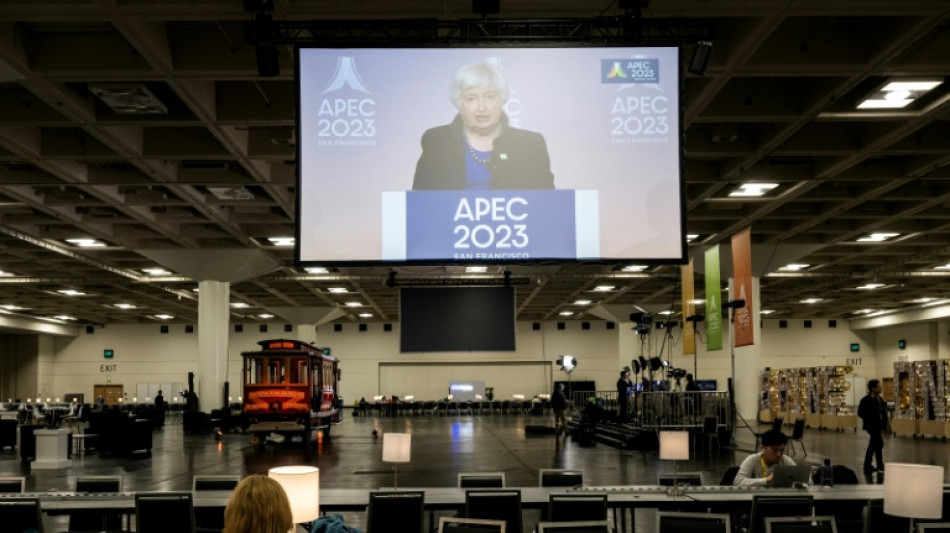
US postpones Asia trade deal rollout after domestic fire / Photo: ANDREW CABALLERO-REYNOLDS - AFP
 Premier Doerkson Names Surrey MLA to TransLink Role Citing SkyTrain Commitment

 Mikal Bridges Hits Buzzer-Beater to Defeat Trail Blazers 97-96
 Lotto Results for Saturday, November 21, 2026

 PSU Bank Stocks Surge Up to 27% in November Amid FPI Inflows
 Manchester City vs Fulham Live: Haaland Disallowed Goal and Muniz Strike
President Joe Biden's administration signaled Monday it would postpone a draft of an Asia trade pact that had been set to be unveiled at a summit in San Francisco, after facing domestic criticism.
Biden, welcoming 20 other members of the Asia-Pacific Economic Cooperation (APEC) forum to San Francisco where he will meet on the sidelines with Chinese President Xi Jinping, had been expected to announce substantial progress on a nascent trade deal.
But Treasury Secretary Janet Yellen said there was still work to be done on the most contentious part of the so-called Indo-Pacific Economic Framework for Prosperity (IPEF), the trade component.
"There's been significant progress, but it looks not to be complete, like something that is likely to require further work," she told reporters after leading talks of APEC foreign ministers.
"Nevertheless, in a number of areas that I think are critically important to the United States, like supply chains, environment, sustainable finance, we've made a huge amount of progress and we've made progress on trade too, but it appears not to be complete," she said.
IPEF falls well short of a traditional trade deal as it does not offer trade access.
Nonetheless, it would aim to set standards for business across some 40 percent of the global economy including three of the world's top five economies -- the United States, Japan and India.
IPEF also includes Australia, South Korea and much of Southeast Asia, but notably not China, as the United States tries again to assert a leadership role in Asia.
Senator Sherrod Brown, a member of Biden's Democratic Party close to labor unions, who faces reelection next year in battleground Ohio, on the eve of the summit called for the entire removal of trade from the IPEF.
"Any trade deal that does not include enforceable labor standards is unacceptable," Brown said.
The Democrats enjoy only a slender majority in the Senate and some in the party fear IPEF could be a replay of the Trans-Pacific Partnership, a more ambitious trade deal that former president Barack Obama pitched to Asian allies.
Donald Trump denounced that deal as ignoring US workers' interests and pulled out immediately after entering the White House in 2017.
L.Miller--AMWN

