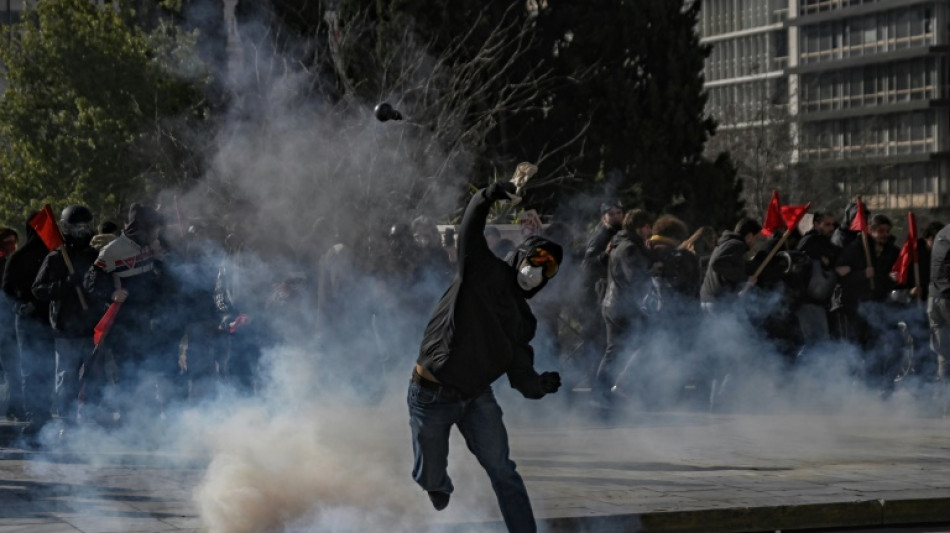
Tear gas battle as Greek students protest university reform / Photo: Aris MESSINIS - AFP
 Premier Doerkson Names Surrey MLA to TransLink Role Citing SkyTrain Commitment

 Mikal Bridges Hits Buzzer-Beater to Defeat Trail Blazers 97-96

 Lotto Results for Saturday, November 21, 2026

 PSU Bank Stocks Surge Up to 27% in November Amid FPI Inflows
 Manchester City vs Fulham Live: Haaland Disallowed Goal and Muniz Strike

Greek students clashed with police in Athens Friday as thousands protested a controversial bill on private universities, which they say will favour the rich.
Riot police fired tear gas and used batons to keep students away from parliament ahead of a vote on the bill.
Some protesters hurled stones and Molotov cocktails and setting bins on fire. Media reported that at least eight people had been injured and nine arrested.
The proposed measure will make degrees from approved private institutions equivalent to public university diplomas. The bill will also allow foreign universities to open in Greece using a nonprofit status despite charging tuition fees.
Police said around 17,000 people marched to parliament in central Syntagma Square for the latest in weeks of student protests against the reform. Organisers put the turnout at 30,000.
"No to education for the few and chosen, free education for all," many chanted.
Demonstrator Iraklis Marinopoulos, 19, said the reform would "undermine" public university degrees and threaten regional colleges in smaller Greek cities.
"Wealthier students will be able to enrol with lower grades. They will just pay and obtain a degree," he told AFP.
Athina, a 20-year-old engineering student, said private institutions would eat into the meagre funds for public universities and devalue public university degrees.
The government says the new bill will enable Greek public universities to enter into partnerships with foreign academic institutions, improving their international appeal.
It has also said it will introduce stricter rules for private institutions.
- 'New horizons' -
Prime Minister Kyriakos Mitsotakis told parliament the reform would enable Greek students "to study at international universities without leaving home".
It was "a step that opens new horizons to the new generation," he argued.
"We are establishing something that exists even in North Korea. Sadly, we are probably the last alongside Cuba to have a hard state monopoly on higher education".
Ahead of the vote, which the ruling majority is expected to carry, opposition parties accused the government of chronically underfunding public universities.
Parliament spokesman for the main opposition Syriza party, Sokratis Famellos, said Greece spent just 7.1 percent of its budget on education when the European Union average is 9.6 percent.
And while the European average is one lecturer per 13 students, in Greece the average is 1 to 47, he said.
"You are doing this so that a few of your friends, some funds and colleges, can make a profit," Famellos told the debate.
Public Greek universities are plagued by run-down infrastructure, political meddling in student affairs, and random violence and vandalism.
Efforts by previous conservative governments to reform higher education have floundered in the face of student protests, many of them marred by violence.
P.Silva--AMWN

