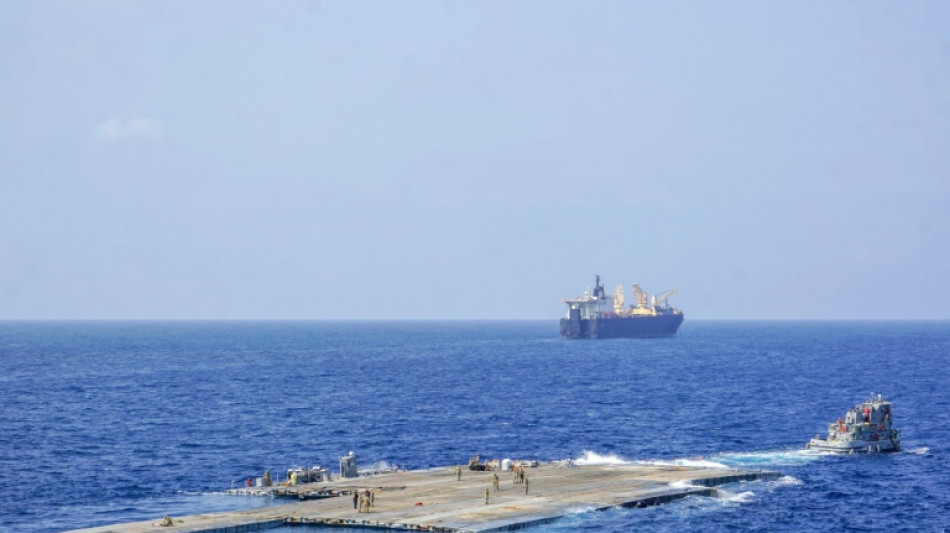
US military says aid pier anchored to Gaza beach / Photo: - - US Central Command (CENTCOM)/AFP
 Eastside Jazz Festival Returns to Birmingham for Three-Day Event in February 2027

 Experts Warn Social Security Crisis Looms After Decades of Congressional Inaction

 Dar Global and Trump Organization Launch $700M Luxury Resort in Qatar

 Former Iowa State Women's Basketball Players Accuse Coach Bill Fennelly of Abuse

 New to The Street Show #781 Premieres Tonight on Bloomberg Television with Roadzen, Robo.ai, PureCipher and American Fusion

 How Families Budget for Youth Sports Travel Seasons
US troops early Thursday anchored a long-awaited temporary pier, meant to boost aid deliveries into war-ravaged Gaza, to a beach in the besieged Palestinian territory, the US military said.
"Today at approximately 7:40 am (0440 GMT) United States Central Command personnel supporting the humanitarian mission to deliver additional humanitarian aid to Palestinian civilians in need anchored a temporary pier to the beach in Gaza," CENTCOM said in a post on social media platform X.
The US-built pier, announced in March by President Joe Biden and constructed at a cost of at least $320 million, is part of international efforts to circumvent restrictions on overland access into the Gaza Strip imposed by Israel, Washington's close ally.
The US military's CENTCOM, which operated in the Middle East, said that "as part of this effort, no US troops entered Gaza."
"Trucks carrying humanitarian assistance are expected to begin moving ashore in the coming days," it added, with UN agencies to "receive the aid and coordinate its distribution into Gaza".
The United Nations has warned of a looming famine in Gaza, where it says the vast majority of the coastal territory's 2.4 million inhabitants have been displaced since the start of the Israel-Hamas war, now in its eighth month.
The bloodiest-ever Gaza war began after Hamas's October 7 attack on southern Israel, which resulted in the deaths of more than 1,170 people, mostly civilians, according to an AFP tally of Israeli official figures.
Israel's military retaliation has killed at least 35,233 people, also mostly civilians, according to the health ministry in the Hamas-run Gaza Strip.
The UN has argued that opening up land crossing points and allowing more aid trucks into Gaza is the only way to stem the spiralling humanitarian crisis.
- 'Land routes most effective' -
But the primary crossing into Gaza, on the territory's border with Egypt, has been closed for days after Israel seized it from Hamas last week.
Israeli troops took over the Palestinian side of the Rafah crossing as the military threatened a wider assault on the southern city, defying warnings from the United States and others over the fate of some 1.4 million civilians who had been sheltering there.
Thursday's announcement came after a CENTCOM official said Wednesday that hundreds of tonnes of aid were already ready for delivery via the pier, with "thousands of tonnes" more "in the pipeline".
Britain said late Wednesday that a ship carrying aid had left from the Mediterranean island of Cyprus towards the new pier, carrying an initial nearly 100 tonnes of "shelter coverage kits".
The pier will initially facilitate the delivery of around 90 truckloads of international aid into Gaza each day, the British statement said.
It added that the volume of aid would be scaled up to 150 truckloads a day once the pier is fully operational, without providing a clear timeline.
It also acknowledged that the maritime corridor was "not a replacement for aid being delivered through land routes, which remain the quickest and most effective way of getting much-needed aid into Gaza".
"We know that more is required, particularly via land," British Prime Minister Rishi Sunak said in the statement.
P.Stevenson--AMWN


