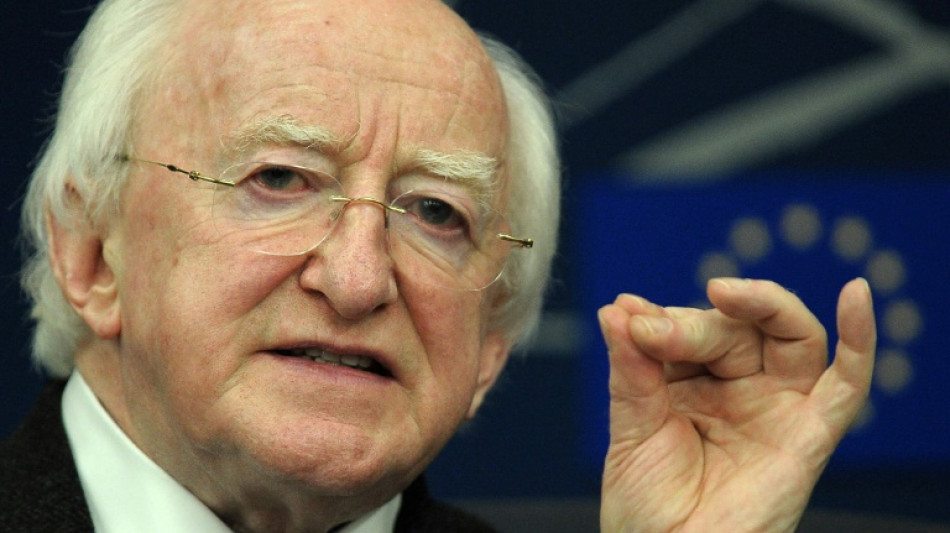
Irish president hits out at UK govt 'Troubles' law / Photo: Frederick FLORIN - AFP
 Eastside Jazz Festival Returns to Birmingham for Three-Day Event in February 2027

 Experts Warn Social Security Crisis Looms After Decades of Congressional Inaction
 Dar Global and Trump Organization Launch $700M Luxury Resort in Qatar

 Former Iowa State Women's Basketball Players Accuse Coach Bill Fennelly of Abuse

 New to The Street Show #781 Premieres Tonight on Bloomberg Television with Roadzen, Robo.ai, PureCipher and American Fusion

 How Families Budget for Youth Sports Travel Seasons
Ireland's president on Friday hit out at new UK legislation designed to draw a line under the violence during Northern Ireland "Troubles", 50 years on from the biggest single-day loss of life in that period.
Michael D. Higgins said the new law was neither morally acceptable nor politically feasible, in a speech at a wreath-laying ceremony in Dublin.
The event was to commemorate the 33 people and an unborn child killed when four bombs ripped through Dublin and Monaghan in 1974, explosions also wounded more than 300 people.
Higgins said London's introduction of the legislation had ended any chance the victims' families had of finding out what happened, or of securing justice.
The Northern Ireland Troubles (Legacy and Reconciliation) Act 2023 came into force this month, halting any inquests, civil cases and criminal prosecutions linked to the Troubles.
Most controversially, it granted immunity to former combatants on all sides, including paramilitary groups and British service personnel, who say they have been unfairly prosecuted.
Higgins said the new law had meant families who had spent decades fighting for investigations not only faced further uncertainty and delays but also "the deprivation of legal rights".
He added: "It is not morally acceptable, nor is it politically feasible, to request that those affected by such tragedy should forget about the past, draw a line or move on."
Ireland said in December it had launched legal action against the UK government in the European Court of Human Rights over the legacy law.
All Northern Irish political parties oppose the legislation, and Europe's leading rights watchdog, the Council of Europe, has also expressed "serious concerns".
No warnings were given for the deadly 1974 blasts commemorated on Friday.
Although no one has been convicted in connection with the atrocity, pro-UK paramilitary group the Ulster Volunteer Force (UVF) admitted responsibility in 1993.
More than 3,500 people died during the "Troubles", which began in the late 1960s and ended with a landmark 1998 peace accord.
T.Ward--AMWN


