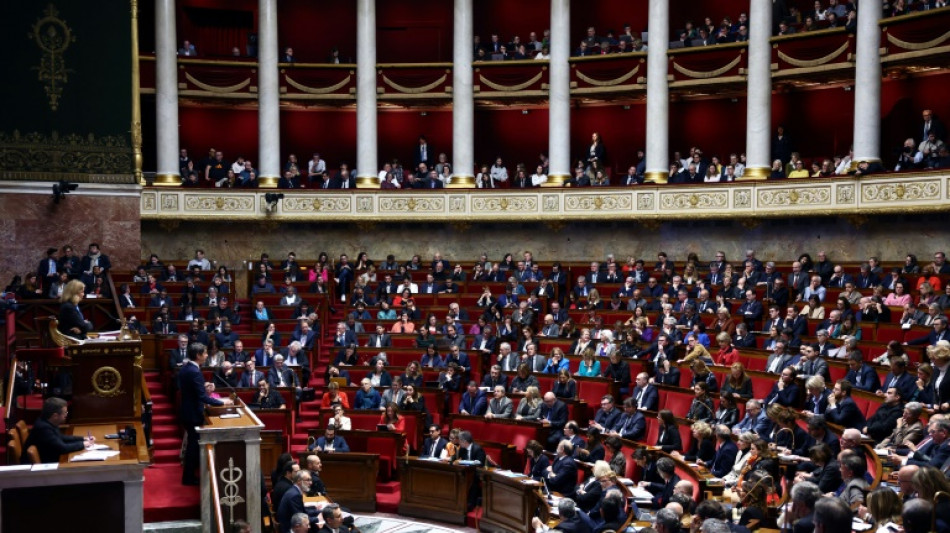
French parliament debates divisive bill on assisted dying / Photo: Emmanuel Dunand - AFP
 Eastside Jazz Festival Returns to Birmingham for Three-Day Event in February 2027

 Experts Warn Social Security Crisis Looms After Decades of Congressional Inaction

 Dar Global and Trump Organization Launch $700M Luxury Resort in Qatar

 Former Iowa State Women's Basketball Players Accuse Coach Bill Fennelly of Abuse

 New to The Street Show #781 Premieres Tonight on Bloomberg Television with Roadzen, Robo.ai, PureCipher and American Fusion

 How Families Budget for Youth Sports Travel Seasons

France's parliament on Monday started debating a deeply controversial right-to-die bill backed by President Emmanuel Macron, who has made it a flagship reform of his second term.
If the bill becomes law -- at the end of discussions likely to last for more than a year -- it will bring France closer in line with its European neighbours, some of whom already allow assisted suicide.
Speaking in the National Assembly lower house, Health Minister Catherine Vautrin said the government was seeking "an ethical response to the suffering of people at the end of their life."
"It is to parliament's credit that it takes up the most serious and distressing issues that affect and sometimes torment our society," she said.
Macron has insisted that any authorisation to choose death should be limited to people with incurable illnesses and intense pain.
The bill is widely referred to as focussing on "end of life" or "aid in dying" in the French debate, rather than "assisted suicide" or "euthanasia".
Macron said in March that France needed the law because "there are situations you cannot humanely accept".
The goal was "to reconcile the autonomy of the individual with the solidarity of the nation", he said.
The bill is facing stiff opposition from religious leaders in what is traditionally a Catholic country, as well as many health workers.
While most left-leaning deputies and Macron allies back the legislation, some of them said they would join the conservative opposition in voting against, mostly for reasons based on personal experience.
- 'Who am I?' -
All parties' parliamentary leaders have said that they will not pressure their MPs to follow the party line.
Communist deputy Andre Chassaigne whose brother, suffering from pancreatic cancer, killed himself, has said he could not back a law that allowed "killing".
"I helped my mother die," Green deputy Sandrine Rousseau said last month. "She committed suicide and I was there. Who am I to prevent her?"
One key question is whether patients who are no longer able to trigger the protocol ending their life themselves can be euthanised by qualified personnel.
Only people born in France or long-term residents will be allowed to apply for assisted dying.
Eligible patients will have to be over 18, able to clearly express their wishes and suffer from a condition that limits their life expectancy to the short or medium term.
Psychiatric illnesses are specifically ruled out from the bill, as are neurodegenerative conditions such as Alzheimer's.
The National Assembly set aside two weeks of discussions for the first reading of the bill, with the vote scheduled for June 11, before the legislation is sent to the Senate upper house in the autumn.
Until now, French patients in pain wishing to end their lives have had to travel abroad, including to neighbouring Belgium which, along with the Netherlands, in 2002 became the first EU country to allow euthanasia.
Spain in 2021 authorised euthanasia and medically-assisted suicide for people with a serious and incurable illness, followed by Portugal last year.
burs/jh-as/yad
D.Moore--AMWN


