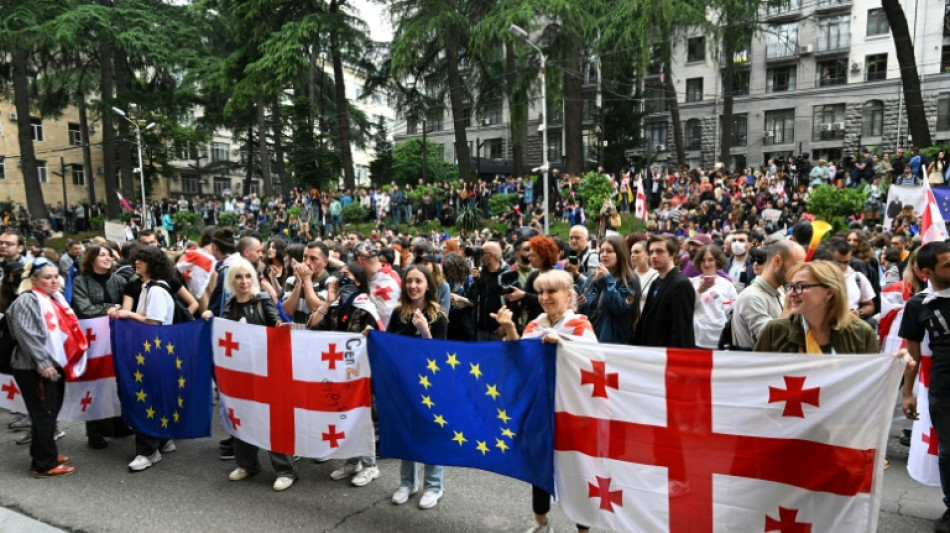
Thousands rally in Georgia to protest adoption of 'foreign influence' law / Photo: Vano SHLAMOV - AFP
 Eastside Jazz Festival Returns to Birmingham for Three-Day Event in February 2027

 Experts Warn Social Security Crisis Looms After Decades of Congressional Inaction

 Dar Global and Trump Organization Launch $700M Luxury Resort in Qatar

 Former Iowa State Women's Basketball Players Accuse Coach Bill Fennelly of Abuse

 New to The Street Show #781 Premieres Tonight on Bloomberg Television with Roadzen, Robo.ai, PureCipher and American Fusion

 How Families Budget for Youth Sports Travel Seasons

Thousands of Georgians rallied Tuesday outside parliament after ruling party MPs adopted a divisive "foreign influence" law, overcoming a presidential veto on the bill despite Western warnings the move could jeopardise the country's path to the European Union.
The law, which critics have compared to repressive Russian legislation used to silence dissent, forces groups receiving at least 20 percent of funding from abroad to register as "organisations pursuing the interests of a foreign power."
The proposal has drawn fierce opposition from Western governments including the United States, which said the measure risked "stifling" freedom of expression in the Black Sea Caucasus nation.
Brussels warned the measure was "incompatible" with the ex-Soviet republic's longstanding bid for EU membership, which is enshrined in the country's constitution and supported -- according to opinion polls -- by more than 80 percent of the population.
Lawmakers voted 84 to 4 to pass the bill on Tuesday, after overriding pro-EU President Salome Zurabishvili's veto.
Most opposition MPs walked out of the 150-seat chamber ahead of the vote.
The EU said that it deeply regretted the law being adopted, and foreign affairs chief Josep Borrell said the bloc was "considering all options to react to these developments".
- 'Angry, frustrated' -
Waving Georgian and EU flags, thousands of protesters gathered outside parliament on Tuesday evening with crowds swelling after the chamber voted to adopt the law.
Georgia's national anthem and EU's Ode to Joy were performed at the rally.
Zurabishvili addressed the crowd by video link.
"You are angry today, aren't you? Get angry, but let's get to work. The work is that we have to prepare, first of all, for a true referendum," she said referring to October's elections.
"Do we want a European future or Russian slavery? Eighty-four men cannot decide this, we can -- we, all together."
Georgia has been gripped by a wave of unprecedented daily rallies for the past seven weeks since the ruling Georgian Dream party revived the plans, which are similar to measures it dropped last year after a public outcry.
"I feel so angry, I feel so frustrated. The most important thing right now is to not lose hope," protestor Lizi Kenchoshvili, 23, told AFP outside parliament minutes after the vote, vowing to continue protesting.
Opposition lawmaker Khatia Dekanoidze told AFP the result was to be expected.
"It's not about the law, it's about the geopolitical choice in favour of Russia. Right now we are waiting for the sanctions from the United States and also from the European Union," she said.
Prime Minister Irakli Kobakhidze said the idea of sanctions was not "serious".
"No one can punish the Georgian people, and no one can punish the authorities elected by the Georgian people," he told a press conference after the vote.
His party, Georgian Dream, says the law will ensure "transparency" and argues Western-funded groups undermine Georgia's sovereignty.
But rights groups and Western governments warn the law will further ignite tensions in the deeply polarised Caucasus country ahead of October parliamentary elections seen as a key democratic test.
Non-governmental organisations, including anti-corruption group Transparency International, have told AFP the law could see their assets frozen and their work limited.
Tensions were high in the parliamentary chamber ahead of the vote, with opposition lawmaker Giorgi Vashadze doused with water as he gave a speech.
Scuffles and fights have broken out between government and opposition lawmakers on at least two previous occasions over the last month.
- 'Derailing' -
Earlier Borrell warned that Georgia's government was "derailing from the European track."
President Zurabishvili, a fierce critic of the ruling party, has called on the opposition to form a united front ahead of parliamentary elections in October.
The law was first adopted by parliament two weeks ago, but vetoed by Zurabishvili days later on May 18.
The United States announced last week it would place visa restrictions on Georgian officials should the bill be signed into law and was reviewing its relations with Tbilisi.
Activists, independent journalists and opposition politicians have faced weeks of violence and threats since the government announced the draft legislation, in what rights groups have called a targeted campaign.
Opposition politicians have accused the government of derailing Georgia from its Western trajectory and leading the country back to the Kremlin's orbit -- an accusation it denies.
J.Williams--AMWN


