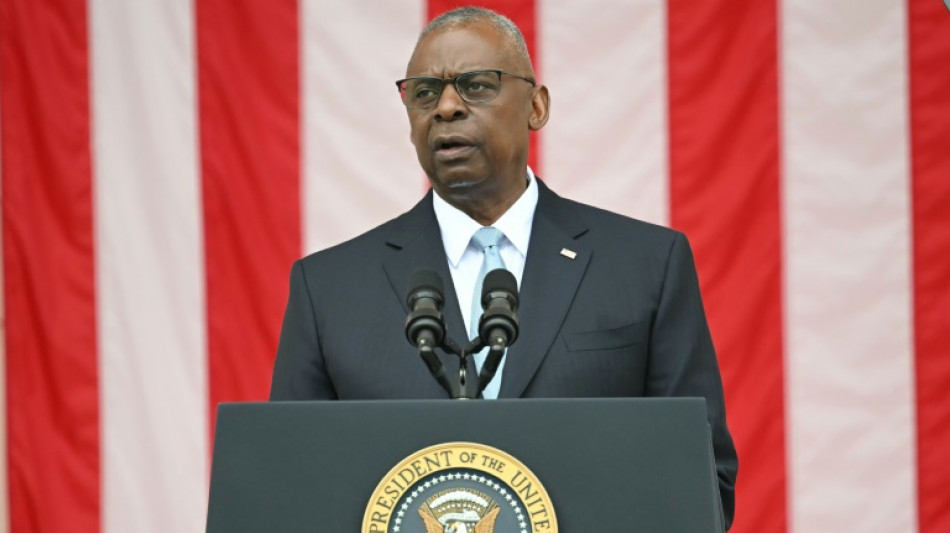
US, China defence chiefs to hold rare talks in Singapore / Photo: Mandel NGAN - AFP
 Eastside Jazz Festival Returns to Birmingham for Three-Day Event in February 2027

 Experts Warn Social Security Crisis Looms After Decades of Congressional Inaction
 Dar Global and Trump Organization Launch $700M Luxury Resort in Qatar

 Former Iowa State Women's Basketball Players Accuse Coach Bill Fennelly of Abuse

 New to The Street Show #781 Premieres Tonight on Bloomberg Television with Roadzen, Robo.ai, PureCipher and American Fusion

 How Families Budget for Youth Sports Travel Seasons
The US and Chinese defence chiefs are set to hold rare direct talks in Singapore this weekend, offering hopes of further military dialogue aimed at preventing flashpoint disputes from spinning out of control.
The expected meeting between the United States' Lloyd Austin and China's Dong Jun at the Shangri-La Dialogue will be the first substantive face-to-face talks between their countries' defence chiefs in 18 months.
The security forum is an annual gathering of defence chiefs from around the world that has in recent years become a barometer of US-China relations.
This year's edition, starting Friday, will come a week after China held military drills around Taiwan and warned of war over the island.
The dispute over democratic and US-backed Taiwan, which China has vowed to bring under its control, is the highest-profile of many rows between the global powers.
Beijing is also furious over Washington's deepening defence ties in the Asia-Pacific, particularly with the Philippines.
China has in recent years grown increasingly assertive in staking its claims in the contested South China Sea, including by building artificial islands and militarising them.
It effectively suspended military talks with the United States in late 2022 in response to then-US House Speaker Nancy Pelosi's visit to Taiwan.
The two sides agreed after a summit between Chinese leader Xi Jinping and US President Joe Biden in November last year to restart high-level military talks.
Austin and Dong then talked over the phone in April.
Their meeting in Singapore -- announced by the Pentagon last week -- would be the most substantial encounter on defence since the presidential summit.
However, the two sides have yet to resume much of the direct military dialogue that was scrapped after Pelosi's Taiwan visit.
"The hope here is for the (Dong-Austin) meeting to be the beginnings of cautious rapprochement to re-establish military-to-military open lines of communication," Mustafa Izzuddin, senior international affairs analyst with consultancy Solaris Strategies Singapore, told AFP.
Biden and Xi agreed at their summit to set up a communications channel between the US Indo-Pacific Command chief and China's commanders responsible for military operations near Taiwan, Japan and in the South China Sea.
A US official recently highlighted the importance of direct talks between those commanders.
Izzuddin described such dialogue as "essential".
"It's exceptionally important because when we talk about what is happening in the South China Sea and Taiwan, it's essentially about defence and security," he said.
- Threat of conflict -
Austin and Dong will also give speeches this weekend at the Shangri-La Dialogue in which they are expected to touch on a range of their nations' pressure points.
The United States is increasingly worried about China's fast-developing military capabilities.
China already has the largest navy in the world and this month carried out a sea test of its third and biggest aircraft carrier.
In 2021, China reportedly stunned US defence officials with a globe-circling hypersonic test flight involving a high-speed missile launch over the South China Sea.
In Beijing, China's leaders are enraged by the United States routinely deploying warships and fighter jets in the Taiwan Strait and South China Sea.
China views this as part of a decades-long US effort to contain it.
"If the United States does not hit the brakes but continues to speed down the wrong path, no amount of guardrails can prevent derailing, and there will surely be conflict and confrontation," China's then-foreign minister Qin Gang said last year.
Song Zhongping, a Chinese military analyst and former People's Liberation Army officer, told AFP that Dong's Singapore speech would likely include a call for the United States to stop "provoking" China on Taiwan and the South China Sea.
"We especially want to warn certain countries from outside the region -- the US, Japan -- that interfering in the Taiwan Strait and the South China Sea will inevitably cause serious regional conflict," he said.
Song also downplayed the prospects of deeper US-China military dialogue unless the United States cut its support for Taiwan.
"If the US cannot turn a new leaf on this issue, it cannot achieve results no matter who it speaks with."
burs-mba/amj/kma/pbt
H.E.Young--AMWN


