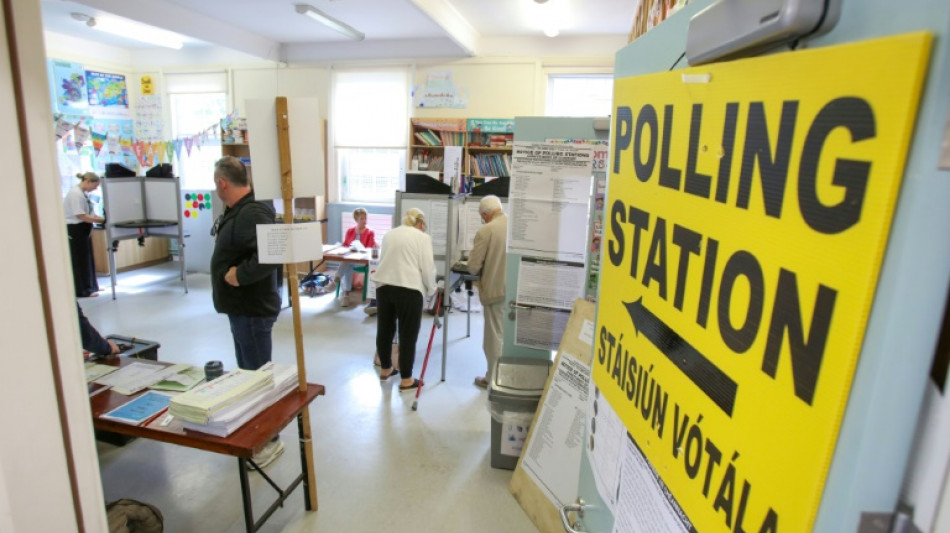
Slovakia begins EU vote in wake of PM shooting, Meloni's Italy next / Photo: Paul Faith - AFP
 PSU Bank Stocks Surge Up to 27% in November Amid FPI Inflows

 Manchester City vs Fulham Live: Haaland Disallowed Goal and Muniz Strike

 Miao and Dong Traditional Knowledge Offers Climate Resilience Lessons at COP31

 Rosalind Eleazar on Immersing in Los Angeles for 'Misty Green' Role

 FlatRx Publishes a Dated Price Comparison of Compounded Tirzepatide at 27 U.S. Telehealth Programs Counted at a 10 mg Weekly Dose

 Abanico Coffee Roasters Opens Second San Francisco Location in Inner Sunset
Slovakia on Saturday opened its polling stations in EU-wide elections, under the shadow of last month's shooting of Prime Minister Robert Fico.
It marked the halfway point of the four days of elections across the bloc to choose the next European Parliament.
Most of the EU's 27 countries -- including powerhouses Germany and France -- will hold their votes on Sunday.
But Italy, the EU's third-biggest economy, will start voting later Saturday, with its results likely to have a big impact on how the parliament is configured and on the future course of the bloc.
In Slovakia, the May 15 assassination attempt on Fico by a 71-year-old poet rocked the nation of 5.4 million and spread shockwaves across the EU.
A visibly thinner Fico had issued a pre-poll video describing his attacker as "an activist of the Slovak opposition" which he accused of "aggressive and hateful politics".
"It was only a matter of time before a tragedy would occur," the four-time PM said in the 14-minute video.
His party, which highlighted the attack in its campaign events, opposes EU arms deliveries to Ukraine and rails against alleged "warmongers" in Brussels.
Violence has occurred elsewhere in the bloc.
Late Friday, a man hit Danish Prime Minister Mette Frederiksen in a Copenhagen square.
She was not seriously hurt, according to witnesses. Police arrested the assailant, whose motive was not immediately known. Denmark also votes on Sunday.
EU Commission chief Ursula von der Leyen condemned the "despicable act" against Frederiksen.
But it was the shooting of Fico that was the most dramatic incident in the bloc ahead of the polls.
In its wake, support for Fico's left-wing populist Smer-SD party has skyrocketed and soared past its main liberal rival to the top of voter-intention surveys.
Historically however, Slovakia registers low turnout in EU elections. In the last one, in 2019, just 22 percent of voters cast ballots.
- Meloni, queenmaker? -
Later Saturday attention will shift to Italy's vote. Far-right Prime Minister Giorgia Meloni is hoping a strong showing from her party will strengthen her hand as a key EU powerbroker.
Polls suggest her post-fascist Brothers of Italy could come out on top with 27 percent of the vote, which would reflect a broader surge of gains for far-right groups across the EU.
That could make her a potential kingmaker -- or more appropriately, queenmaker -- as her backing could be crucial in deciding if current von der Leyen, a German conservative, earns a second term helming the commission.
Meloni has already been courted by centre-right von der Leyen -- and by French far-right leader Marine Le Pen, who wants to create an EU supergroup of far-right parties.
Meloni has not said what she will do, but has insisted her goal is to relegate EU leftwing parties to the opposition benches.
Domestically, a commanding performance could help further tighten Meloni's dominance over Italy's notoriously turbulent political scene.
The prime minister has been omnipresent in national media in the run up to the elections, notably portraying herself as a bulwark against illegal immigration.
Increasing backlash against migrants has driven far-right fortunes across the EU, and was one of the key reasons Meloni was propelled to power in 2022.
Overall, polls ahead of the vote suggested that far-right parties could claim around a quarter of the 720 seats in the incoming EU parliament.
In the Netherlands, which voted on Thursday, the anti-immigration party of extreme-right leader Geert Wilders -- which is already in a new governing coalition -- took second place, according to exit polls.
The fact that Dutch pro-European parties did better than expected provided some succour to centrists hoping to hold off a far-right surge.
Von der Leyen's conservative European People's Party and the centre-left Socialists and Democrats still remain on course to be the two biggest groupings in the EU parliament.
M.A.Colin--AMWN


