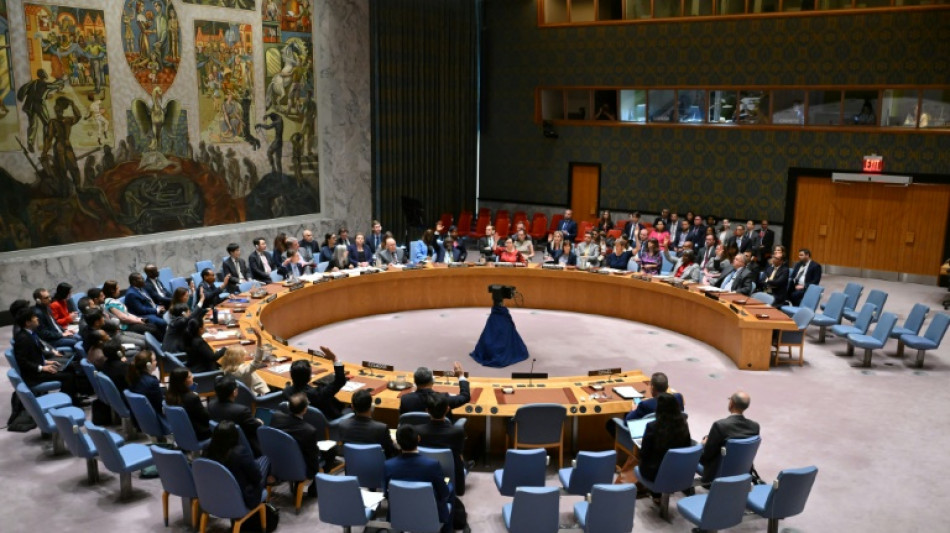
UN Sec. Council votes for US-drafted Gaza ceasefire resolution / Photo: ANGELA WEISS - AFP
 PSU Bank Stocks Surge Up to 27% in November Amid FPI Inflows

 Manchester City vs Fulham Live: Haaland Disallowed Goal and Muniz Strike

 Miao and Dong Traditional Knowledge Offers Climate Resilience Lessons at COP31

 Rosalind Eleazar on Immersing in Los Angeles for 'Misty Green' Role

 FlatRx Publishes a Dated Price Comparison of Compounded Tirzepatide at 27 U.S. Telehealth Programs Counted at a 10 mg Weekly Dose

 Abanico Coffee Roasters Opens Second San Francisco Location in Inner Sunset
The United Nations Security Council on Monday adopted a US-drafted resolution supporting a ceasefire plan in Gaza, as Washington leads an intense diplomatic campaign to push Hamas to accept the proposal.
The text -- passed with 14 votes in favor and Russia abstaining -- "welcomes" the truce and hostage release proposal announced on May 31 by President Joe Biden, and urges "parties to fully implement its terms without delay and without condition."
The resolution says Israel has accepted the truce plan, and "calls upon Hamas to also accept it."
Hamas said Monday that it "welcomes" the vote.
The United States, a staunch ally of Israel, has been widely criticized for having blocked several previous UN draft resolutions calling for a ceasefire in Gaza.
But Biden late last month launched a new US effort to secure a truce and hostage release.
"Today we voted for peace," US ambassador Linda Thomas-Greenfield said after the UN session.
"Today this Council sent a clear message to Hamas: accept the ceasefire deal on the table. Israel has already agreed to this deal and the fighting could stop today if Hamas would do the same."
However the deal remains uncertain as Hamas officials have insisted that any ceasefire agreement must guarantee a permanent end to the war -- a demand Israel has firmly rejected, vowing to destroy Hamas and free the remaining captives.
Under the proposal, Israel would withdraw from Gaza population centers and Hamas would free the hostages. The ceasefire would last an initial six weeks, with it extended as negotiators seek a permanent end to hostilities.
- Hamas silence -
Since the unprecedented attack by Palestinian Islamist movement Hamas on October 7 against Israel, and the subsequent Israeli counterattack, the UN Security Council has struggled to act.
Following two resolutions focused on humanitarian aid, the Security Council finally at the end of March demanded an "immediate ceasefire" for the duration of Ramadan, after the United States abstained from the vote.
The Gaza war was sparked by Hamas's attack on southern Israel, which resulted in the deaths of 1,194 people, mostly civilians, according to an AFP tally based on Israeli official figures.
Israel's retaliatory offensive has killed at least 37,084 people in Gaza, mostly civilians, according to the Hamas-run territory's health ministry.
The first phase of the truce would see an "immediate, full and complete ceasefire," the release of hostages in exchange for Palestinian prisoners in Israeli jails, and the "withdrawal of Israeli forces from the populated areas in Gaza."
This would also allow the "safe and effective distribution of humanitarian assistance at scale throughout the Gaza Strip to all Palestinian civilians who need it."
US Secretary of State Antony Blinken held talks in Israel with Prime Minister Benjamin Netanyahu on Monday, the latest effort to halt the eight months of war.
Ch.Havering--AMWN


