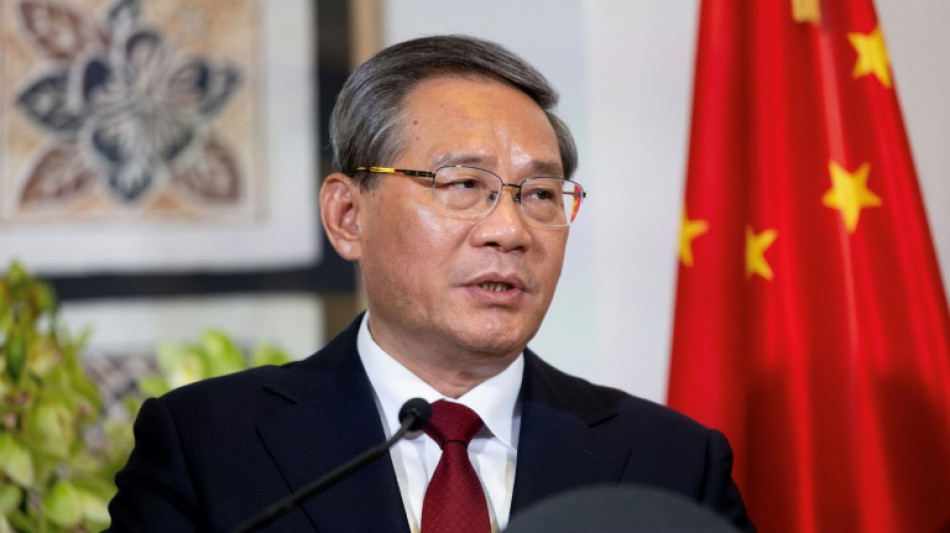
Chinese Premier Li launches trade-friendly Australia visit / Photo: Marty MELVILLE - AFP/File
 PSU Bank Stocks Surge Up to 27% in November Amid FPI Inflows

 Manchester City vs Fulham Live: Haaland Disallowed Goal and Muniz Strike

 Miao and Dong Traditional Knowledge Offers Climate Resilience Lessons at COP31

 Rosalind Eleazar on Immersing in Los Angeles for 'Misty Green' Role

 FlatRx Publishes a Dated Price Comparison of Compounded Tirzepatide at 27 U.S. Telehealth Programs Counted at a 10 mg Weekly Dose

 Abanico Coffee Roasters Opens Second San Francisco Location in Inner Sunset
China's Premier Li Qiang embarked on a four-day trip to Australia on Saturday, dangling the promise of expanded trade even as the two nations compete for influence in the Pacific.
Li -- the second most powerful man in China after President Xi Jinping -- touched down in Adelaide at the start of a diplomatic mission across the resource-rich continent.
The premier waved from the plane's doors and was greeted on the airport tarmac by Australian Foreign Minister Penny Wong, other government officials, and a group of photographers and TV journalists.
Flying in from a similarly trade-centred visit to New Zealand, Li is the highest ranking Chinese official to visit either country since 2017.
The premier will tour a South Australian wine grower and check in on two Chinese-loaned giant pandas in Adelaide zoo, hold talks with Prime Minister Anthony Albanese before tucking into a state lunch in Canberra, and then travel to a lithium mine in Western Australia.
His vineyard visit is a nod to China's recent lifting of swingeing trade sanctions on wine, timber, barley and beef exports imposed in 2020 during a diplomatic rift with a former conservative government.
The measures cost Australian exporters an estimated Aus$20 billion ($13 billion) a year.
Australia's rock lobster industry hopes Li will reopen its exports to China, removing one of the last sanctions in place since Albanese's government took power in 2022 and adopted a softer diplomatic approach to Beijing.
The Chinese premier's visit "reflects the improving tone," said Ryan Neelam, director of the foreign policy programme at Sydney-based think tank the Lowy Institute.
"The relationship is now more focused on the economic opportunities between them than it has in the past, which has been overshadowed by the political and security differences," he said.
"But at the same time, those differences haven't gone away."
Australia has tightened its defence alliance with the United States as it seeks to parry Beijing's expanding diplomatic and military influence on island states scattered around the Pacific region.
China describes the AUKUS security pact between Washington, London and Canberra -- a deal that would equip Australia with nuclear-powered but conventionally armed submarines to patrol the region -- as a divisive measure that raises nuclear proliferation risks.
- Wine and pandas -
In the most recent a sign of military tensions, Australia accused China of "unsafe and unprofessional" conduct after one of its warplanes fired flares in the path of a naval helicopter last month over the Yellow Sea.
Albanese has promised to tell Li the behaviour was "inappropriate".
Canberra also reacted with "outrage" when a Beijing court handed down a suspended death sentence to Chinese-Australian dissident writer Yang Jun earlier this year.
Such disagreements are likely to be aired behind closed doors, Neelam said.
Instead, Li sets a friendlier tone on the first full day of his trip Sunday -- visiting the famed Barossa winemaking region in Adelaide, hometown of Australia's foreign minister, who is credited with helping stabilise relations with Beijing.
China's punitive tariffs had effectively blocked premium Australian wine exports, worth an estimated Aus$1 billion a year, until just three months ago.
Even now, Australian vintners are hesitant to rush back into pre-tariff levels of trade with China, said Paul Turale, marketing manager at industry body Wine Australia.
"A lot of importers are probably taking a more conservative approach to bringing in new labels or new wines and are waiting to see it stabilise," he said.
"It will take some time to grow to what the industry was before."
First, though, Li will pop into Adelaide Zoo where giant pandas Wang Wang and Fu Ni have been on loan from China since 2009.
Hopes are high that the pair -- instruments of China's so-called panda diplomacy -- will be allowed to stay despite producing no offspring in their time together.
M.A.Colin--AMWN


