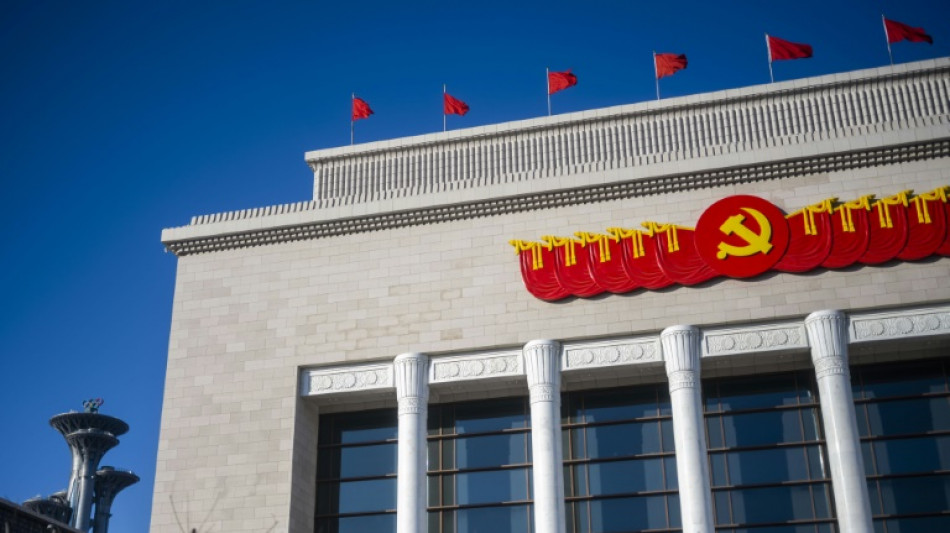
China pursues gold in global image by hosting Olympics
 Dangote to launch $16bn refinery in Kenya

 North Korean leader 'extremely obese': Seoul spy agency

 Yankees and pope-backed White Sox start MLB playoffs with wins
 Malaysia's ex-PM Mahathir in hospital for observation
 'No limits': Marathon world record holder Sawe chasing history
 Countdown begins to biggest-ever Rugby World Cup

 Bangladesh women lose ground after quota reform

 Vietnam admits 'differing opinions' on Hanoi development

 Stocks temper gains as oil pares heavy losses, US data in focus
 New Zealand denies breaching climate commitments to EU

 Albert becomes youngest US scorer in 4-2 win over Chile

 Pirate island's plunging population shows Greece's demographic decline
 With elections ahead, Latvia's Russian-speakers reject Moscow's help

 Brazil football clubs face massive sponsorship blow from betting ban
 ChatGPT maker wants to be the App Store for AI as safety concerns grow

 Women fight fires and sexism in Indonesian Borneo

 Forsling's OT blast lifts Florida over Carolina in NHL opener
 Alpha Growth Management Opens Rep Office in Japan

 NBA close to picking new $12-13bn Vegas team owners: report
 LA28 Olympics torch relay to visit all 50 states
 Spain brush aside Croatia in Nations League, England down Czechs
 Trump hails 'morally binding' AI self-regulation pledge
 Yamal inspires Spain to Croatia romp on World Cup homecoming

 UN to hold fourth informal poll of secretary-general candidates

 Who are the Emiratis behind crisis-hit Manchester City?

China warns almost daily against "politicising" this week's Beijing Olympics, but for its rulers, hosting the Games has always been about far more than sport and the medal count.
Even under the shadow of a pandemic, Western accusations of genocide against Muslim minorities and diplomatic boycotts, staging the Olympics is about global prestige for China and its ruling Communist Party, analysts say.
Beijing 2022's difficulties may even increase the country's stock, experts say. Hosting what it calls "a safe and splendid" Games in a pandemic will boost China's claims that its relative success controlling Covid illustrates the superiority of its top-down governing approach.
China's frequent criticisms about Western nations politicising sport is "at the very least ironic, if not completely hypocritical", said Steve Tsang, director of the China Institute at SOAS University of London.
"The fact they are using the Olympic Games as a major political event to project China's international image –- which is a separate political act -– is completely ignored."
China has not always insisted on separating sport and politics.
After the newly founded People’s Republic of China competed in the 1952 Helsinki Games, it then sat out the next quarter century, initially in protest against the presence of athletes from political rival Taiwan, although domestic upheaval under Mao Zedong was also a major factor.
China returned in 1980 at Lake Placid, but later that year it joined the dozens of countries who skipped the Moscow Summer Olympics following the Soviet invasion of Afghanistan.
- Coming-out party -
Since then, China's Communist Party has latched onto the Olympics as leverage in its global power play.
Beijing bid for the 2000 Games but lost to Sydney after the United States and allies raised human rights and other concerns.
Undaunted, the Chinese capital fought back and successfully won the 2008 hosting rights.
With the world watching, it was China's coming-out party -- and it brought the house down, winning both the medal count and international acclaim.
The government left nothing to chance at those Games, shutting down Beijing, using lip-sync singers and computer-generated fireworks during the opening ceremony, and shooing migrant workers and others considered undesirable out of sight.
The upcoming Games will be even more strict, with ultra-tight Covid-19 controls and China warning foreign athletes against making political gestures.
Politics and the Olympics are hardly strange bedfellows, and host countries always hope to use a successful Games to send a wider message.
Tokyo 1964 and Seoul 1988 came with subtexts of national renewal for formerly war-torn countries, and Hitler used the 1936 Games to showcase Nazism's arrival.
- Domestic audience -
But as the only city to host both the Summer and Winter Games, Beijing's return to the Olympic spotlight takes on additional lustre.
Jung Woo Lee, sport policy researcher at the University of Edinburgh, said the Winter Olympics in particular are viewed as a "more exclusive" club of "more advanced and affluent" hosts.
"The staging of the Winter Olympics in their capital city can symbolically mean that China is no longer lagging behind Western democracies in terms of its international prestige," Lee said.
There are domestic gains as well for China's government.
Despite its image of total control, the Communist Party can seem to display a surprising level of insecurity, obsessively playing up its successes to a home audience while sweeping failures under the rug, analysts say.
"The real message is to people in China, how much the Communist Party is able to make China stand tall and make Chinese people proud," Tsang said.
- World Cup next? -
Richard Baka, co-director of the Olympic Research Network at Victoria University in Melbourne, said that despite the uncomfortable scrutiny that might accompany China's hosting of the event, Beijing's leaders would probably do it all over again.
"This signifies: we're now an active force in the modern world. We're a force to contend with," he said.
It may be some time before China hosts the Games again.
New Olympic voting procedures will allow early favourites to be singled out from among future bidding cities, and the IOC may shy away from more China controversy, Baka said.
But that won't stop China from hosting other major sports events.
"They would be saying, 'We run very good Games,'" he added.
"We could maybe run other things again in the future -- maybe a World Cup of soccer."
L.Durand--AMWN