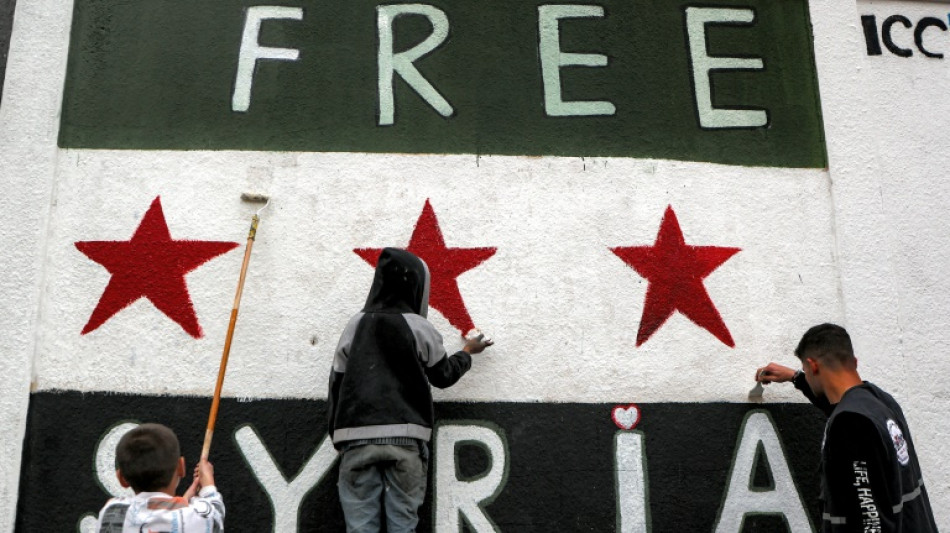
Syria's new rulers step up engagement with the world / Photo: AAREF WATAD - AFP
 Nigeria's Tinubu confirms 32 dead after military plane crash

 'Reckless' AI firms can't control models, says whistleblower
 Switching on brain cells: the Nobel-winning science of optogenetics
 Quebec votes as separatist surge poses test for Canada PM

 Euro slides as concerns about French debt mount
 Former Trump press secretary Leavitt joins Fox News

 Djokovic advances to China Open final as Medvedev out for hitting fan with ball
 Disgraced former US House speaker dies at 84
 Euro slides as worries about French debt grow
 US withdraws all bomber aircraft from UK airbase
 Drone hits Ethiopia IDP camp as fears grow of regional war

 US-German trio wins medicine Nobel for illuminating the brain
 England captain Kane driven by desire for records says Tuchel
 N.Irish court hears challenge to disputed Orangemen parade

 Talking points from the Bahrain Grand Prix in Malaysia

 Yemen, Saudi Arabia target Houthis in new campaign as war escalates
 US-German trio wins medicine Nobel for work on optogenetics
 Swiatek, Zheng survive three-set tests in China Open third round
 Hasan says Test cricket momentum turning for Bangladesh
 Intense heat puts births in jeopardy, UN tells Fiji talks
 US arrests woman accused of spying for China on Taiwan leader's family
 Yemen military announces broad strikes against Houthis
 Zuckerberg skewered again on screen in 'The Social Reckoning'
 Fiji urges 'just' climate transition, financing at pre-COP gathering

 Thailand's Jeeno overcomes late wobble to win Lotte Championship
Syria's new rulers stepped up engagement on Tuesday with countries that deemed ousted president Bashar al-Assad a pariah, with the French flag raised at the embassy for the first time in over a decade.
Assad fled Syria just over a week ago, as his forces abandoned tanks and other equipment in the face of a lightning offensive spearheaded by the Islamist Hayat Tahrir al-Sham (HTS).
The collapse of Assad's rule on December 8 stunned the world and sparked celebrations around Syria and beyond, after his crackdown on democracy protests in 2011 led to one of the deadliest wars of the century.
Rooted in Syria's branch of Al-Qaeda, HTS is proscribed by several Western governments as a terrorist organisation, though it has sought to moderate its rhetoric and pledged to protect the country's religious minorities.
Turkey and Qatar, which backed the anti-Assad opposition, have reopened embassies in Damascus, while US and British officials have launched communications with Syria's new leaders.
France, a key early backer of the uprising, sent a delegation to Damascus on Tuesday, with special envoy Jean-Francois Guillaume saying his country was preparing to stand with Syrians during the transitional period.
An AFP journalist saw the French flag raised in the embassy's entrance hall for the first time since the mission was shuttered in 2012.
After meeting Syria's new leaders, the United Nations humanitarian chief Tom Fletcher said on Tuesday he was "encouraged", and that there was a "basis for ambitious scaling-up of vital humanitarian support".
German diplomats were also in Damascus on Tuesday, where they will hold talks that will focus on "an inclusive transition process in Syria and the protection of minorities" as well as "the possibilities for a diplomatic presence".
Syria came under international sanctions over Assad's crackdown on protests, which sparked a war that killed more than 500,000 people and forced half of the population to flee their homes.
Assad left behind a country scarred by decades of torture, disappearances and summary executions, as well as economic mismanagement that has left 70 percent of the population in need of aid.
Abu Mohammed al-Jolani, who heads HTS, stressed the need in a meeting with a delegation of British diplomats to end "all sanctions imposed on Syria so that Syrian refugees can return to their country".
He also said Syria's rebel factions will be "disbanded and the fighters trained to join the ranks of the defence ministry".
"All will be subject to the law," he added, according to posts on the group's Telegram channel.
The EU's top diplomat Kaja Kallas said the lifting of sanctions and removing HTS from its blacklist would depend on "when we see positive steps, not the words, but actual steps and deeds from the new leadership".
- 'Colour of peace' -
In Damascus's old souk, many shops had reopened more than a week since Assad's ouster, according to an AFP journalist.
Some shopkeepers were painting their store facades white, erasing the colours of the old Syrian flag that under Assad's rule had become ubiquitous.
"We have been working non-stop for a week to paint everything white," Omar Bashur, a 61-year-old artisan said.
"White is the colour of peace," he added.
Abu Imad, another vendor, was selling vegetables from his car at a square in central Damascus.
"Everything happened at once: the regime fell, prices dropped, life got better. We hope it isn't temporary," he said.
With Assad gone, the Syrian pound started to recover against the dollar, moneychangers and traders said, as foreign currencies again became available on the local market.
Iran, meanwhile, which backed Assad throughout the civil war, said its embassy in Syria -- abandoned and vandalised in the wake of Assad's fall -- would reopen once the "necessary conditions" are met.
Russia was the other main backer of Assad's rule.
On Monday, the ousted president broke his silence with a statement issued on Telegram saying that he only left to Russia once Damascus had fallen, and denounced the country's new leaders as "terrorists".
Long before the emergence of HTS and jihadist groups in the Syrian war, Assad consistently branded all his opponents, including non-violent protesters, as "terrorists".
"My departure from Syria was neither planned nor did it occur during the final hours of the battles," said the statement.
Several former officials had told AFP that Assad was already out of the country hours before the rebels seized Damascus.
- 'My tears were dry' -
Around the country, Syrians deprived for years of news of missing loved ones searched desperately for clues that might help them find closure.
In a war-ravaged Palestinian refugee camp near Damascus, Radwan Adwan was stacking stones to rebuild his father's grave, finally able to return to the cemetery.
"Without the fall of the regime, it would have been impossible to see my father's grave again," said 45-year-old Adwan.
Yarmuk camp was bombed and besieged by Assad's forces, emptied of most of its residents and reduced to ruins before its recapture in 2018, when access to the cemetery was officially banned.
"When we arrived, there was no trace of the grave," said Adwan.
His mother Zeina sat on a small metal chair in front of her husband's gravesite.
She was "finally" able to weep for him, she said. "Before, my tears were dry."
O.Norris--AMWN