770-km US megaflash sets new lightning record: UN
 South Korea score late to reach Asian Games football final

 Tom Kim defies jet-lag, Kho cards ace as Asian Games golf begins

 Thai teen rocker Nene aims to tour, write music... and return to school

 Ivory Coast clamps down on harmful illegal gold rush

 Nagoya mayor says sorry for Asian Games 'inconveniences'

 G20 trade officials meet under shadow of tariffs, overcapacity

 India's fat dog vote goes viral

 Asian Games crowds in spotlight as 998 see hosts in 50,000 stadium

 The eight stadiums for the 2027 Rugby World Cup

 Thieves swipe drugs under nose of Fiji police, swap with flour

 South Korea demands North apologise for DMZ mine blasts

 In Nepal's flood zone, teachers mourn students who never returned

 US Supreme Court lifts limits on third-country deportations

 Antonelli eager to 're-establish order' as F1 returns to Malaysia

 Paw-fect candidate: Australia finds new koala rescue dog

 One third of world population exposed to harmful air pollution: monitor

 North Korea denies South's claim it was apparently behind DMZ mine blasts

 West Bank's violent settlers part of a new generation fuelled by ideology

 US-led coalition ends mission in Iraq

 Pope-backed White Sox join Braves with MLB playoff wins

 Psychology Software Tools Builds on Early Bioz Success to Expand Access to Publication-Backed Product Evidence

 Alpha Growth Management Opens Rep Office in Japan

 NBA close to picking new $12-13bn Vegas team owners: report
 LA28 Olympics torch relay to visit all 50 states
 Spain brush aside Croatia in Nations League, England down Czechs

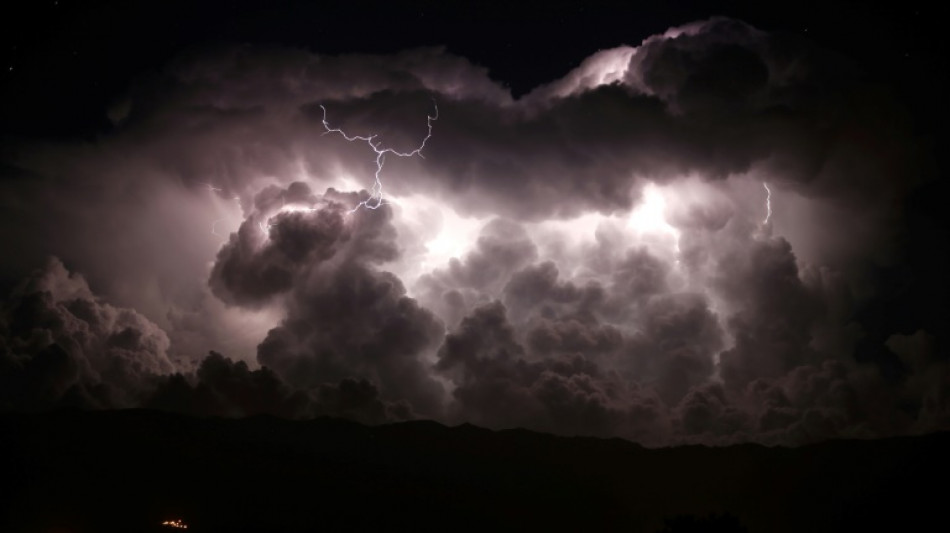
A single flash of lightning in the United States nearly two years ago cut across the sky for nearly 770 kilometres, setting a new world record, the United Nations said Tuesday.
The new record for the longest detected megaflash, measured in the southern US on April 29, 2020, stretched a full 768 kilometres, or 477.2 miles, across Mississippi, Louisiana and Texas.
That is equivalent to the distance between New York City and Columbus, Ohio, or between London and the German city of Hamburg, the UN's World Meteorological Organization (WMO) pointed out in a statement.
That lightning bolt zig-zagged some 60 kilometres further than the previous record, set in southern Brazil on October 31, 2018.
The WMO's committee of experts on weather and climate extremes also reported a new world record for the duration of a lightning flash.
A single flash that developed continuously through a thunderstorm over Uruguay and northern Argentina on June 18, 2020 lasted for 17.1 seconds -- 0.37 seconds longer than the previous record set on March 4, 2019, also in northern Argentina.
- 'Even greater extremes' -
"These are extraordinary records from single lightning flash events," Randall Cerveny, the WMO rapporteur of weather and climate extremes, said in the statement.
"Environmental extremes are living measurements of the power of nature, as well as scientific progress in being able to make such assessments," he said.
The technology used to detect the length and duration of lightning flashes has improved dramatically in recent years, enabling records far greater than what was once the norm.
The previous "megaflash" records, from 2018 and 2019, were the first verified with new satellite lightning imagery technology and were both more than double the prior records using data collected from ground-based technology.
"It is likely that even greater extremes still exist, and that we will be able to observe them as lightning detection technology improves," Cerveny said.
The WMO highlighted that the new record strikes happened in the Great Plains in North America and the La Plata basin in South America, known as hotspots for so-called Mesoscale Convective System (MCS) thunderstorms, which enable megaflashes.
It stressed that the flashes that set the new records were not isolated events, but happened during active and large-scale thunderstorms, making them all the more dangerous.
"Lightning is a major hazard that claims many lives every year," WMO chief Petteri Taalas said in the statement.
"The findings highlight important public lightning safety concerns for electrified clouds where flashes can travel extremely large distances."
WMO pointed out that the only lightning-safe locations are big buildings with wiring and plumbing, or fully enclosed, metal-topped vehicles.
The UN agency maintains official global records for a range weather and climate-related statistics, including temperature, rainfall and wind.
All such records are stored in the WMO Archive of Weather and Climate Extremes.
The archive currently includes two other lightning-related extremes.
One is for the most people killed by a single direct strike of lightning, when 21 people died in Zimbabwe in 1975 as they huddled for safety in a hut that was hit.
The other is for an indirect strike, when 469 people died in Dronka, Egypt when lightning struck a set of oil tanks in 1994, causing burning oil to flood the town.
Y.Nakamura--AMWN