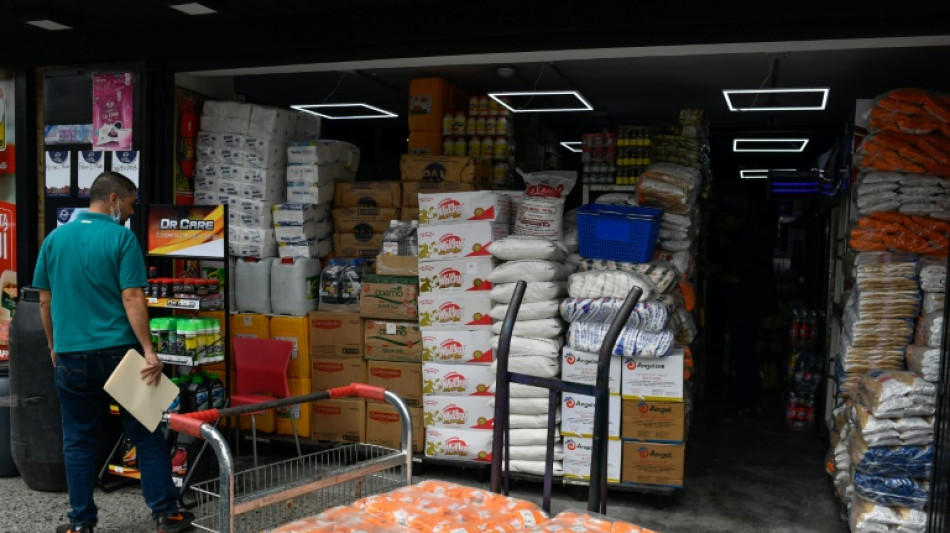
US-Venezuela business picking up despite punishing sanctions / Photo: Federico PARRA - AFP
 Dubai Police Expand Luxury Patrol Fleet with 525-hp Defender

 Tocvan Defines Priority Gold Target Areas at Gran Pilar From Project-Wide Soil Sampling and Geologic Mapping; 225 Soils at or Above 100 ppb Gold
 InterContinental Hotels Group PLC Announces Transaction in Own Shares - November 18

 What to Do When Two Households Become One

 AbTherx Licenses Atlas(TM) Platform to Athenova Therapeutics for Next-Generation Targeted Alpha Radiopharmaceutical Discovery
 Ameriwest Advances Its Copper Focused Strategy Through Proposed Sale of Railroad Valley to Pure Energy Minerals

 Who Does the Best Deep Plane Facelift in Sarasota?

 Silver Storm to Attend the 121 Mining Investment Conference in London, UK
 NuRAN Wireless Raises First Two Towers in Benin as 4G Rollout Beats Expectations in Cameroon and Ivory Coast

 Xreal Aura Review: A Comfortable VR Alternative With Flawed Controls
Venezuela's imports of US food and farming products are on the rise, with the private sector driving increased business between the two former partners despite punishing sanctions imposed on Caracas by Washington.
"Venezuela was disappearing from the world of imports and exports for a while, but it's coming back," Luis Vicente Garcia, general manager at the Venezuelan-American Chamber of Commerce (VENANCHAM), told AFP.
"We're at a turning point," Garcia said.
Total imports of food and farming supplies in Venezuela were $2.4 billion in 2021, a 31.2 percent increase over 2020.
The oil-rich but cash-strapped South American country is now experiencing timid growth after a years-long recession in which its gross domestic product shrunk by 80 percent.
Purchases from the United States reached $634 million in 2021, second only to the $934 million spent in Brazil, according to a report by the US Department of Agriculture, which said that opportunities in Venezuela are improving.
Although the US figure represents a 45 percent increase from the previous year, it is still a far cry from the $1.4 billion per year seen between 2010 and 2014. In 2017, at the height of US-Venezuelan tensions, US imports were worth just $400 million.
The main purchases are grains, pasta, tinned fruit and vegetables, liquor and animal feed.
Imports are crucial for Venezuela, which only produces 50 percent of its basic corn and 45 percent of its rice needs, according to the Fedeagro union of agricultural producers.
VENAMCHAM says trade between Venezuela and the US were around $38 billion in 2008, at a time when Washington was Caracas's largest crude customer.
- Softening controls -
That figure fell to just under $2 billion in 2021, but has increased almost 28 percent in the first quarter of 2022 compared to the previous year.
At the height of Venezuela's economic crisis, the government of President Nicolas Maduro blamed the scarcity of basic necessities such as food, which produced interminable lines at supermarkets, on the US "blockade."
Between 2017 and 2018, sanctions were against individuals, freezing bank accounts and barring US businesses and citizens from engaging in commerce with dozens of Venezuelan state officials.
The United States did not recognize Maduro's 2018 re-election in a vote boycotted by the opposition. The year before, Washington imposed a series of sanctions against his government, including an oil embargo, in response to a crackdown on demonstrators.
"When the sanctions arrived... there was a reaction (by businesses): I'm not going to take part in this market," said Garcia.
Even though medicine and food was exempt, the fear of reprisals was a barrier.
But faced with a cash flow problem, the government, which used to almost monopolize food imports, opened the doors to the private sector.
It was "around two or three years ago that the government started to let private enterprises import," Garcia said.
Venezuela food imports have also benefited since 2018 from the lifting of tariffs.
The softening of tight currency exchange controls has also helped, as has remittances that are worth an estimated $2.5 billion to $3 billion a year.
There have also been movements on the political front.
On May 17, US President Joe Biden softened certain sanctions in a bid to promote negotiations between Maduro and the opposition, which were suspended in October.
O.Johnson--AMWN