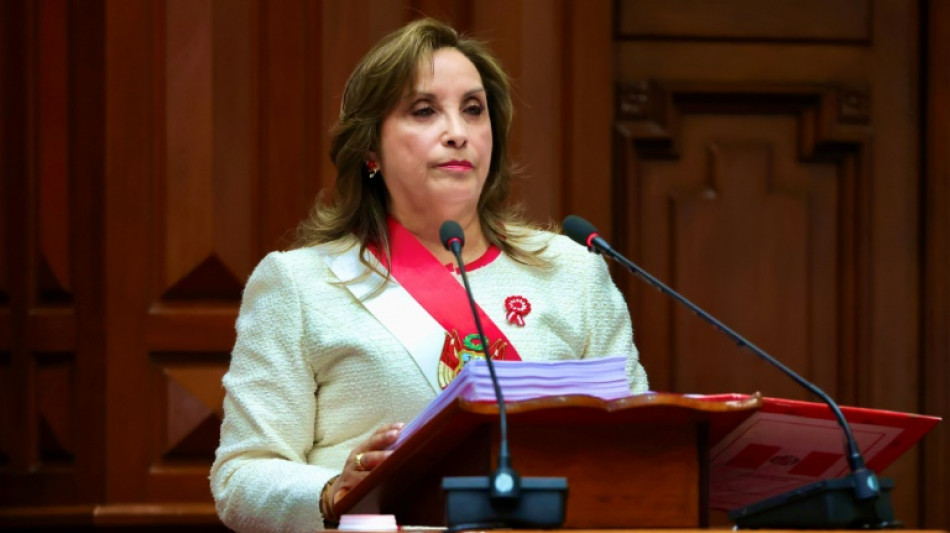
Peru's president signs military crimes amnesty bill into law / Photo: Jairo DIAZ - Peruvian Presidency/AFP/File
 Writer Realizes She Is Lesbian After Child Comes Out as Transgender

 Shruti Haasan Reveals Kamal Haasan’s Defense of Her Film Career

 Trump Reduces Public Appearances Amid CIA-Mossad Warnings of Iranian Drone Plot

 Italy Fines Meta $880 Million Over Facebook Photo Access Violations

 MotorTrend's Top Picks for the Best Hatchbacks of 2026

 Clare Luvanga Leads Washington Spirit to Third Straight NWSL Championship with 2-1 Win

 BingX: Major Announcement of Far-Reaching Significance
Peruvian President Dina Boluarte on Wednesday signed into law a controversial bill granting amnesty to military personnel, police and members of civilian self-defense units over a bloody 1980-2000 campaign against leftist Shining Path guerrillas.
"Today, with the enactment of this amnesty law, the government is paying tribute to the military and self-defense groups that participated in the fight against terrorism," Boluarte said during a ceremony at the presidential palace.
The law benefits uniformed personnel accused or convicted of crimes committed during fighting between state forces and the Shining Path and Tupac Amaru rebel groups, in which 70,000 people were killed, according to official figures.
The Inter-American Court of Human Rights (IACHR) had said Peru must "immediately suspend" approval of the law or -- if it was enacted -- refrain from applying it while the court looks into how the amnesty would affect victims' rights.
Boluarte had criticized the IACHR's decision.
A report by UN experts last month urged Boluarte's government to veto the law, arguing Peru "has a duty to investigate, prosecute and punish gross human rights violations and crimes under international law committed during the conflict."
The new law could affect 156 cases that have been decided and more than 600 others still underway over crimes committed during that 20-year span, those experts said.
In August 2024, Peru adopted a statute of limitations for crimes against humanity committed before 2002, effectively shutting down hundreds of investigations into alleged crimes committed during the fighting.
The initiative benefited late president Alberto Fujimori, who was jailed for atrocities -- including the massacre of civilians by the army -- but released from prison in 2023 on humanitarian grounds.
It also helped 600 prosecuted military personnel.
According to Peru's Truth and Reconciliation Commission, there are more than 4,000 clandestine graves in the country as a result of two decades of political violence.
D.Cunningha--AMWN