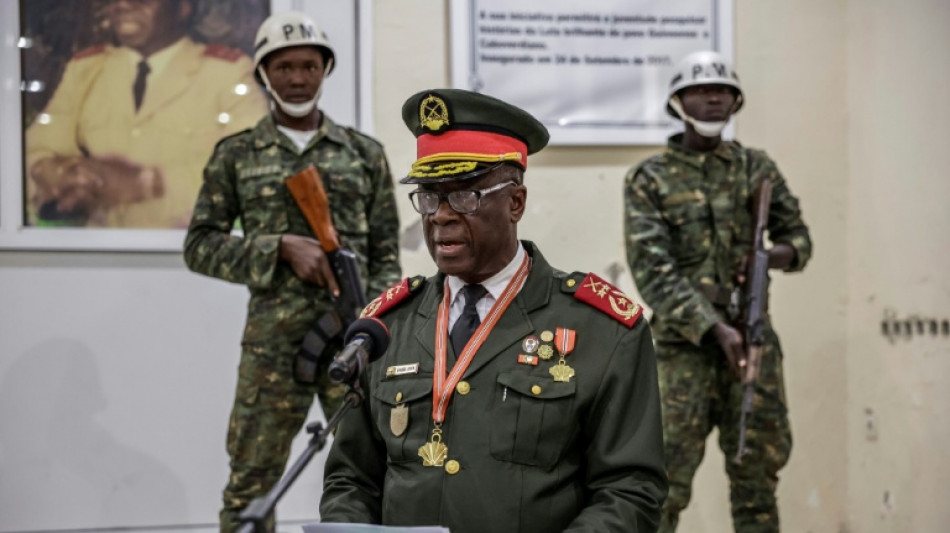
G. Bissau junta consolidates power as condemnation of coup spreads / Photo: Patrick MEINHARDT - AFP
 Pope condemns environmental harm in Italy's 'Land of Fires'
 Russian war drama among favourites for top Cannes prize
 China coal mine blast kills at least 90, more missing
 Iran weighs peace proposal, accuses US of 'excessive demands'
 Pope visits Italy's 'Land of Fires'
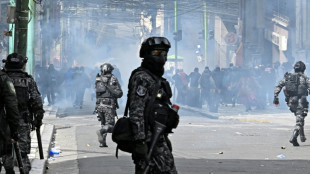 Police, protesters clash in new marches against Bolivian leader

 'Humans want to optimize': Enhanced Games founder embraces doping row
 The Asian workers keeping Greenland in business
 Cannes highlights as film festival wraps up
 Russian war drama among favourites for Cannes top prize
 Waratahs 'on right track' despite crushing Brumbies loss
 SpaceX's enormous Starship splashes down after test flight
 South Korean Kim flirts with 59, shoots 60 to lead CJ Cup Byron Nelson
 NASCAR boss pays tribute to 'badass' Kyle Busch
 Lens beat Nice to win French Cup for first time
 Vunipola guides Montpellier past Ulster to Challenge Cup triumph
 Kevin Warsh: New Fed chair who vows not to be Trump's puppet
 French Gaza activists arrive home after Israel expulsion

 From agave syrup to raw materials: EU, Mexico agree trade expansion

 Who killed Trump's AI order? Musk says it wasn't him
 Klaasen helps Hyderabad past Bangalore
 Gauff at ease in Paris as she prepares to defend French Open title
 Ebola risk now at highest level in DR Congo, says WHO
 Wawrinka considering return for famous French Open shorts
 EU seeks to rebalance trade relationship with China
The new military leader of Guinea-Bissau appointed an ally of the ousted president as prime minister on Friday, as international criticism grew of this week's coup.
The military took "total control" of the west African country on Wednesday -- a day before the provisional results of national elections were due to be announced -- and President Umaro Sissoco Embalo took refuge in neighbouring Senegal.
The true motives for the putsch, the fifth the west African country has suffered in 45 years, remain unclear.
On Friday, Guinea-Bissau's new military leader, General Horta N'Tam, named as his prime minister Ilidio Vieira Te, the finance minister in Embalo's government.
N'Tam, who has been appointed to run the small, volatile country for a one-year transitional period, is also seen as an ally of Embalo's.
The people of Guinea-Bissau "expect a lot" of their new leaders, he told Te during a brief swearing-in ceremony, saying he hoped the junta and the new prime minister would "continue to work hand-in-hand".
Outside the country, international condemnation of the coup continued to mount.
The African Union announced on Friday it was suspending Guinea-Bissau "with immediate effect", shortly after the Economic Community of West African States (ECOWAS) froze Guinea-Bissau out of "all decision-making bodies".
United Nations Secretary-General Antonio Guterres condemned the military's "unacceptable violation of democratic principles", while the European Union urged "a swift return to the constitutional order and the resumption of the electoral process".
- Motives for coup -
In Dakar, Senegalese President Ousmane Sonko said on Friday he thought the coup was a stitch-up, echoing suspicions voiced by a number of political analysts consulted by AFP.
"Everyone knows that what happened in Guinea-Bissau was a scam," Sonko told the Senegalese parliament in Dakar, without elaborating.
"We should continue with the electoral process and let the (electoral) commission announce who won."
Opposition candidate Fernando Dias da Costa told AFP on Thursday he believed he had beaten Embalo in Sunday's presidential election.
He alleged that Embalo, who also claimed victory, had "organised" the power grab to prevent him from taking office.
His view was shared by a west African analyst who told AFP on Thursday the coup was "the ideal scenario for Mr Embalo".
It could allow the ousted president to "potentially reposition himself for the next elections", the analyst said on condition of anonymity.
Other political researchers say a high-level turf war to control illegal drug smuggling networks may have also played a part in Guinea-Bissau's instability.
General Denis N'Canha, head of the presidential military office, alluded to the trafficking on Thursday when he said a plan involving "drug lords" had been uncovered, including "the introduction of weapons into the country to alter the constitutional order".
- Illicit drugs trade -
Crippling poverty, chaotic administration and political tumult have made Guinea-Bissau a fertile ground for corruption and drug smuggling.
It is a key transit point for Latin American cocaine destined for Europe to the point that some analysts have dubbed it a "narco-state".
Senior politicians and military brass are suspected of implication in the illicit trade in hard drugs.
Meanwhile, life in the capital Bissau began to return to a semblance of normality.
Vehicles returned to the streets, borders were ordered to reopen and markets started functioning again.
"I resumed my work because if I stay home, I will have nothing to eat," Boubacar Embalo, a 25-year-old street vendor, told AFP.
Sandwiched between Senegal and Guinea, Guinea-Bissau had already undergone four coups and a host of attempted takeovers since its independence from Portugal in 1974.
Among the world's poorest countries, it has now joined the list of states suspended from the AU following coups, alongside Burkina Faso, Mali, Madagascar, Niger and Sudan.
O.Karlsson--AMWN