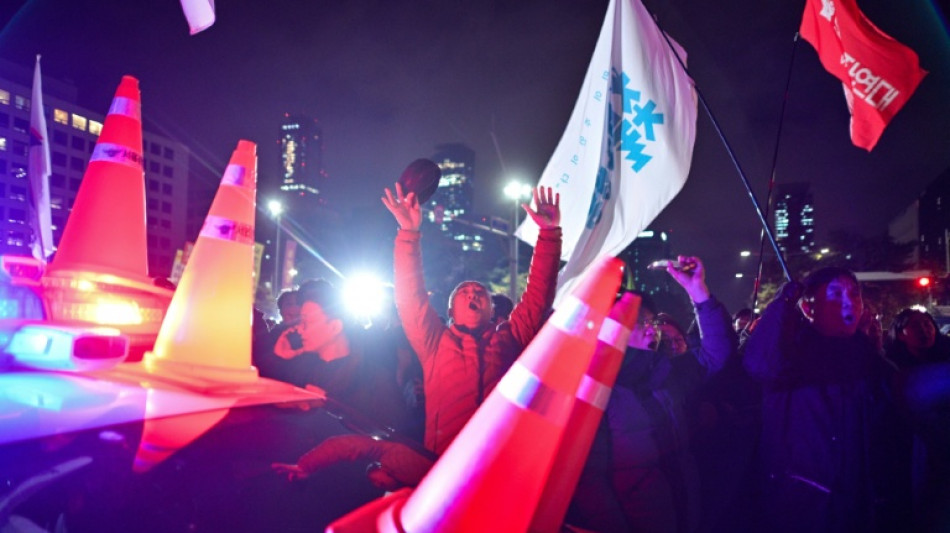
How South Korea's brief martial law upended lives / Photo: Anthony WALLACE - AFP/File
 Russian war drama among favourites for top Cannes prize
 China coal mine blast kills at least 90, more missing

 Iran weighs peace proposal, accuses US of 'excessive demands'

 Pope visits Italy's 'Land of Fires'
 Police, protesters clash in new marches against Bolivian leader

 'Humans want to optimize': Enhanced Games founder embraces doping row

 The Asian workers keeping Greenland in business

 Cannes highlights as film festival wraps up
 Russian war drama among favourites for Cannes top prize

 Waratahs 'on right track' despite crushing Brumbies loss

 SpaceX's enormous Starship splashes down after test flight
 South Korean Kim flirts with 59, shoots 60 to lead CJ Cup Byron Nelson
 NASCAR boss pays tribute to 'badass' Kyle Busch

 Lens beat Nice to win French Cup for first time

 Vunipola guides Montpellier past Ulster to Challenge Cup triumph
 Kevin Warsh: New Fed chair who vows not to be Trump's puppet
 French Gaza activists arrive home after Israel expulsion

 From agave syrup to raw materials: EU, Mexico agree trade expansion

 Who killed Trump's AI order? Musk says it wasn't him
 Klaasen helps Hyderabad past Bangalore

 Gauff at ease in Paris as she prepares to defend French Open title

 Ebola risk now at highest level in DR Congo, says WHO

 Wawrinka considering return for famous French Open shorts

 EU seeks to rebalance trade relationship with China
 Spurs must play with 'blood, character, and spirit': De Zerbi

When South Korea's leader declared martial law a year ago, one young woman blocked a tank, a civil servant resigned in protest and a lawmaker switched sides to remove him from office.
They are among the many South Koreans whose lives were transformed on December 3, 2024.
That wintry night, then-president Yoon Suk Yeol interrupted national television broadcasts to suspend civilian rule for the first time in more than four decades.
Soldiers and tanks deployed in central Seoul. Troops landed by helicopter, smashing windows and storming parliament as lawmakers fought to overturn the decree.
With thousands of protesters filling the streets, the National Assembly voted within hours to nullify Yoon's order.
A year on, AFP spoke to three people who were there fighting to protect democracy, and whose lives will never be the same.
- Lawmaker with 'nowhere to go' -
Freshman lawmaker Kim Sang-wook rushed to the National Assembly, where he faced down armed soldiers.
"I shouted, 'The National Assembly is not a place for you to enter!'" he told AFP.
Kim was a member of Yoon's conservative People Power Party party, but he felt martial law had to be undone.
After helping to halt the decree in an emergency vote, Kim found himself working with the opposition to impeach the president.
They were eight votes short, and Kim took the lead in persuading his colleagues.
Just over a week after the short-lived martial law, on December 14, a dozen lawmakers from Yoon's ruling party helped pass the impeachment measure.
"The first thought was relief -- we had stopped it," Kim said.
"The next thought was, 'What do I do now, what happens now?'" he added, saying he had "nowhere to go".
As members of his party stormed out and the opposition cheered, Kim felt he "had been left completely alone in the world".
A photo of him sitting alone and crying in the chamber went viral.
After weeks of reflection, Kim publicly backed opposition leader Lee Jae Myung, who later became president.
Kim then also joined the party he once opposed.
"What happened after December 3 gave my life and my politics a direction," he said.
"I now know clearly where I should go, and for that, I am grateful."
- Lone civil servant -
Ryu Hyuk, then inspector general at the justice ministry, made his way to the office as soon as he heard Yoon's stunning decision.
Officials had already gathered there to discuss the martial law.
As the ministry's internal watchdog, 57-year-old Ryu told AFP he was convinced "it would not be appropriate to carry out any work related to that declaration".
He decided to quit, and as he scribbled a resignation letter, his anger surged.
Bursting back into the meeting room, he shouted: "No matter your political views, martial law is not acceptable."
He then walked out -- the first and only civil servant to resign during the crisis.
Ryu said with certainty that "if martial law had continued, many public officials would have shared my views".
Nearly a year later, he still has not decided where to turn next.
A registered lawyer, he could reopen his practice, but now usually spends his days scuba diving and running.
- The woman who 'wasn't afraid' -
Kim Da-in had only just learned how to drive but found herself speeding toward the National Assembly with her parents as martial law was declared.
"I think my family felt the weight of what martial law meant," Kim told AFP.
They arrived after parliament had struck it down, but the streets were still in chaos.
The 25-year-old then saw a military tank turning to the National Assembly, and ran towards it without hesitation.
"I wasn't afraid," she told AFP.
After that night, she joined protesters who took to the streets in the freezing cold and rallied outside Yoon's residence.
Seeing "the culture, the energy" that activists had created "made me think they can do anything", Kim said.
"And it made me want to be among them."
She is now preparing to switch from online university studies to a physical campus, where she can attend classes with some of those who had inspired her.
Kim has become known as "the woman who stopped the tank" after a video of her action went viral.
"I didn't think about gender when I stepped in front of the tank," she said.
"What I want to say... is simple: I intend to keep standing my ground."
L.Davis--AMWN