CERN upbeat as China halts particle accelerator mega-project / Photo: Elodie LE MAOU - AFP/File
 The movies vying for the Cannes Film Festival's top prize

 Banned ex-100m champ Kerley to compete clean at Enhanced Games

 Senegal's president sacks PM after months of tensions

 US mulls new strikes on Iran: US media reports

 SpaceX sends Starship rocket sailing into space

 Russell bounces back to beat Antonelli in sprint qualifying

 Mexico, EU lower tariffs in bid to grow non-US trade

 Fresh confrontation between police, protesters in Bolivia

 US Fed chair says will be 'reform-oriented' at glitzy White House swearing-in

 Ace, eagle lift Im to early CJ Cup Byron Nelson lead

 Antonelli romps opening practice ahead of Russell

 Pakistan military chief arrives in Tehran in push to end Iran war

 US intelligence chief Tulsi Gabbard resigns

 Pep 'made me believe I could be a coach', says Kompany

 Rising Spain star Jodar wants to 'follow own path' at Roland Garros

 Success fuels Guardiola's campaign for a 'better society'

 SpaceX to retry Starship test launch Friday

 Stocks gain, oil higher as investors weigh Mideast peace prospects

 Barcelona's Putellas dismisses talk of future before Champions League final

 Carrick appointed as Man Utd permanent coach

 Sabalenka poised to 'go for it' at Roland Garros

 Sinner says returning to Roland Garros 'special feeling' after 2025 final

 PSG defender Hakimi bids to have rape case dismissed

 Sinner stands between Djokovic and record 25th major crown at French Open

 Dethroned clay queen Swiatek 'willing to fight'

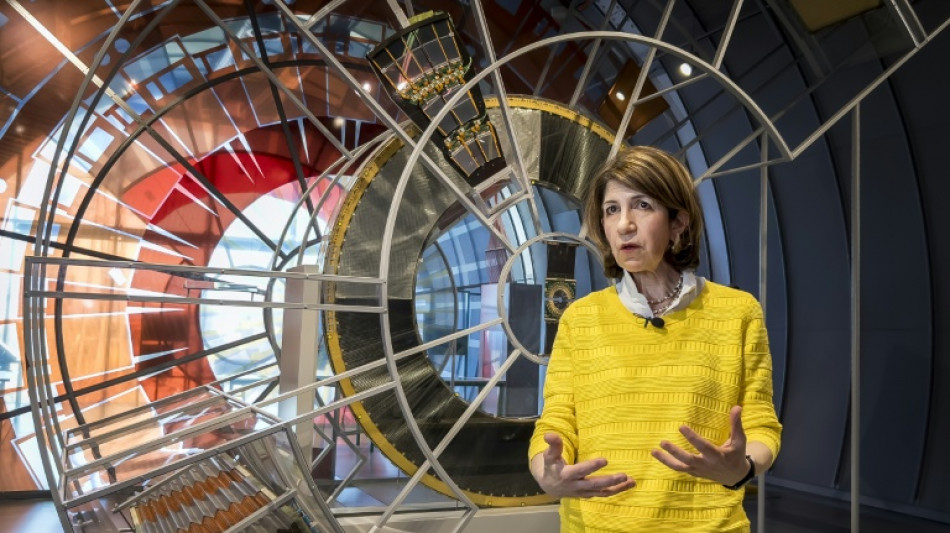
The chief of the CERN physics laboratory says China's decision to pause its major particle accelerator project presents an "opportunity" to ensure Europe's rival plan goes ahead.
Ten years ago, China announced its intention to build the Circular Electron Positron Collider (CEPC), which at 100 kilometres (62 miles) long would be the world's largest particle accelerator.
But Beijing recently put the project on ice, CERN's director-general Fabiola Gianotti told a small group of journalists at a recent briefing.
China's CEPC would be way bigger than CERN's Large Hadron Collider (LHC) -- currently the world's largest, whizzing particles into each other at phenomenal speeds.
The 27-kilometre proton-smashing ring running about 100 metres (330 feet) below the border between France and Switzerland, has, among other things, been used to prove the existence of the Higgs boson.
Dubbed the God particle, its discovery in 2012 broadened science's understanding of how particles acquire mass.
CERN, the European Organization for Nuclear Research whose main offices also straddle the border near Geneva, seeks to unravel what the universe is made of and how it works.
The LHC is expected to have fully run its course by around 2040, and CERN is considering building a far larger collider to allow scientists to keep pushing the boundaries of knowledge.
- Search for dark matter -
The planned Future Circular Collider (FCC) would be a ring with a circumference of 91 km and an average depth of 200 metres.
Scientists believe that ordinary matter -- such as stars, gases, dust, planets and everything on them -- accounts for just five percent of the universe.
The FCC will try to reveal what makes up the other 95 percent of the energy and matter in the universe -- so-called dark matter and dark energy, which scientists have yet to observe directly.
The gigantic project, costing around $17 billion, has not yet received the green light from CERN's 25 member states.
But the CERN Council, its decision-making body, "issued a very positive opinion on November 7" regarding the feasibility study, which includes geological, territorial, technological, scientific, and financial aspects, announced Gianotti.
"If all goes well, the project could be approved in 2028," she added.
The FCC, which could become operational by the end of the 2040s, is considered excessive by its opponents, especially if China was doing similar research in a similar-sized ring at a cheaper price.
But China's halt gives CERN a clear run.
- Window of opportunity -
"The Chinese Academy of Sciences, which filters projects, has decided to give the green light to a smaller, lower-energy collider, rather than the larger CEPC, which is in direct competition with CERN," said Gianotti.
In China, Wang Yifang, head of the Institute of High Energy Physics at the Chinese Academy of Sciences, confirmed to AFP that the CEPC was not included in the next five-year plan.
"We plan to submit CEPC for consideration again in 2030, unless FCC is officially approved before then, in which case we will seek to join FCC, and give up CEPC," he said.
For Gianotti, "this is an opportunity: firstly, because if the Chinese project had been approved, it would likely have started much sooner than the FCC."
"It's also interesting to know that, if the FCC is approved, the Chinese would abandon their project to come and work with us," added the Italian, whose five-year term finishes at the end of December.
Gianotti will be succeeded by British physicist Mark Thomson.
But China's decision has provided an argument for the Co-cernes collective, which brings together local opponents of the FCC who fear the effects of the massive digging project.
If a super collider was of "real scientific interest, China would undoubtedly not have abandoned it," it says.
P.Costa--AMWN