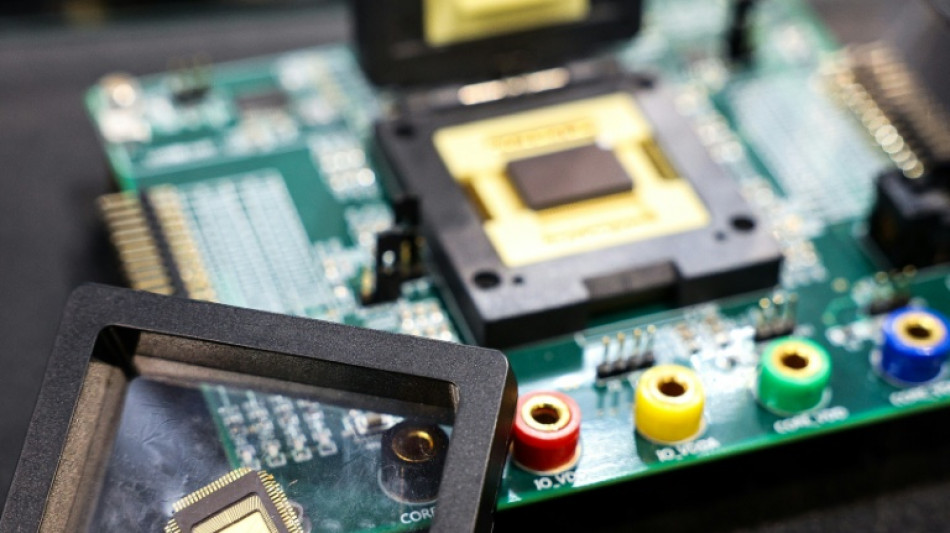
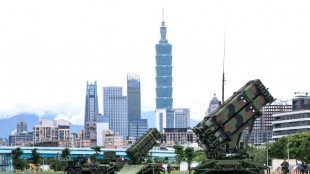
Taiwan to keep production of 'most advanced' chips at home: deputy FM / Photo: I-HWA CHENG - AFP
 SpaceX sends Starship rocket sailing into space
 Russell bounces back to beat Antonelli in sprint qualifying

 Mexico, EU lower tariffs in bid to grow non-US trade

 Fresh confrontation between police, protesters in Bolivia
 US Fed chair says will be 'reform-oriented' at glitzy White House swearing-in

 Ace, eagle lift Im to early CJ Cup Byron Nelson lead
 Antonelli romps opening practice ahead of Russell
 Pakistan military chief arrives in Tehran in push to end Iran war

 US intelligence chief Tulsi Gabbard resigns

 Pep 'made me believe I could be a coach', says Kompany
 Rising Spain star Jodar wants to 'follow own path' at Roland Garros

 Success fuels Guardiola's campaign for a 'better society'
 SpaceX to retry Starship test launch Friday

 Stocks gain, oil higher as investors weigh Mideast peace prospects

 Barcelona's Putellas dismisses talk of future before Champions League final
 Carrick appointed as Man Utd permanent coach

 Sabalenka poised to 'go for it' at Roland Garros
 Sinner says returning to Roland Garros 'special feeling' after 2025 final
 PSG defender Hakimi bids to have rape case dismissed

 Sinner stands between Djokovic and record 25th major crown at French Open
 Dethroned clay queen Swiatek 'willing to fight'
 France's youngest PM Attal to run for president

 Man City needed 'new energy' as Guardiola seeks break from coaching
 Tennis players 'ignored' but 'united' in Grand Slam pay dispute
 Tuchel has 'no fear' after omitting star names from England's World Cup squad
Taiwan plans to keep making the "most advanced" chips on home soil and remain "indispensable" to the global semiconductor industry, the deputy foreign minister told AFP, despite intense Chinese military pressure.
The democratic island makes more than half of the world's chips, and nearly all of the most advanced ones, that power everything from smartphones to AI data centres.
Its dominance of the industry has long been seen as a "silicon shield" protecting it from an invasion or blockade by China -- which claims the island is part of its territory -- and an incentive for the United States to defend it.
But the threat of a Chinese attack has fuelled concerns about potential disruptions to global supply chains and has increased pressure for more chip production beyond Taiwan's shores.
"We will try to maintain the most advanced technology in Taiwan, and to be sure that Taiwan continues to play an indispensable role" in the semiconductor ecosystem, Deputy Foreign Minister Francois Chih-chung Wu told AFP in an interview Wednesday.
"I think it's the same logic for every country, even countries not under such a very complicated geopolitical situation."
China has ramped up military pressure on Taiwan in recent years, deploying on an almost daily basis fighter jets and warships around the island.
Taiwan has responded by increasing defence spending to upgrade its military equipment and improve its ability to wage asymmetric warfare.
- 'Core interest' -
The island does not have enough land, water or energy to accommodate the fabrication plants, or fabs, needed to meet soaring demand for chips, "so step by step we enlarge our investment in the world, but still linking with Taiwan", said Wu, who was previously the representative to France.
Taiwan's TSMC, the world's largest chipmaker, has already invested in fabs in the United States, Japan and Germany.
And earlier this year the firm pledged to spend an additional US$100 billion on US chip plants, as President Donald Trump threatened to impose tariffs on overseas-made semiconductors.
However, replicating TSMC's factories in the United States is full of challenges, said Wu, citing Taiwan's "very special culture to make the semiconductors very well".
The best way to reduce risks to the chip industry was not to move fabs abroad but to "prevent the war", Wu said.
US Secretary of Commerce Howard Lutnick said recently he had proposed to Taiwan a 50-50 split in chip production, an idea that Taipei rejected.
While Washington is Taiwan's most important security backer, some of Trump's comments about the island and flip-flopping on Ukraine have raised doubts over his willingness to defend it.
Wu, however, expressed confidence that the United States, as well as Europe, would respond to a Chinese attack on Taiwan in order to protect their "national interest" in the region.
"It just happens that your interest and Taiwan's interest we share together," Wu said.
Those interests, he said, included the semiconductor industry but also peace, and freedom of navigation in the Taiwan Strait, which is a key international shipping route.
"I think Donald Trump understands better and better, day by day, the strategic importance of Taiwan... and will defend American interests in his own way," Wu said.
"We are the core interest of China, but we are also a core interest of the US."
Y.Nakamura--AMWN