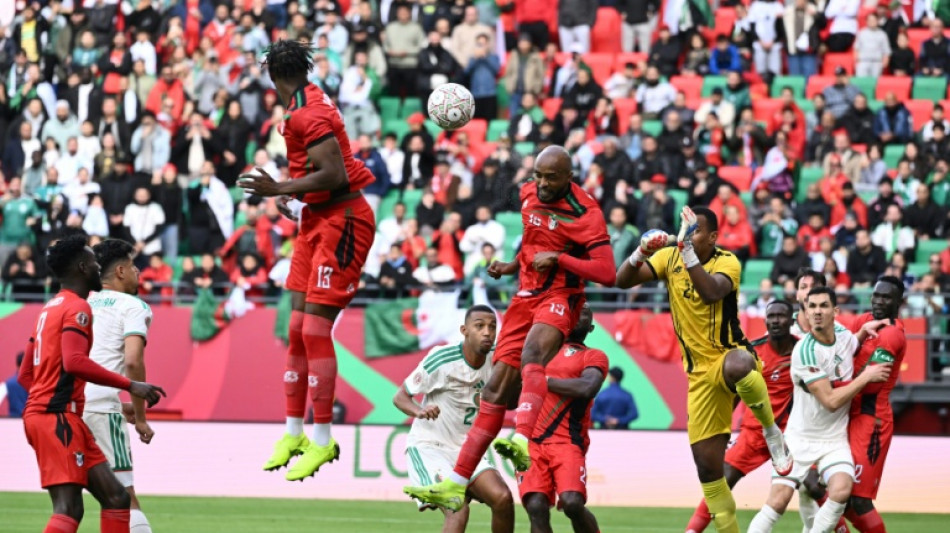
'Make our country happy': Sudan dream of AFCON glory as conflict rages at home / Photo: SEBASTIEN BOZON - AFP/File
 Search Underway for 'Dooars Rani' Tigress After Second Escape from Buxa Tiger Reserve

 The Dilemma of Recording Live Music: Preserving Memories vs. Being Present

 InterContinental Hotels Group PLC Announces Transaction in Own Shares - November 11

 Fulcrum Metals PLC Announces New Critical Mineral Recoveries Expand Potential
 Fulcrum Metals PLC Announces Publication of Updated Investor Presentation

 Christmas Day Shifts More than Double as Americans Return to In-Person Holiday Celebrations

 Thukukile Zuma Resigns from ANC Johannesburg Leadership Amid Disciplinary Dispute
 CM Mohan Yadav Meets Bohra Spiritual Leader to Discuss Simhastha 2028 and Development
 Eli Crane Defeats Jonathan Nez in Tight Arizona Congressional Race

When war broke out in Sudan in April 2023, Ammar Taifour was in a training camp with his club Al Merrikh in Khartoum.
"I just remember the surprise, the shock of the first gunshots. It was very surprising," the 28-year-old midfielder with the Sudan team at the Africa Cup of Nations tells AFP.
"Then in the days after that there were power cuts and constant gunshots. It was just unbelievable.
"I just pray for peace and for everyone who's in this situation to be safe and make it out."
Taifour, who was born in the United States, is among the lucky ones. He says he is "grateful and blessed" that family members in Sudan were able to leave the country.
Goalkeeper Mohamed Al Nour, meanwhile, had to deal with the anguish of his brother being taken prisoner by the paramilitary Rapid Support Forces.
"Luckily I have not lost any members of my family but my brother was taken prisoner for nine months by the RSF before being released," says Al Nour.
"We have experienced terror, people being killed. We just hope things improve."
The war that erupted close to three years ago between the country's army and its former allies the RSF has had a devastating impact on the population.
Tens of thousands of people have been killed and 11 million driven from their homes in what the UN has declared "the world's worst humanitarian disaster".
Despite that backdrop, Sudan's national football team qualified for the ongoing AFCON in Morocco and on Sunday they beat Equatorial Guinea 1-0 in Casablanca.
It was just their second win at the Cup of Nations in 18 matches across six tournament appearances since they lifted the trophy in 1970.
They play Burkina Faso in their final group game on Wednesday and do so with the pressure off because they are already assured of progressing to the last 16.
That is a remarkable achievement regardless of the current off-field context, given Sudan have only once made the knockout stages at an AFCON since 1970 -– they reached the quarter-finals in 2012.
- 'Big responsibility' -
"It's a big honour," says Taifour. "But also we have big expectations and we want to make it as far as possible and even to win the tournament, make our country happy."
"Obviously it's a big responsibility. I think each one of us as individuals, we know the situation that's going on, we all can relate to it, we all have someone involved.
"So whatever we can do to help, whatever we can do to bring some happiness, we try our best to do so."
Al Nour, also known by his nickname Abooja, adds: "Of course the team has been impacted. Everyone has just tried to get through this period but it has been difficult with the tension all over Sudan."
"In the end our results on the pitch are what make the people happy and boost their morale."
The impact of the conflict on Sudanese football has been enormous, leading to the domestic championship being halted and the country's two biggest clubs going into exile.
Al Hilal and Al Merrikh of Omdurman played in the Mauritanian league last season. A domestic elite league did make its return in July, but now the two rivals are playing in Rwanda.
Some players have moved to different countries like Taifour, who departed Al Merrikh for Libya and is now plying his trade in Tunisia.
Despite that the national team has flourished under Ghanaian coach Kwesi Appiah.
They qualified for the competition at the expense of Ghana and put in some good showings in their World Cup qualifying group, beating the Democratic Republic of Congo and drawing with Senegal en route to finishing third.
In August they got to the semi-finals of the African Nations Championship -– a competition for locally-based players -– and they also appeared at the recent FIFA Arab Cup in Qatar.
"We have tried to use every match as preparation and to build chemistry within the group," says Taifour.
Al Nour, meanwhile, describes Appiah as "an exceptional person. We have learnt a lot thanks to him".
It has all led to this, with Sudan now building towards a Cup of Nations knockout tie this weekend and hoping to put smiles on the faces of supporters back home.
Y.Aukaiv--AMWN