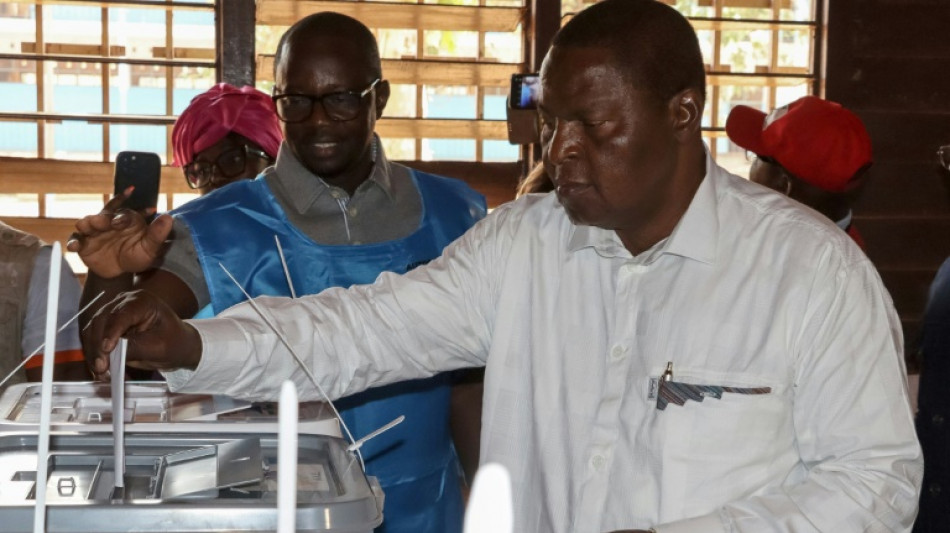
AU observers praise 'peaceful' Central African Republic polls / Photo: Annela NIAMOLO - AFP
 Search Underway for 'Dooars Rani' Tigress After Second Escape from Buxa Tiger Reserve

 The Dilemma of Recording Live Music: Preserving Memories vs. Being Present

 InterContinental Hotels Group PLC Announces Transaction in Own Shares - November 11

 Fulcrum Metals PLC Announces New Critical Mineral Recoveries Expand Potential
 Fulcrum Metals PLC Announces Publication of Updated Investor Presentation

 Christmas Day Shifts More than Double as Americans Return to In-Person Holiday Celebrations

 Thukukile Zuma Resigns from ANC Johannesburg Leadership Amid Disciplinary Dispute

 CM Mohan Yadav Meets Bohra Spiritual Leader to Discuss Simhastha 2028 and Development

 Eli Crane Defeats Jonathan Nez in Tight Arizona Congressional Race

African Union observers on Tuesday said elections in the Central African Republic, where incumbent president Faustin-Archange Touadera is widely expected to win, had gone ahead peacefully.
Touadera, 68, is seeking a third term and has touted his efforts steadying a nation long plagued by conflict.
Part of the opposition had called for a boycott, condemning the election as a sham and lacking political dialogue.
Touadera went into the election in pole position after a new constitution was adopted in 2023 allowing him to seek another term.
AU delegation representative Bernard Makuza praised the elections -- which included parliamentary, municipal and regional ballots at the same time -- as "a step forward towards democracy".
He said that given their compliance with the legal framework in force, the polls were "incomparable with the electoral processes of 2016 and 2020".
At those elections, the AU had expressed misgivings over poll fairness.
The AU delegates monitored this year's polls in three of the country's 20 prefectures.
Makuza, a former Rwandan prime minister, stressed that the "overall security" of the country had allowed voting to take place in a "general atmosphere of calm".
He said sources on the ground reported the electoral process had gone ahead peacefully across the country apart from the Haut-Mbomou prefecture in the southeast.
The region is beset by tensions between the Central African armed forces, supported by Russian Wagner group mercenaries, and a local militia.
Wagner has established itself as one of the Central African government's main security partners.
- 'Legal avenues' -
In 2020, only 50 percent of sub-prefectures were able to host polling normally.
The electoral process was marred by an attempted coup by rebels from the Coalition of Patriots for Change (CPC) and by violence.
This time, Makuza urged candidates with a grievance to "resort to legal avenues in the case of disputes".
The AU monitors will send their final conclusions to the Central African government within a month.
However, Yves Sanghamy Maikane, spokesman for the party of opposition leader Anicet-Georges Dologuele, denounced malfeasance in the poll process, in remarks during a press conference attended by foreign diplomats and the UN special representative.
He separately told AFP he did not want to see the African Union's view of proceedings "create a misleading narrative".
Provisional results are due to be published on January 5, while the Constitutional Court is due to announce final results -- in the event of first-round victories not requiring a run-off -- on January 20.
Since Touadera was first elected in the middle of a civil war, the Central African Republic has seen unrest ease, although feuds persist between armed groups and the government in some regions.
Despite being pushed back, anti-government fighters are still at large on main highways, as well as in the east near the borders with war-battered Sudan and South Sudan.
Nearly 90 percent of the country is now under government authority, compared to 80 percent being held by armed groups four years ago, analysts have told AFP.
A.Jones--AMWN