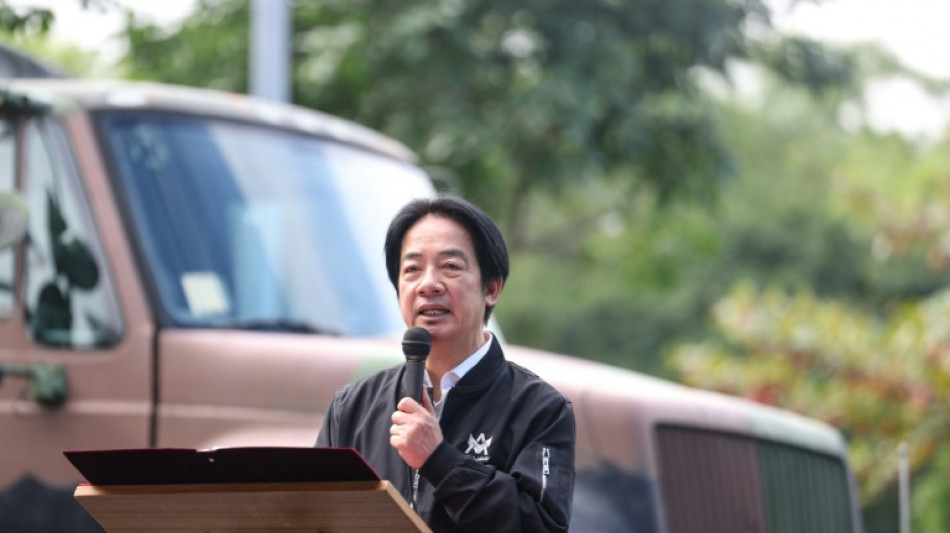
Taiwan's president vows to defend sovereignty after China drills / Photo: I-Hwa Cheng - AFP/File
 Search Underway for 'Dooars Rani' Tigress After Second Escape from Buxa Tiger Reserve

 The Dilemma of Recording Live Music: Preserving Memories vs. Being Present

 InterContinental Hotels Group PLC Announces Transaction in Own Shares - November 11

 Fulcrum Metals PLC Announces New Critical Mineral Recoveries Expand Potential
 Fulcrum Metals PLC Announces Publication of Updated Investor Presentation
 Christmas Day Shifts More than Double as Americans Return to In-Person Holiday Celebrations

 Thukukile Zuma Resigns from ANC Johannesburg Leadership Amid Disciplinary Dispute
 CM Mohan Yadav Meets Bohra Spiritual Leader to Discuss Simhastha 2028 and Development

 Eli Crane Defeats Jonathan Nez in Tight Arizona Congressional Race

Taiwanese President Lai Ching-te vowed on Thursday to defend the democratic island's sovereignty in a New Year's speech, after China carried out military drills.
Beijing launched missiles and deployed dozens of fighter jets, navy ships and coastguard vessels this week to encircle Taiwan's main island, in exercises condemned by Taipei as "highly provocative".
China claims democratic Taiwan is part of its territory and has threatened to use force to annex it.
"My stance has always been clear: to steadfastly defend national sovereignty, strengthen national defence and whole-of-society resilience, comprehensively establish effective deterrence capabilities, and build robust democratic defence mechanisms," Lai said in a televised address from the Presidential Office.
China's show of force follows a bumper round of arms sales to Taipei by the United States, Taiwan's main security backer, and comments from Japan's prime minister that the use of force against Taiwan could warrant a military response from Tokyo.
Lai said international support for Taiwan "has never wavered", which signalled that "Taiwan is no longer just Taiwan".
"We are not only indispensable, we are also a trustworthy, responsible force for good in the international community," Lai said.
But Lai warned that opposition delays in passing the government's annual budget and an additional $40 billion defence spending bill could lead to questions about "Taiwan's resolve" to defend itself.
"In the face of China's grave military ambitions, Taiwan has no time to wait, nor any time for internal strife," Lai said.
"We may hold differing views on many issues, but without a resilient national defence, there will be no nation, nor any space for debate."
China's latest military exercise was the sixth major round of manoeuvres since 2022 when a visit to Taiwan by then-US House Speaker Nancy Pelosi enraged Beijing.
Taiwan has responded to the growing pressure by increasing defence spending on smaller and more nimble weaponry to enable its military to wage asymmetric warfare against more powerful Chinese forces.
But it is under US pressure to do more.
Lai's government aims to boost its 2026 defence budget to more than three percent of gross domestic product and increase spending to five percent of GDP by 2030.
- 'Unity not division' -
Lai's speech capped a dramatic few weeks in Taiwan, with a deadly metro stabbing attack in Taipei that left three people dead and a deepening domestic political crisis.
The Kuomintang party (KMT) and the Taiwan People's Party, which together control the parliament, are furious after Premier Cho Jung-tai, who belongs to Lai's Democratic Progressive Party, refused to sign opposition-backed amendments to a revenue-sharing bill, preventing them from taking effect.
Lai publicly supported Cho's decision, further angering opposition parties, which have accused the government of "defying the Constitution" and launched impeachment proceedings against them.
"I hope that our ruling and opposition parties can stand united," Lai said.
"Only through unity, not division, can we avoid sending the wrong signals to China that it could invade Taiwan."
Y.Kobayashi--AMWN