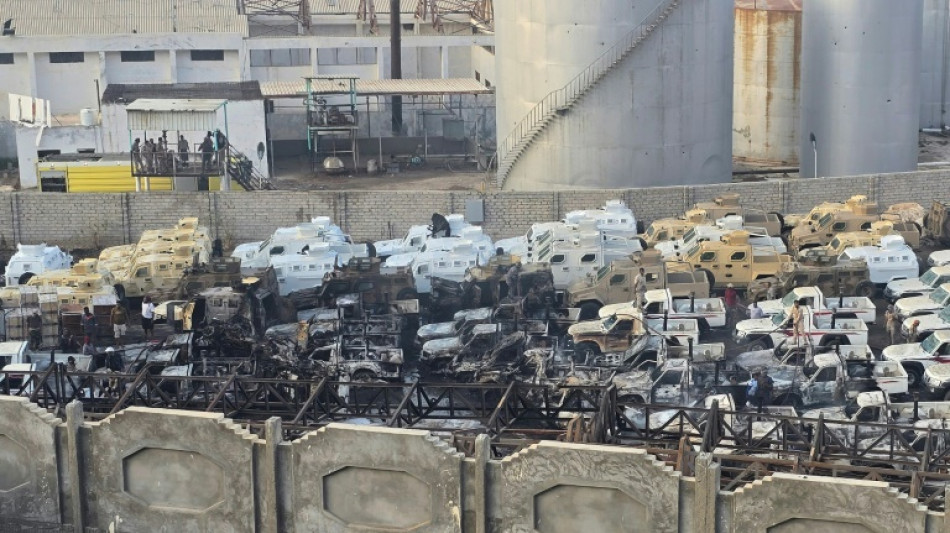
Best of frenemies: Saudi, UAE rivalry bursts into view / Photo: STRINGER - AFP
 New Zealand, India form 'strategic partnership'

 Courtois 'proud' as sun sets on Belgium's 'Golden Generation'

 Economic uncertainty looms over Venezuela quake zone
 'Beast' Haaland a different player to me, says Kane

 My goals don't matter if we win World Cup, says Yamal

 Spain's Merino living 'wildest dreams' with late World Cup winners

 Apple sues OpenAI for stealing trade secrets

 Spain set up World Cup semi-final with France after late win against Belgium

 Alfred trumps Thomas in battle of Olympic sprint champions

 Brutal heat wave forecast for western US this weekend

 Music industry launches AI-generated content labels

 SK hynix surges on first day of trading on Wall Street

 Edwards leaves role with Liverpool owners FSG

 Wemby to Spurs fans: 'I'm here to stay, whatever it takes'
 Trump administration weakens habitat protections for endangered species

 Scheffler misses first cut in four years as McIlroy leads at Scottish Open

 Nearly 50 abducted pupils, teachers rescued in Nigeria

 Wanyonyi sets new world best in men's 1,000m
 Djokovic expects to be back at Wimbledon next year

 Sinner, Zverev power into Wimbledon final

 Trump says agreed to more Iran talks but insists truce over

 Zverev hungry for Wimbledon glory after Paris breakthrough

 England risk losing Guehi for Norway World Cup quarter-final

 UK police launch murder probe into ex-MP's death

 Woad is unruffled by the lake as she sails into Evian lead

For years, the United Arab Emirates and Saudi Arabia projected geopolitical and economic power across the Gulf and beyond, seemingly in tandem.
But a growing rivalry and struggle for influence has come to a head -- most recently in Yemen -- following years of divergence over a tangle of competing interests that reach from regional waterways to the corridors of power in Washington, analysts say.
The once-close relationship between Saudi Crown Prince Mohammed bin Salman and UAE President Sheikh Mohamed bin Zayed Al Nahyan was long seen as the backbone of the alliance between the two Gulf powers.
But as their ambitions grew apart and Prince Mohammed accelerated sweeping economic reforms at home while reasserting Saudi dominance abroad, talk has swirled of a rift with the Emirati leader, previously considered his mentor.
Now the pair find themselves on opposing sides over oil production and in Sudan, the Horn of Africa and now Yemen, where the two countries are part of an anti-Houthi military coalition but support rival factions within the internationally recognised government.
Yemen and Gulf expert Baraa Shiban pointed to deep strategic and ideological differences, with Saudi Arabia alarmed by what it views as the UAE's willingness in war-torn Yemen and Sudan to "break the country" by backing disruptive forces in a bid for influence, with Riyadh preferring instead to preserve existing authorities.
He also said there was an "obsession" among the Emirati leadership about fighting the Muslim Brotherhood and political Islam, a stance the UAE has sought to push across the region but which is not shared to the same degree by Saudi Arabia.
Saudi Arabia is also keen to hold on to what it considers its own regional preeminence.
"Seeing one country with huge influence, like the United Arab Emirates, crafting bilateral deals... suddenly having footholds in multiple countries with those non-state actors, it's something they would be very concerned about," Shiban said.
- Growing apart in Yemen -
The countries' opposition in Yemen burst into view recently when the separatist Southern Transitional Council (STC) -- supported by the UAE and part of Yemen's governing alliance -- seized swathes of resource-rich Hadramawt and Mahra provinces from forces loyal to the government, backed by Saudi Arabia.
The Saudi-led military coalition in Yemen, which it formed to fight the Houthi rebels and to which the UAE nominally belongs, on Tuesday bombed an alleged Emirati weapons shipment destined for the separatists.
But the cracks in the coalition had started to show years earlier, with the UAE pulling out the bulk of its forces in July 2019.
UAE and Saudi aims in Yemen are "significantly different" and there is "no way to reconcile the two approaches", Shiban said.
- Opposing sides in Sudan -
In November, US President Donald Trump promised to end a grinding war in Sudan following a request by Prince Mohammed during a trip to Washington.
Abu Dhabi has been widely accused of arming the paramilitary Rapid Support Forces (RSF), which have been fighting Sudan's regular army since April 2023. The UAE has repeatedly denied the accusations.
The Sudanese army, meanwhile, has received support from Saudi Arabia.
Middle East and North Africa researcher Emadeddin Badi said it was difficult to view the STC's advance in Yemen "as anything but retaliation by the UAE for (Prince Mohammed's) visit to Trump", which he said was implicitly understood as Saudi Arabia pushing for a tougher stance on the UAE.
- Horn of Africa 'trigger' -
The Horn of Africa has become another arena of competition thanks to its strategic position, abutting the Red Sea, Gulf of Aden and Indian Ocean.
The UAE has fostered ties with Ethiopia and Somaliland, which seeks to break away from Somalia, and has operated a military base at the port of Berbera since 2017.
Saudi Arabia, meanwhile, has sought to bolster Mogadishu.
Israel, which established ties with the UAE in 2020, last week recognised Somaliland in a move condemned by Saudi Arabia and 20 other mostly Muslim countries. The UAE did not join in the condemnation.
Badi said the recognition would have been a "trigger that amplified the threat perception on the Saudi side".
Somaliland could later look to recognise Israel, "which is something that the UAE intends to leverage", he added.
- Economic rivals -
Following a spat between the UAE and Saudi over OPEC output curbs in 2021, economic rivalry has sharpened as both seek to diversify away from oil.
Riyadh has since moved aggressively to attract multinationals, requiring companies that do business with government agencies to base their regional headquarters there, prompting some to relocate from the UAE.
The push under Saudi's Vision 2030 national blueprint has extended to aviation, tourism and media, with Saudi Arabia launching a new airline, airport and leisure projects to rival Dubai's established hubs.
In recent weeks Riyadh has also quietly relaxed its laws to allow wealthy, non-Muslim foreign residents to purchase alcohol -- seen as another bid to attract overseas workers who would otherwise be drawn to the UAE.
J.Williams--AMWN