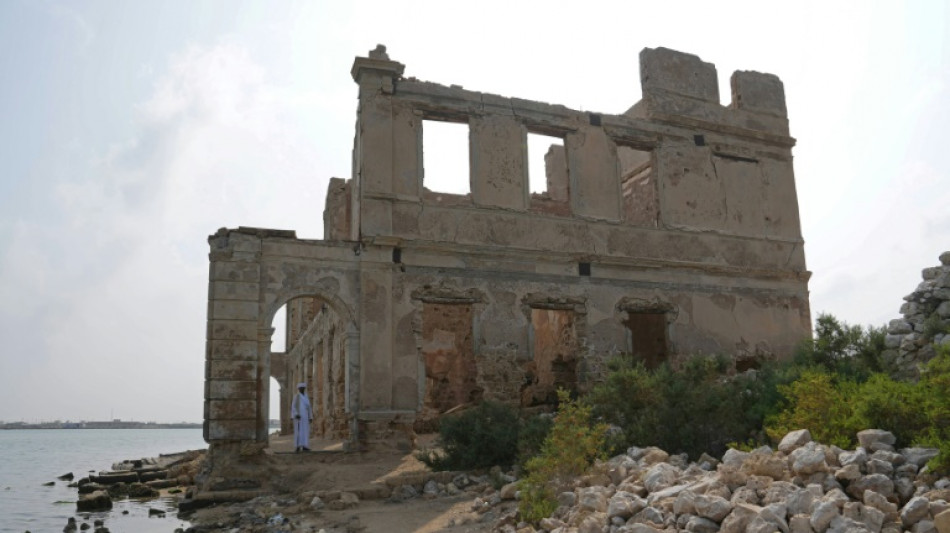
In Sudan's old port of Suakin, dreams of a tourism revival / Photo: Mutawakil ISSA - AFP
 Thai beer dynasty mother drops 'ungrateful child' case against son
 France v Morocco rematch as World Cup quarter-finals get under way

 Modi visits Australia for minerals talks and rockstar welcome

 Sensors, early starts: how Spain keeps working when heat hits
 Kenya Rastafarians hope for freedom to smoke
 Pacific nation of Tuvalu condemns Chinese missile launch into Pacific
 How a viral post sparked India's Gen-Z protest

 Cambodia wants to bring tigers back, but should it?
 Chinese repairwomen smash stereotypes with power tools
 Ecuador's Death Canal: watery grave for victims of gang violence

 'Unique event': Solar eclipse fever fills empty Spain

 Venezuela says Caracas airport to reopen to commercial flights 'soon as possible'

 World Cup: Eight teams remain in the hunt for glory

 Caledonia Mining Corporation Plc: Notification of Relevant Change to Significant Shareholder

 Former Real Madrid coach Arbeloa named Fulham manager

 Messi inspires Argentina great escape over Egypt, Swiss advance

 US strikes Iran after Hormuz attacks, Tehran threatens response

 Djokovic wins five-hour epic to earn Sinner showdown at Wimbledon

 US strikes Iran after Hormuz tanker attacks: military

 Messi 'didn't want to go home' as Argentina comeback stuns Egypt
 Netflix strikes deals in short-form video push
 The height factor: how a small building survived Venezuela's quakes

 Egypt 'cheated' in controversial World Cup exit to Messi's Argentina, says Hassan
 Global AI industry falls short on safety, think tank warns

 'History made': Egyptian pride despite World Cup heartbreak
The mayor of Suakin dreams of a rebirth for his town, an ancient Red Sea port spared by the wars that have marked Sudan's history but reduced to ruins by the ravages of time.
"It was called the 'White City'," for its unique buildings made of coral stone taken from the seabed, said mayor Abu Mohamed El-Amin Artega, who is also the leader of the Artega tribe, part of eastern Sudan's Beja ethnic group.
Now the once-booming port and tourist draw languishes on the water, effectively forgotten for years as Sudan remains mired in a devastating war between the army and paramilitary forces.
But inside the ruins of a mosque, a restoration crew is hard at work rebuilding this piece of Suakin, over a century after the city was abandoned.
"Before the war, a lot of people came, a lot of tourists," said Ahmed Bushra, an engineer with the association Safeguarding Sudan's Living Heritage from Conflict and Climate Change (SSLH).
"We hope in the future, when peace comes to Sudan, they will come and enjoy our beautiful historic buildings here," he told AFP.
Architecture student Doha Abdelaziz Mohamed is part of the crew bringing the mosque back to life with funding from the British Council and support from UNESCO.
"When I came here, I was stunned by the architecture," the 23-year-old said.
The builders "used techniques that are no longer employed today", she told AFP. "We are here to keep our people's heritage."
- Abandoned -
The ancient port -- set on an oval island nestled within a lagoon -- served for centuries as a transit point for merchant caravans, Muslim and Christian pilgrims travelling to Mecca and Jerusalem, and the regional slave trade, according to the Rome-based heritage institute ICCROM.
It became a vibrant crossroads under the Ottoman Empire, said Artega, 55, and its population grew to around 25,000 as a construction boom took off.
"The streets were so crowded that, as our forefathers said, you could hardly move."
Everything changed in 1905, when the British built a deeper commercial port 60 kilometres (37 miles) north, to accommodate increased maritime traffic with the opening of the Suez Canal.
"Merchants and residents moved to Port Sudan," the mayor said, lamenting the decline of what he calls "Sudan's great treasure".
But his Artega tribe, which has administered the city since the sixth century with powers "passed from father to son", refused to leave.
His ancestor, he said, scolded the British: "You found a port as prosperous as a fine hen -- you took its eggs, plucked its feathers and now you spit its bones back at us."
As proof of the Artega's influence, he keeps at home what he says are swords and uniforms gifted to his ancestors by Queen Victoria during the British colonial period.
The rise of Port Sudan spelled disaster for Suakin, whose grand public buildings and elegant coral townhouses were left to decay, slowly eaten away by the humid winds and summer heat.
But the 1990s brought new hope, with the opening of a new passenger port linking Suakin to Jeddah in Saudi Arabia.
Today, the Sudanese transport company Tarco operates daily crossings, carrying around 200 passengers per trip from the modern port of Suakin, within sight of the ancient city and its impoverished environs.
- Lease to Turkey -
The city's optimism grew in 2017 when then-president Omar al-Bashir granted the old port to his Turkish counterpart, Recep Tayyip Erdogan, under a 99-year lease for touristic development.
A Turkish company restored the old governor's palace, customs house and two mosques, but the project stalled in 2019 after Bashir fell from power in the face of mass protests.
Then, in April 2023, the cruise passengers and scuba divers who once stopped in Suakin completely vanished when fighting erupted between the army and the paramilitary Rapid Support Forces (RSF).
A rusting cargo ship now lies stranded on a sandbank in the blue lagoon, where only a handful of fishing boats float around.
But Bushra, from SSLH, remains optimistic. He hopes to see the mosque, which houses the tomb of a Sufi sheikh, host a traditional music festival when the renovation is complete, "in five months".
"When we finish the restoration, the tourists can come here," he said.
Y.Nakamura--AMWN