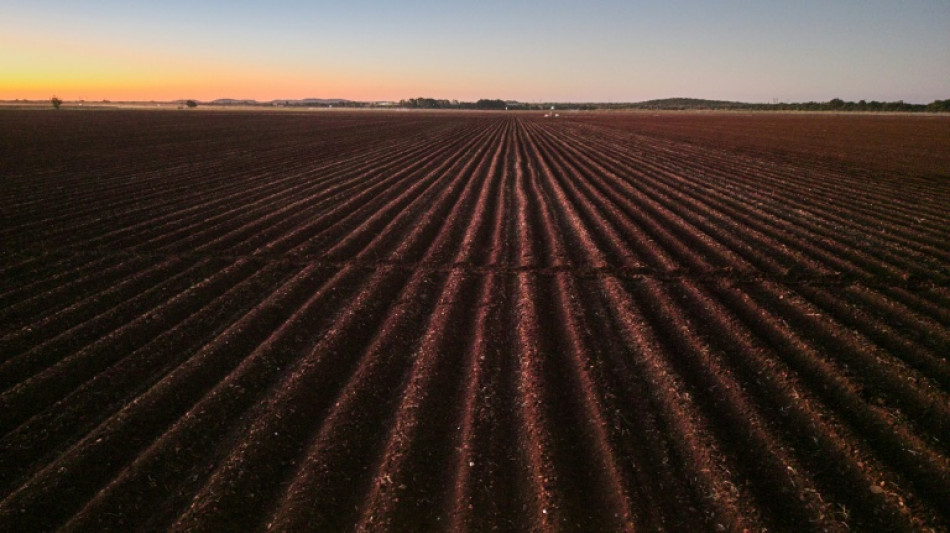
Zimbabwe farmers seek US help over long-promised payouts / Photo: Zinyange Auntony - AFP/File
 Belgium boosted by Balogun furore: Tielemans

 Samsung expects 1,800% operating profit leap on AI boom

 Belgium thrash USA to end World Cup dream and set up Spain showdown

 France's Le Pen faces pivotal ruling in race for president

 NATO allies seek to win over Trump after Iran ire
 US leads international concern after China test-fires missile into Pacific

 Close to tears and on his own as Ronaldo's World Cup dream ends

 Argentina's gruelling World Cup schedule a concern for Scaloni

 Race to recover bodies ahead of Venezuela quake cleanup

 Egypt coach Hassan says Palestinian suffering 'a shame on the world'

 NBA Kings waive six-time All-Star forward DeRozan

 Greaves and Hope centuries usher West Indies towards safety

 'I celebrated in bed' -- Norway's Solbakken stays grounded after beating Brazil

 Canada chooses Germany's TKMS to build new fleet of submarines

 Mbappe condemns racist abuse by Paraguayan senator after World Cup clash

 FIFA chief forced to defend Balogun World Cup reprieve

 Antetokounmpo says goodbye to Milwaukee in video

 Fairytale Fery sinks Dimitrov to make Grand Slam history at Wimbledon

 Canadian Artemis II crew member to retire from space agency

 Prince Harry arrives in UK amid security spat

 'Agony' in Cuba amid third nationwide blackout in six months

 For Trump's World Cup, 'America First' collides with world's game

 England's World Cup campaign takes flight with Mexico win

 Tour de France stage record still 'far away' for Pogacar

 Infantino told Trump FIFA disciplinary body is 'independent'

As white Zimbabwe farmers again ask the Trump administration to weigh in on long-promised government compensation for their evictions 25 years ago, many of them are increasingly ageing and desperate.
Farmers' unions engaged a US lobbying firm late last year to raise their plight in Washington in the hopes of a funding breakthrough, according to a public disclosure filing.
The government of Zimbabwean President Emmerson Mnangagwa has been unable to deliver on a 2020 deal to pay compensation of $3.5 billion to about 3,500 commercial farmers evicted in a botched land reform programme in the early 2000s.
Saddled by $21 billion debt, the government changed the offer in 2023 to one percent in cash with the remainder in US-dollar-denominated Zimbabwean treasury bonds with two percent interest.
Nearly 1,000 farmers have signed up, Finance Minister Mthuli Ncube told AFP, with several hundred reportedly already receiving some cash and bonds last year.
However, the process has been opaque and achingly slow, and many farmers have refused the new deal.
Outside intervention is "not necessarily a bad thing," Ncube said about reports of hiring US firm Mercury Public Affairs, which has ties to President Donald Trump's administration.
"We are committed to paying and if they are trying to get other people to get us to pay, we have no problems with that," Ncube told AFP.
"We are paying anyway and we would like to pay faster," he said.
- 'Desperate' -
According to a letter in a Department of Justice disclosure filing, four groups representing former commercial farmers engaged the firm to support their bid for "full compensation".
The group would contact administration representatives "to promote paying the Zimbabwean farmers the remaining balance of USD 3.5 billion owed," it said.
This could be through new financing from international institutions such as the World Bank.
With many farmers now in their 70s and 80s, some are in financial difficulty, said Harry Orphanides from the Property and Farm Compensation Association, one of the groups that approached the US firm.
"It's a serious strain on the farmers, especially those who are elderly and have no other sources of income as they were completely dependent on farming," Orphanides told AFP.
"Some of them are really desperate," he said.
About 4,000 farms were seized without compensation in the late President Robert Mugabe's land‑reform drive, which aimed to redistribute the country's arable land -- then largely owned by the white minority -- to black subsistence farmers.
It was marked by violent invasions in which farmers were killed. Many farms ended up in the hands of government or ruling party cronies while some fell into neglect.
The damage caused to the agriculture sector ravaged the economy and lead to food shortages.
With the 2020 Global Compensation Deed (GCD), the government agreed to payments for infrastructure and improvements to farms, but not the value of the land, considered to have been seized by colonial settlers.
- Transactional -
Obtaining US government intervention "may depend on whether there's anything (President Donald) Trump wants from Zimbabwe," rights lawyer Siphosami Malunga told AFP.
"New US foreign policy in Africa is more transactional," he said.
The issue was morally and legally complex, he said, with compensation for colonial-era crimes, including land dispossession, yet to be addressed.
At the same time, the white farmers "were promised compensation and it has not been paid so they are entitled to fight for it whichever way," Malunga said.
"If the Trump administration does take this up, it will likely seek some kind of deal," said South Africa-based analyst Nicole Beardsworth, calling it a "risky prospect".
There could be demands for access to Zimbabwe's significant mineral resources, she said, warning of possible "unintended consequences that far exceed the compensation they are seeking".
Opposition politician Trust Chikohora said forcing the government to pay quickly was "not sustainable".
It was unhelpful to "put pressure on the government to fulfil things which are impossible to fulfil," he said.
A.Jones--AMWN