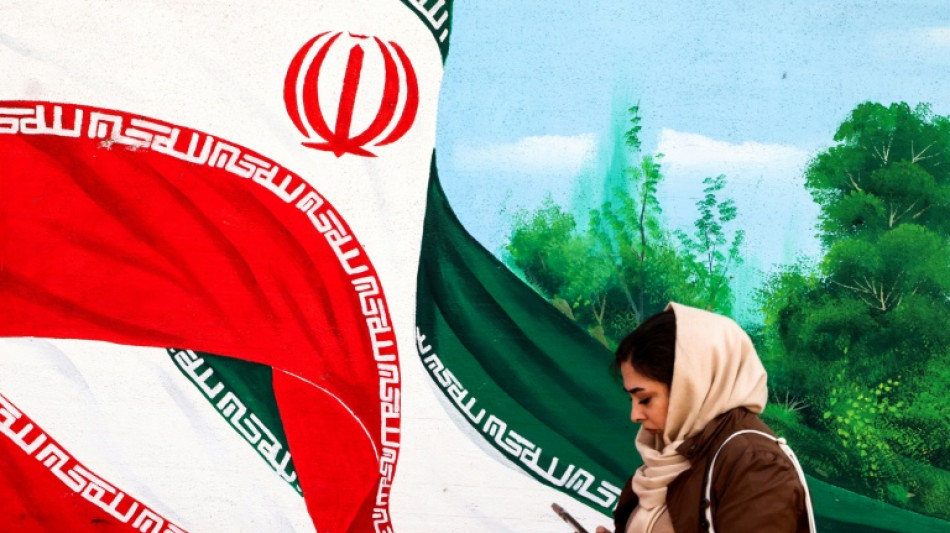
Iran says would respond 'ferociously' to any US attack, even limited strikes / Photo: ATTA KENARE - AFP
 Brussels Education Unions Schedule Major November Protest Over Funding and Reforms

 iPS Cell Research Accelerates Drug Discovery for ALS and Spinal Cord Injury

 Rene Eyre Revisits Autobiographical Performance 'Say A Little Prayer' in London

 UAE's HCT Holds Record Graduation and Announces Major Training Expansion

 NASA Awards $10B Lunar Contract Framework to SpaceX, Blue Origin

 Katy Perry Tells Fans Ex-Husband Russell Brand 'Should Be in Jail' During UK Concert

Iran said Monday that a US attack of any scale would spur the Islamic republic to respond "ferociously", after President Donald Trump said he was considering limited strikes against the country.
The United States has built up forces in the Middle East to pile pressure on Iran to make a deal at negotiations due to restart on Thursday, with Trump weighing a limited strike if no agreement is reached.
On Monday Iran's foreign ministry reiterated that any strike, even limited, would be "would be regarded as an act of aggression. Period".
"And any state would react to an act of aggression as part of its inherent right of self-defence ferociously so that's what we would do," ministry spokesman Esmaeil Baqaei said at a briefing in Tehran attended by an AFP journalist.
The two countries concluded a second round of indirect talks in Switzerland on Tuesday under Omani mediation.
Further talks, confirmed by Iran and Oman but not by the United States, are scheduled for Thursday.
The European Union, which has been sidelined in mediation on Iran, called for a diplomatic solution ahead of the talks.
"We don't need another war in this region. We already have a lot," EU foreign policy chief Kaja Kallas said ahead of a meeting of EU foreign ministers.
"It is true that Iran is at its weakest point that they have been. We should be really using this time to find a diplomatic solution."
Iran's clerical authorities have faced recent steep challenges, including a wave of mass protests that peaked in January, last year's 12-day war with Israel, and the weakening of Iran's regional proxies.
- Fears of conflict -
Iran has, however, insisted only discussions on the country's nuclear programme are on the table at mediated talks. The West believes the programme is aimed at making a bomb, which Tehran denies.
Iranian Foreign Minister Abbas Araghchi is leading the negotiations for Iran, while the United States is represented by envoy Steve Witkoff and Trump's son-in-law Jared Kushner.
Trump is wondering why Iran has not "capitulated" in the face of Washington's military deployment, Witkoff said in an interview with Fox News broadcast over the weekend.
Baqaei responded Monday by saying that Iranians had never capitulated at any point in their history.
Trump had initially threatened military action over the violent crackdown on the protests that rights groups say saw thousands of people killed by security forces, but his attention soon shifted to Iran's nuclear programme.
Scattered anti-government protests have continued in the country, despite the threat of suppression and arrests.
Students rallied to commemorate those killed in competing pro- and anti-government demonstrations as the university semester restarted over the weekend.
Iranians' fears of a new conflict have grown and the concerns have also prompted several foreign countries to urge their citizens to leave Iran.
India on Monday joined Sweden, Serbia, Poland and Australia in calling for its citizens -- estimated at 10,000 in the country by the foreign ministry -- to leave Iran.
S.Gregor--AMWN

