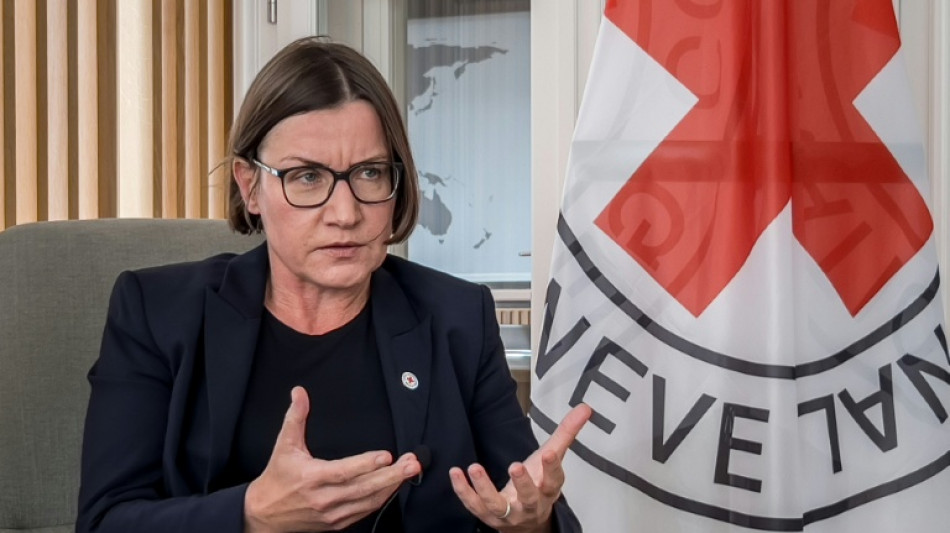
Red Cross urges Afghanistan-Pakistan 'de-escalation' / Photo: Elodie LE MAOU - AFP
 iPS Cell Research Accelerates Drug Discovery for ALS and Spinal Cord Injury

 Rene Eyre Revisits Autobiographical Performance 'Say A Little Prayer' in London

 UAE's HCT Holds Record Graduation and Announces Major Training Expansion

 NASA Awards $10B Lunar Contract Framework to SpaceX, Blue Origin

 Katy Perry Tells Fans Ex-Husband Russell Brand 'Should Be in Jail' During UK Concert

The president of the International Committee of the Red Cross called on Friday for a de-escalation of hostilities between Afghanistan and Pakistan, insisting that civilians must be protected and healthcare access guaranteed.
Pakistan bombed major cities in Afghanistan including the capital Kabul on Friday, with Islamabad's defence minister declaring the neighbours at "open war" following months of tit-for-tat clashes.
"We are witnessing a profound escalation of hostilities between Afghanistan and Pakistan," ICRC President Mirjana Spoljaric said in a statement, calling for "restraint and de-escalation".
She highlighted that the upsurge in violence was harming people in a region that had "already endured decades of conflict, displacement and loss".
"They have seen and felt the impact of war on their loved ones in their communities," she said.
Pakistan's latest operation came after Afghan forces attacked Pakistani border troops on Thursday night in retaliation for earlier air strikes by Islamabad.
Islamabad accuses Afghanistan of failing to act against militant groups that carry out attacks in Pakistan, which the Taliban government denies.
Spoljaric stressed that under international law, "civilians, the wounded and others not -- or no longer -- taking part in the fighting must be protected".
"Humanitarian assistance must reach all those affected (and) hospitals must be able to operate and access to essential services must be guaranteed," she added.
"These are not privileges," insisted the head of the ICRC, which is the caretaker of the Geneva Conventions.
"They are obligations under international humanitarian law."
Spoljaric said her organisation was "preparing an operational response to humanitarian needs on the ground", in cooperation with the Afghan and Pakistan Red Crescent societies and state authorities.
"The focus on both sides of the border now is to support health facilities treating people who were wounded by hostilities," she said.
She stressed however that "no humanitarian response can compensate for political will to respect the rules of war and prioritise de-escalation".
F.Schneider--AMWN


