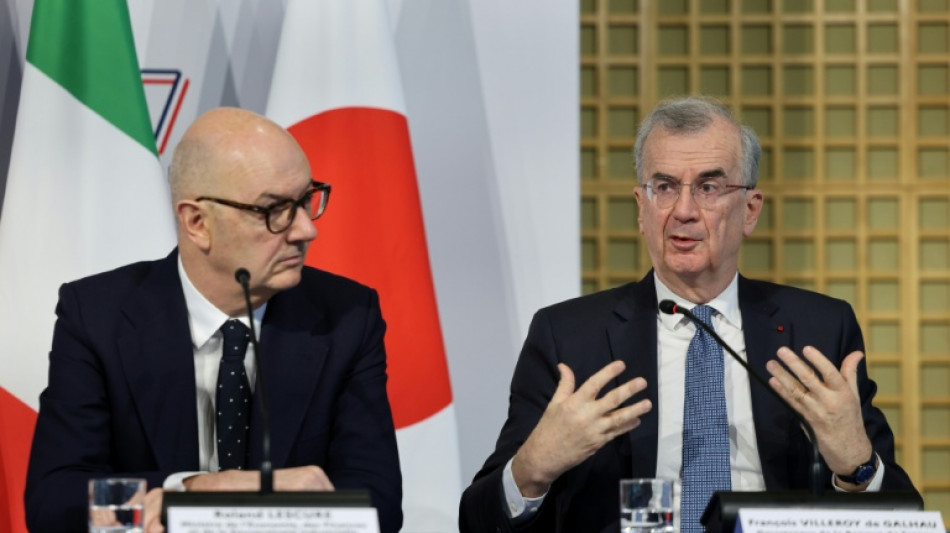
France says planning G7 finance meeting on Mideast / Photo: Ludovic MARIN - AFP/File
 Rene Eyre Revisits Autobiographical Performance 'Say A Little Prayer' in London

 UAE's HCT Holds Record Graduation and Announces Major Training Expansion

 NASA Awards $10B Lunar Contract Framework to SpaceX, Blue Origin

 Katy Perry Tells Fans Ex-Husband Russell Brand 'Should Be in Jail' During UK Concert

 South African election results renew debate over identity-based voting

 South African voters report smoother local election but declining IEC trust

 Dolly Parton museum and Nashville hotel open after singer’s death

France is planning a meeting of G7 finance ministers on the Middle East crisis, with central bankers also in attendance, the country's Economy and Finance Minister, Roland Lescure, said on Wednesday.
"I have spoken with various counterparts, in particular Scott Bessent, who is the US Treasury Secretary. And we agreed to hold a meeting which will place at the beginning of next week," he told Franceinfo radio.
"We want to let a week go by to see how the conflict develops, how the markets evolve. We'll have the finance ministers and the central bank governors there as well."
France currently holds the rotating presidency of the Group of Seven advanced economies, which also includes Canada, Germany, Italy, Japan, the United Kingdom and the United States.
A first meeting of finance ministers under the French presidency was held on January 27.
Lescure said next week's meeting was expected to be an exchange of views.
"We're going to listen to what is coming up from the ground, from businesses, from economists in these different parts of the world," he added.
"The idea is to be able to discuss the state of the situation, so that we can assess any responses that might be needed, if we have to act.
"In a conflict which is currently a local conflict in one region but has global repercussions, it is obviously essential that we coordinate."
The war in the Middle East, sparked by the US-Israeli bombing of Iran on Saturday, has in recent days led to a sharp fall in stock markets, particularly in Europe and Asia.
Since the start of the week, France's benchmark CAC40 index has lost more than five percent. Its German equivalent, the Dax, has fallen by nearly six percent, while London's FTSE 100 has dropped nearly four percent.
Investors are concerned about the sharp rise in hydrocarbon prices due to disruptions to supplies through the Strait of Hormuz, which handles some 20 percent of the seaborne world's oil and liquefied natural gas .
L.Miller--AMWN