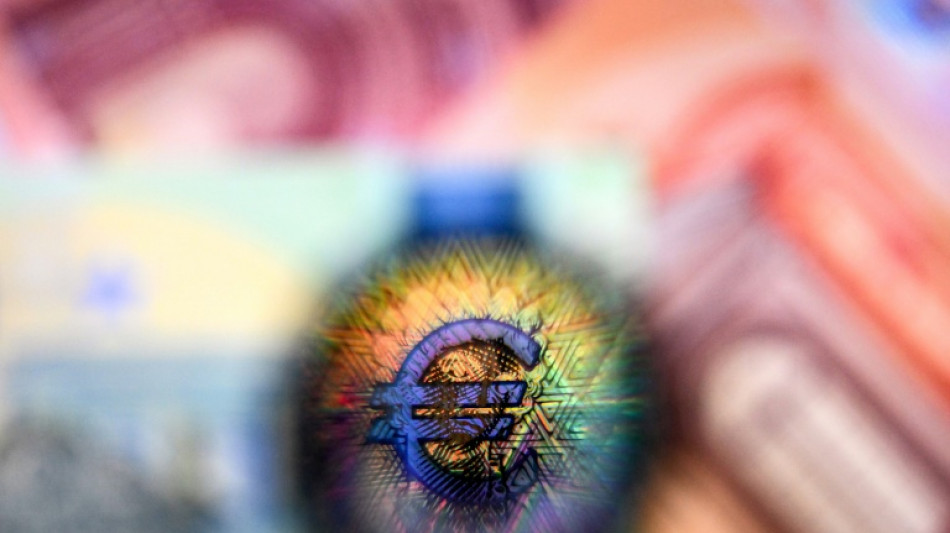
EU wants to tap citizens' savings. Easier said than done / Photo: Kirill KUDRYAVTSEV - AFP/File
 Euphoric homecoming for Cape Verde after heroic World Cup defeat

 Tour de France stage under threat due to forest fires: official
 UK hard-right leader Farage faces new allegations over gifts
 OPEC+ raises quotas again as Middle East calms

 Azam to captain Pakistan on West Indies and England Test tours

 Revival hopes grow for long-closed Greek Orthodox seminary off Istanbul
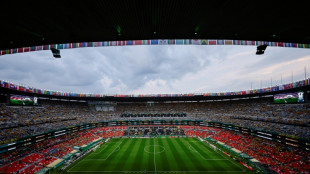
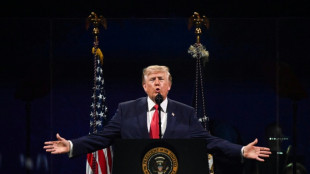 Trump hails US, blasts 'communists' in 250th anniversary speech

 Taiwanese film hunters rescue ageing reels from bygone era
 Trump arrives for US 250th birthday speech after storm delay

 All Blacks wing Fineanganofo's debut began 'in the toilet, spewing'

 Xhaka -- Switzerland's World Cup rock born to be skipper
 Trump pushes ahead with US 250th birthday speech after storm delay
 Australia's Schmidt rues missed opportunities as Wilson defends Donaldson

 Deschamps hails France for staying cool in World Cup win over Paraguay

 Japan ready for Ireland after 'big statement' against Italy

 Mbappe says France happy 'to get hands dirty' after World Cup win

 France beat Paraguay with Mbappe penalty to reach World Cup quarter-finals

 Ukraine denies Moscow claim of seizing strategic stronghold

 Dinusha shines for Sri Lanka on second day of West Indies Test

 Julian Quinones, Mexico's not-so-secret World Cup weapon
 Erasmus celebrates equalling record with win for weakened Springboks
 'I'm going with him': families fear for bodies of Venezuela's quake dead

 Venezuela quake death toll rises to nearly 3,000
 England unhappy with Rita Ora show before T20 World Cup final

 Morocco end Canada World Cup dream to reach quarters as France face Philly heat

The idea sounds simple: tap trillions of euros of EU citizens' savings to unlock capital for European companies through a more integrated financial market.
Getting over the finish line, however, has been complicated, with EU states unable to agree and the idea languishing for years.
More than a decade after the European Union first floated the idea of a deeper capital market, the issue has come roaring back into the spotlight -- and with it the type of concern that dogged previous efforts.
The renewed impetus stems from fears the EU is lagging dangerously behind the world's two biggest economies, the United States and China -- one of the topics set to dominate a summit of the bloc's leaders this week.
Some, including European Commission President Ursula von der Leyen, have raised the prospect of several EU states moving forward, leaving others behind, to establish a Savings and Investments Union.
A key element of such a union is centralising market supervision, an issue pitting the EU's six biggest economies against smaller countries.
France, Germany, Italy and three others say the move is necessary, but Luxembourg and Ireland have expressed reservations.
The topic will be discussed in depth when EU leaders meet Thursday.
But what really does the EU want, and can it be achieved?
- What is the plan? -
The idea first appeared as the "Capital Markets Union" when then-president of the commission Jean-Claude Juncker raised it in 2014.
Now the EU prefers the phrase "Savings and Investments Union" -- which combines the Capital Markets Union and the Banking Union.
Brussels wants to unify national financial markets to make investments flow more seamlessly across the EU.
The commission also wants markets to provide more attractive financial instruments to European citizens, who are more fearful of investing in stock markets than their American counterparts.
Currently, 10 trillion euros ($11.6 trillion) of EU citizens' savings are held as bank deposits, according to the bloc's executive, because people see it as safe.
The reform push is also about giving better access to money for businesses.
By harmonising financial markets and getting rid of the fragmentation that hinders pooling vast capital, there could be much bigger sums available for scale-ups and infrastructure, experts say.
"That is one of the key disadvantages the EU is facing compared to the US and China," said analyst Philipp Lausberg of the European Policy Centre think tank.
- Why is this a hot topic again? -
Europe needs money -- lots of it.
A landmark 2024 report estimated the EU's additional investment needs at 750 billion to 800 billion euros annually.
The EU needs to plough more money into its digital and green transitions as well as defence, faced with rising global instability.
Leaders are keen to move fast.
They agreed in February they wanted "to be done with phase one of the Savings and Investment Union, that includes the market integration, the supervision and the securitisation, by June", von der Leyen said.
Without "sufficient progress", she warned willing EU states would press on alone.
Under EU rules, at least nine countries could go full steam ahead on the project without others.
- Is it popular? -
In theory, member states all support the idea.
In practice, there are strong divisions over how it should look.
A group of countries known as "E6" -- France, Germany, Italy, Spain, the Netherlands and Poland -- want the Paris-based European Securities and Markets Authority to become the EU's supervisor of large stock exchanges.
Irish Finance Minister Simon Harris recommended "enhancing" its role instead.
The business community supports the Savings and Investments Union, including Europe's biggest organisation representing firms, BusinessEurope.
Others, while welcoming deeper financial markets, are more cautious.
Julia Symon, head of research and advocacy at NGO Finance Watch, said key barriers need to be removed if Europe wants a "regime comparable to the US, currently the main destination of EU private capital outflows".
This would mean "joint supervision, harmonised insolvency and greater tax coherence, which go far beyond what is currently proposed", she told AFP.
"The goal should not be to expand finance for its own sake, but to ensure that finance serves long-term economic resilience and productive investment."
A.Jones--AMWN