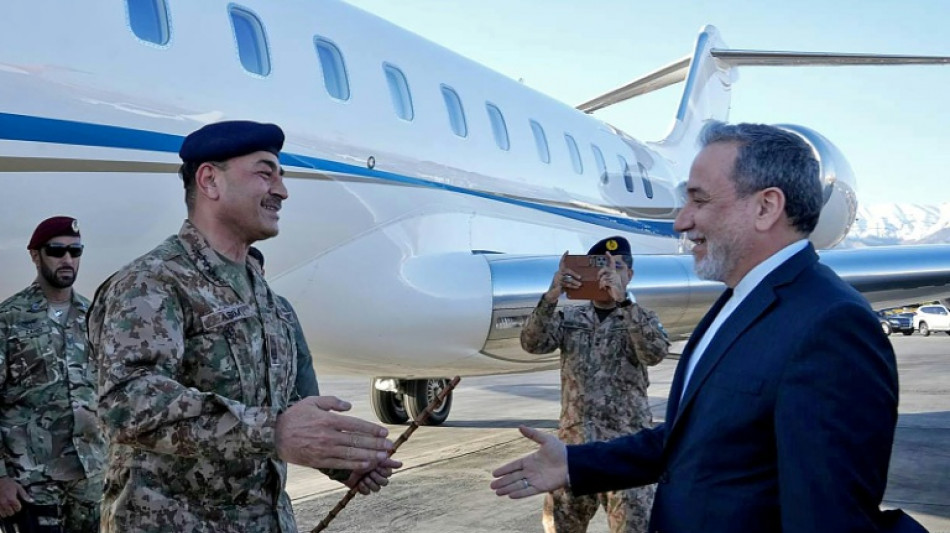
Pakistan's military chief takes lead on US-Iran talks in diplomatic blitz / Photo: - - Iranian Foreign Ministry/AFP
 UK PM unveils plan to help rough sleepers off streets by Christmas

 Tokyo opposes US sanctions on Japanese ICC chief Akane
 Humanoid-maker Unitree surges more than 600% on Shanghai debut
 Bowling great Donald warns Bangladesh that Australia will hit back hard
 STARPRIME Completes Beta Testing of Market-Maker Model for Retail Brokers
 Campaigns kick off in Nigerian presidential race
 Aussie Rules club suspends five players for drinking, bringing women to hotel

 Trump pauses 50% tariffs on Canadian goods for three days

 Five Premier League stars to watch this season

 China's robots open to opportunities in search of commercial breakthrough
 Tech leads losses as Asian stocks track Wall St selloff
 US, South Korea cut drills short after Trump criticism
 Italian scientists bet on octopus to fight crab invasion

 New 'Insidious' reflects anxiety of being a new parent: director

 No.1 Sabalenka slams Wang to advance at Cincinnati
 Turkey rejects Israeli claims after strike on Syria air base
 Bioz and InvivoGen Elevate Scientific Discovery with an Expanded Digital Research Experience
 Empire Metals Limited Announces MRE Upgrade at Pitfield Titanium Project

 InterContinental Hotels Group PLC Announces Transaction in Own Shares - August 19

 Best Place to Buy Gold IRA in 2026 (Guide Released)

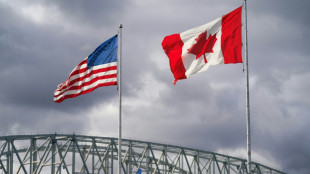 Trump, Carney talk as Canada seeks to hold off new US tariffs
 NASA images reveal crater left by SpaceX rocket's Moon crash
 UN atomic watchdog says found tons of nuclear material at Syria site
 Ecuadoran diplomat enters race to be next UN chief

 US sanctions ICC chief Tomoko Akane of Japan
Over a feverish few days of diplomacy, Pakistan's military and civilian politicians successfully divided the Middle East between them to push for a second round of US-Iran peace talks expected to take place in Islamabad this week.
The country's powerful military chief, Field Marshal Asim Munir, headed to Tehran on Wednesday for what would become a three-day trip, where Iranian leaders said he carried US proposals for a second round of peace talks.
Simultaneously, Prime Minister Shehbaz Sharif and his foreign minister conducted a whirlwind diplomatic tour across regional allies Saudi Arabia, Qatar and Turkey.
The twin trips illustrate the coordination at play in what is often described as a "hybrid regime" in Pakistan, and Munir's central role in the negotiating process.
"The synergy that is going on right now is giving results, and to take this momentum forward all this synergy will be needed," said Sheharyar Khan, executive director of the Islamabad-based National Dialogue Forum.
Munir was one of two Pakistani mediators in the room during face-to-face talks between the United States and Iran in Islamabad on April 11.
"It's not political leadership that takes the decision in these kinds of situations, but the military leadership," said a Pakistani official, speaking on condition of anonymity.
The official described Munir's visit to Iran as "important" in bringing both sides back to the negotiating table.
"The deal is almost done. He is the only person who can convince Iranians for a deal -- that's because of the trust level."
- 'Who is the strong man?' -
While a first round of peace talks between the United States and Iran did not yield an agreement, it did lead to the highest-level face-to-face negotiations between the two sides in decades, and communications channels remained open -- through Pakistan.
Building on that momentum, Pakistan's leaders have been pushing for a second round of talks in Islamabad, with security being stepped up across the capital on Sunday in anticipation.
Munir's rise on the global stage has coincided with a consolidation of military power in Pakistan, which has seen him given unprecedented legal immunity and an extended term.
The military as a whole has also taken a more prominent role in governance.
Critics and the political opposition say the moves, as well as sweeping constitutional reforms, have eroded democracy in the country.
However, the military has repeatedly denied meddling in the civilian domain -- even though it ruled Pakistan for nearly half its existence through a series of coups since independence in 1947.
The National Dialogue Forum's Khan said that, while both civilians and military leaders were working closely together in the current system, it was Munir who had the authority to call the shots.
"Who is the person who can give the results? Who is the strong man? Who is controlling? Who is in the lead? That is obviously Mr. Field Marshal," Khan said.
Munir has also built a close relationship with US President Donald Trump -- who often refers to him as his "favourite field marshal" -- since a brief but intense war with India last year.
Adam Weinstein, deputy director of the Middle East programme at Washington's Quincy Institute, said that relationship was crucial.
"Munir focused on Iran because it's the key stakeholder and he's seen as having the closest relationship with Trump," he said.
"... the prime minister focused on regional states with more traditional foreign policy bureaucracies, whose buy-in matters, but is less critical."
Muhammad Saeed, a retired Pakistani general, told AFP that Munir was in "direct communication" with the US leadership to negotiate through sticking points in the dialogue with Iran.
"His presence is bringing both the sides to a middle ground," he said.
S.F.Warren--AMWN