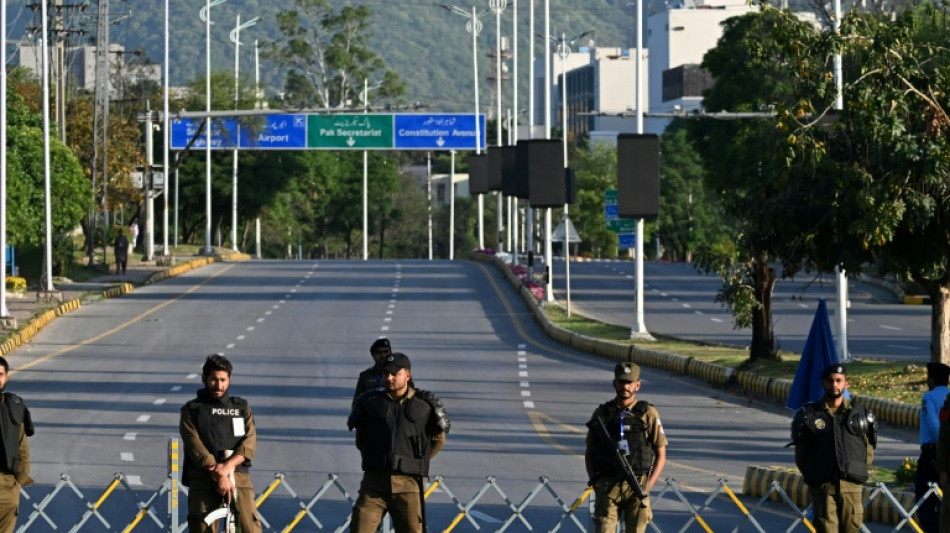
Pakistan's capital holds its breath with US-Iran talks in limbo / Photo: Aamir QURESHI - AFP
 STARPRIME Completes Beta Testing of Market-Maker Model for Retail Brokers
 Campaigns kick off in Nigerian presidential race
 Aussie Rules club suspends five players for drinking, bringing women to hotel

 Trump pauses 50% tariffs on Canadian goods for three days

 Five Premier League stars to watch this season
 China's robots open to opportunities in search of commercial breakthrough
 Tech leads losses as Asian stocks track Wall St selloff
 US, South Korea cut drills short after Trump criticism
 Italian scientists bet on octopus to fight crab invasion

 New 'Insidious' reflects anxiety of being a new parent: director

 No.1 Sabalenka slams Wang to advance at Cincinnati

 Turkey rejects Israeli claims after strike on Syria air base
 InterContinental Hotels Group PLC Announces Transaction in Own Shares - August 19

 Best Place to Buy Gold IRA in 2026 (Guide Released)
 Trump, Carney talk as Canada seeks to hold off new US tariffs

 NASA images reveal crater left by SpaceX rocket's Moon crash

 UN atomic watchdog says found tons of nuclear material at Syria site

 Ecuadoran diplomat enters race to be next UN chief

 US sanctions ICC chief Tomoko Akane of Japan

 US moves to open vast tracts of pristine forests to logging
 US sanctions International Criminal Court chief Tomoko Akane of Japan
 Meta hooked children and misled public: prosecutors

 France's first women's rights minister Yvette Roudy dies, aged 97
 French producer Nicolas Altmayer, Dior PR chief Favier die in car crash
 Bezos consortium bought nearly 40 percent of Liverpool: report
Pakistan's capital was still locked in gear on Wednesday to host high-stakes US-Iran talks that were pushed back at the last minute overnight, but many residents began to tire of the heavy personal and economic toll of tight security restrictions.
Markets were quiet, government officials worked from home, children attended class online and security forces enforced strict curbs on entering the vast "red zone" around the negotiating venue.
US Vice President JD Vance had been expected to arrive on Wednesday morning but the White House abruptly changed plans, with Iran's negotiating delegation also delaying a decision on attending talks.
Many residents hoped that negotiations would bring an end to road closures and other restrictions throughout the capital, with some areas under virtual lockdown.
Initial public euphoria over Pakistan's image being burnished on the global stage has begun to give way to fraying patience after weeks of stop-start restrictions around Islamabad.
"We have to live here, the Red Zone has been shut down. Children cannot go to school, and shops are closed from time to time," said office worker Zainab Ali Uthmankhail, 27.
"Personally I do find it very annoying. My time is wasted. Transport fares have increased. But I am happy that we are doing something positive," she said.
- No customers -
Similar measures were enforced for a first round of US-Iran talks in Islamabad this month, and some restrictions were never lifted.
That round of negotiations ended without an agreement, but US President Donald Trump extended a ceasefire on Wednesday as feverish diplomacy continued to end the Middle East War that began with US and Israeli strikes on Iran on February 28.
Major roads have been closed in recent days to facilitate the arrival of foreign delegations and US cargo planes delivering equipment.
Islamabad residents are used to restrictions and road closures, having lived through periods of militant attacks, political protests and visits by heads of state.
But the intensity and stop-start nature of this month's measures have pushed some to the limit, especially the many small business owners and daily wage workers whose incomes have been slashed in an already struggling economy.
"The impact of the lockdown is that we are not seeing any customers here in the market... the government does not know what one day of their lockdown does to our households," Muhammad Ahsan, 35, the owner of a small jewellery kiosk, said this week.
"Our stoves do not run, we do not find food (in the markets)."
Large businesses were also affected, with major oil refiner Attock announcing it was pausing production at a key unit due to transport disruptions.
Many in Islamabad nonetheless were proud of their country's role in navigating a possible end to weeks of fighting that has killed thousands and thrown the global economy into turmoil.
However, they also braced themselves for more disruption.
"We are giving a small sacrifice to reduce the size of the larger sacrifice," said Syed Umar Hasnain Shah, a young doctor. "So we will continue to sacrifice."
L.Davis--AMWN