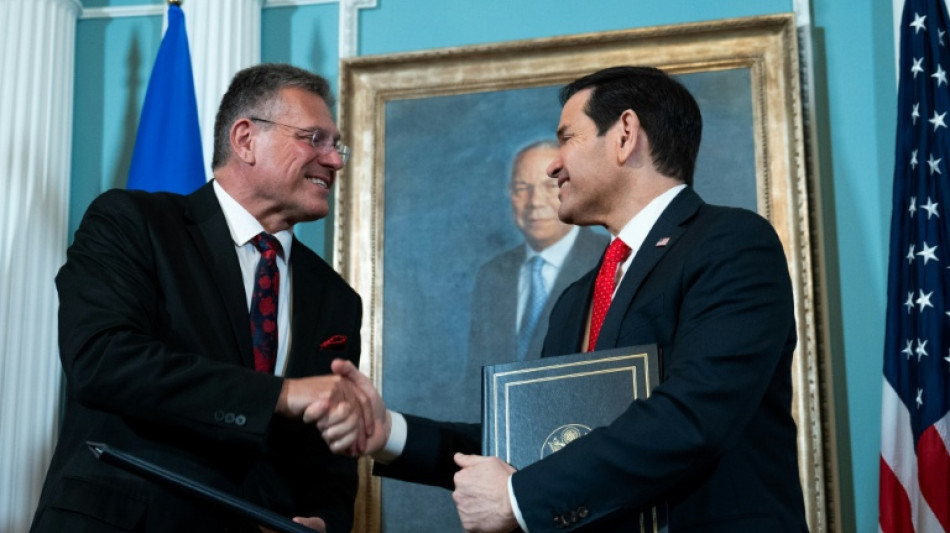
EU, US sign critical minerals plan to counter China reliance / Photo: Annabelle GORDON - AFP
 Trump pauses 50% tariffs on Canadian goods for three days

 Five Premier League stars to watch this season

 China's robots open to opportunities in search of commercial breakthrough
 Tech leads losses as Asian stocks track Wall St selloff

 US, South Korea cut drills short after Trump criticism
 Italian scientists bet on octopus to fight crab invasion

 New 'Insidious' reflects anxiety of being a new parent: director

 No.1 Sabalenka slams Wang to advance at Cincinnati

 Turkey rejects Israeli claims after strike on Syria air base

 Climate change main driver of European ocean warming: study
 Gauff finds a way into the Cincinnati fourth round

 ZZ Top drummer Frank Beard dies at age 77
 Bayern's Musiala reveals 'neurological disorder' after on-field collapse

 Angelique Kidjo immortalised on Hollywood Walk of Fame
 France to expel two Iranian diplomats: foreign minister

 Spain's Granada closes iconic Alhambra as new quake hits
 Venus, Stephens, Monfils named among US Open wild cards

 Rodri joins La Liga champions Barcelona from Manchester City

 Disney, ABC sue US regulator over threat to broadcast licenses

 Trump, Carney hold talks as new US tariffs on Canada loom

 Germany opens new drone research centre as security threats mount
 How only a few tree species drive Amazon forest recovery
 Ivonne A-Baki enters race to be next UN chief
 Ukraine says Russian strike kills 10 in northeast region

 Meta in court over child social media addiction

The European Union and United States signed an agreement Friday to coordinate on the supply of critical minerals needed for key industries including defense, as China's dominance becomes a growing concern.
The pact marks a rare embrace by President Donald Trump's administration of the role of the EU, which it often berates as it instead champions right-wing populists within Europe.
Flexing its muscle at times of tension, Beijing has restricted exports of critical minerals needed for products including semiconductors, electric vehicle batteries and weapons systems.
"The overconcentration of these resources, the fact that they're dominated by one or two places, is an unacceptable risk," US Secretary of State Marco Rubio said as he signed a memorandum of understanding with EU trade chief Maros Sefcovic.
Sefcovic told a separate press briefing that the agreement "formalizes our partnership across the entire value chain, from exploration and extraction to processing, refining, recycling and recovery."
- Cost of dependency -
On concerns that China could retaliate against a potential critical minerals deal involving multiple parties, Sefcovic said: "For us, it's really a matter of economic security. It's a matter of overcoming dependencies."
From recent experience, "we know how dependencies could be expensive, and we have a huge price tag for being dependent on the sources of our fossil fuels," he added.
"We simply want to learn from that experience and have a much more diversified portfolio of suppliers," Sefcovic said.
Rubio noted that the United States and the EU combined are "the largest customers and users" of critical minerals.
"We have to make sure that these supplies and these minerals are available for our futures and in ways that are not monopolized in one place or concentrated heavily in one place," Rubio added.
An action plan said that the EU and United States would explore setting minimum prices on critical minerals -- effectively preventing China or other outside powers from flooding the market with inexpensive exports.
They will also look at coordinating any subsidies and stockpiles of critical minerals, and could coordinate joint standards to ease trade across the Western world, and together invest in research.
The US Trade Representative's office said this plan will be the main mechanism to "coordinate trade policies and measures on critical minerals supply chains with a view to concluding a binding plurilateral agreement on trade."
The Trump administration has previously called for a preferential trade zone among allies on critical minerals.
Washington has also unveiled critical minerals action plans with Mexico and Japan, alongside a supply framework with Australia and others.
P.Costa--AMWN