Global military spending surges on insecurity: report / Photo: Olga MALTSEVA - AFP
 New 'Insidious' reflects anxiety of being a new parent: director

 No.1 Sabalenka slams Wang to advance at Cincinnati

 Turkey rejects Israeli claims after strike on Syria air base
 Climate change main driver of European ocean warming: study
 Gauff finds a way into the Cincinnati fourth round

 ZZ Top drummer Frank Beard dies at age 77
 Bayern's Musiala reveals 'neurological disorder' after on-field collapse

 Angelique Kidjo immortalised on Hollywood Walk of Fame

 France to expel two Iranian diplomats: foreign minister

 Spain's Granada closes iconic Alhambra as new quake hits

 Venus, Stephens, Monfils named among US Open wild cards

 Rodri joins La Liga champions Barcelona from Manchester City

 Disney, ABC sue US regulator over threat to broadcast licenses

 Trump, Carney hold talks as new US tariffs on Canada loom

 Germany opens new drone research centre as security threats mount
 How only a few tree species drive Amazon forest recovery
 Ivonne A-Baki enters race to be next UN chief
 Ukraine says Russian strike kills 10 in northeast region

 Meta in court over child social media addiction

 Vieira appointed Senegal head coach after World Cup disappointment
 F1's Albon re-signs with Williams for 2027

 Borderless.xyz Deepens Africa Coverage as CrissCross Goes Live on Its Network

 Pakistan court orders ex-PM Khan moved from jail to hospital
 'Lonely place': Black UK academics slam racism after Arday's death

 UK PM says not embarrassed by hoax messages with fake Trump aide
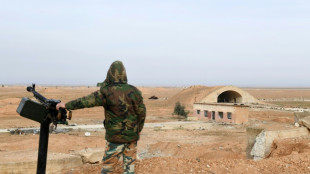
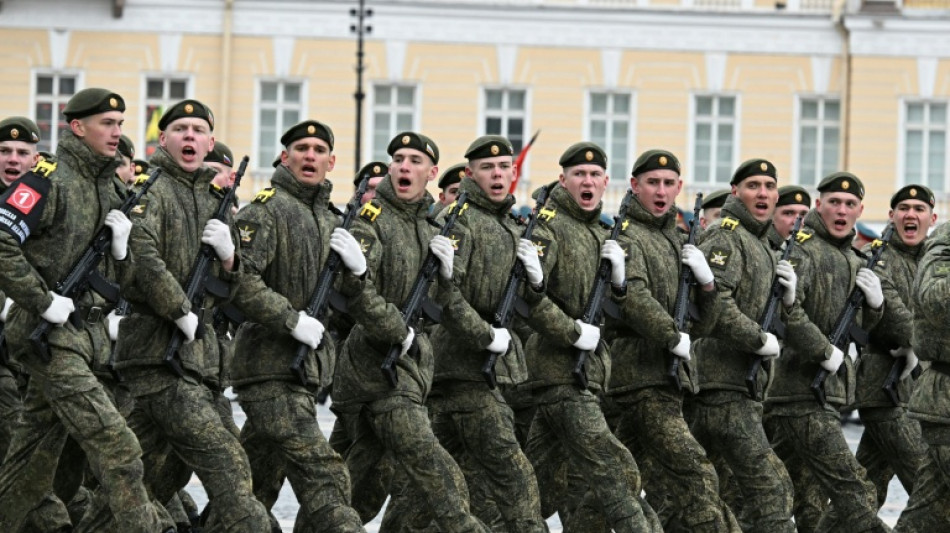
Global military spending reached nearly $2.9 trillion in 2025, marking an 11th consecutive year of growth, researchers said Monday, as insecurity and rearmament fuelled defence budgets.
The three top spenders -- the United States, China and Russia -- spent a combined total of $1.48 trillion, just over half of global expenditure.
Spending rose by 2.9 percent compared with 2024, despite a reduction by the US, the world's biggest spender, according to a report by the Stockholm International Peace Research Institute (SIPRI).
Researcher Lorenzo Scarazzato told AFP the decrease from the US was more than offset by increases in Europe and Asia, as the world marked "another year of wars and increased tensions".
Scarazzato said this was also reflected in the global "military burden" -- the share of worldwide GDP devoted to military spending -- which reached its highest level since 2009.
"Everything points to a world that feels less secure and is spending on its military to compensate for the global landscape," he said.
The US spent $954 billion, 7.5 percent less than in 2024, largely because no new financial military aid to Ukraine was approved. By contrast, Washinhton pledged a total of $127 billion to Kyiv over the previous three years.
But the decrease is expected to be short-lived as the US Congress has approved spending of over $1 trillion for 2026, which could rise to $1.5 trillion in 2027 if US President Donald Trump's budget proposal passes.
The main driver of the global increase was Europe -- including Russia and Ukraine -- where spending surged 14 percent to $864 billion.
"That is driven by two major factors. One is the ongoing war in Ukraine, and the other is the decreased US engagement with Europe," Scarazzato said.
He explained that the US is "pushing for Europe to take more care of its own defence".
Germany, the fourth-largest spender, raised expenditure by 24 percent in 2025 to $114 billion.
Spain also recorded a 50 percent jump to $40.2 billion, pushing military spending above two percent of GDP for the first time since 1994.
- Middle East tensions -
The ongoing war in Ukraine saw both Russia and Ukraine increase their military spending, with each recording the highest share of government spending allocated to the military.
Russia's spending rose 5.9 percent to $190 billion, equivalent to 7.5 percent of GDP.
Ukraine meanwhile boosted spending by 20 percent to $84.1 billion -- a staggering 40 percent of GDP.
Despite persistent tensions in the Middle East, expenditure in the region rose only marginally, by 0.1 percent, to $218 billion.
While most countries in the region increased spending, Israel and Iran actually recorded declines.
In Iran, it fell 5.6 percent to $7.4 billion, but this was mostly due to high annual inflation of 42 percent. In nominal terms, spending actually rose.
Israel's 4.9 percent drop to $48.3 billion reflected a reduced intensity in the Gaza war after a January 2025 ceasefire deal, the researchers explained, while noting Israeli spending was still 97 percent higher than in 2022.
In Asia and Oceania, spending reached $681 billion, an 8.5 percent increase from 2024 -- the region's largest annual increase since 2009.
Scarazzato said the "major player" in the region was China, which has been increasing spending every year for the past three decades, and spent an estimated $336 billion in 2025.
"But perhaps what's interesting is the reaction of some other states, such as South Korea, Japan, and Taiwan, reacting to the threat perception," he said.
Japan raised military expenditure by 9.7 percent, to $62.2 billion in 2025, equivalent to 1.4 percent of GDP -- its highest share since 1958 -- while Taiwan increased its spending by 14 percent to $18.2 billion.
F.Dubois--AMWN