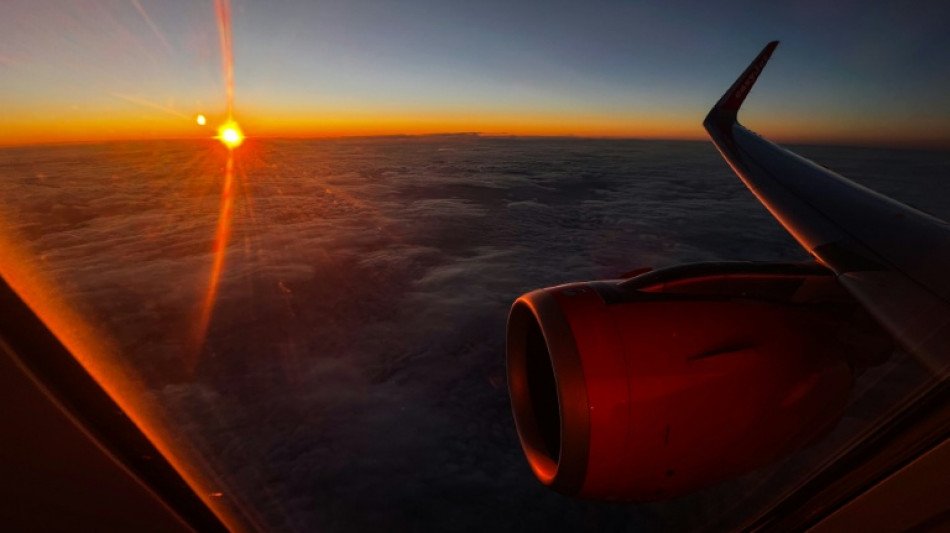
EU opens door to using US jet fuel as shortages loom / Photo: SEBASTIEN BOZON - AFP
 Canada seeks to avert new US tariffs as deadline looms

 US primaries test Democrat comeback hopes in Trump stronghold
 Scientists discover how narwhals grow nature's only straight tusk

 DR Congo Ebola outbreak 'far from being under control': WHO chief

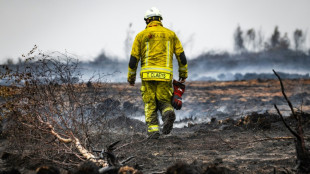 Firefighters in 'decisive' push to encircle Belgian wildfire

 Tribal Partners with ServiceNow to Empower Enterprise Teams to Build and Deploy Apps & Agents

 Fusion Markets Extends Negative Balance Protection to Clients Globally
 India close on victory in first Test against Sri Lanka

 Three lightly injured as new quake hits Spain's Granada

 Syria, US say Israel struck military air base in Idlib province
 France probes Russian disinfo campaign against centrist candidates

 Stocks mostly drop as Mideast hopes dim, interest rates rise
 Bayern's Musiala returns to training after on-field collapse

 China's Baidu, betting on AI, posts fifth straight quarterly revenue drop

 German farmers warn of drought toll on grain harvest
 Pant fastest to 100 sixes as India set Sri Lanka 372 to win first Test
 Russia rebukes Japan ambassador over disputed islands row
 Crude extends gains, most stocks drop as Mideast hopes dim

 Rift deepens as Asia football chief hits back at Qatar in Infantino saga

 India extend lead to 294 in first Sri Lanka Test

 Asian allies stress 'critical cooperation' as Trump slashes Korea drills

 Williams sisters fall at Cincinnati while Zverev advances

 Transylvania's fortified churches face fragile future

 China mourns former premier Zhu Rongji with flags lowered, funeral

 Philippine student killed in rare school shooting

How big is the jet fuel threat to Europe's summer holidays? The EU says it is not facing shortages yet, but it is readying for the worst -- and weighing options including using US kerosene as a back-up.
The US-Israeli war with Iran and the closure of the Strait of Hormuz have sent aviation fuel prices soaring and raised the spectre of shortages during Europe's peak travel season.
On Friday, the EU Aviation Safety Agency (EASA) cleared the way for the use of Jet A, a US-produced aviation fuel that is not currently used in Europe except on return flights from the United States for technical reasons.
In new recommendations, EASA said: "A potential introduction of Jet A in Europe or in other parts of the world would not generate safety concerns provided that its introduction is properly managed."
US-produced Jet A has a higher freezing point from the Jet A‑1 fuel used elsewhere in the world -- making it less resistant to very low temperatures during long-haul flights.
The EASA conditioned its use, warning that its introduction into a system historically running on Jet A‑1 could see "operational" risks when both fuels are used.
At the same time, the European Commission outlined measures available to member states to optimise jet fuel use, including aircraft loading and the allocation of airport slots.
- What about Europe's jet fuel stocks? -
Brussels has repeatedly insisted the 27-nation EU is not yet facing jet fuel shortages.
"At this stage, this is more a problem of economics and fuel costs than availability," Matteo Mirolo, an aviation transport specialist, told AFP.
But "we do have to think about supply, especially as this will not be the last crisis we face."
Before the Middle East war, around 20 percent of the kerosene consumed in Europe transited through the Strait of Hormuz that has been effectively closed by the conflict.
As prices have surged, several airlines, particularly low-cost carriers, have announced flight cancellations.
If the crisis drags on, Brussels is preparing for possible "security of supply issues," EU energy commissioner Dan Jorgensen said Tuesday.
"We are not there yet, but it can happen," Jorgensen said.
The commission said last week it would establish a "fuel observatory" to track EU production, imports, exports and stock levels of transport fuels. It is expected to be up and running in coming days.
Until now, the EU has lacked a detailed overview of strategic fuel stocks across member states.
European legislation requires countries to hold oil stocks equivalent to 90 days of net imports and 61 days of domestic consumption, but does not distinguish between different products such as petrol, diesel or jet fuel.
A commission source said some countries, such as Ireland, are more at risk due to a lack of refining capacity, while others, including Finland, appear better prepared.
The same source also voiced concern some airlines may be using the crisis as an opportunity to drop unprofitable routes.
- What has the EU announced? -
The commission on Friday clarified the rules for governments and airlines on which existing tools can be deployed to ensure jet fuel is used as efficiently as possible and at the lowest possible cost.
It also eased rules restricting "tankering", the practice of aircraft carrying more fuel than necessary to avoid buying more expensive fuel at other airports.
And Brussels confirmed there would be temporary flexibility on airport slots to prevent airlines that exceptionally give up slots because of high fuel costs from being penalised in future slot allocations.
On the sensitive subject of passenger rights, the EU said airlines may be exempt from paying customers compensation if they can prove a cancelled fight was due to "extraordinary circumstances", like a local fuel shortage.
If the crisis drags on, the EU is considering coordinated action by member states to release emergency stocks and voluntarily share jet fuel themselves.
In the longer term, Brussels is also stressing the need to develop non‑fossil sustainable aviation fuels (SAF).
A.Jones--AMWN