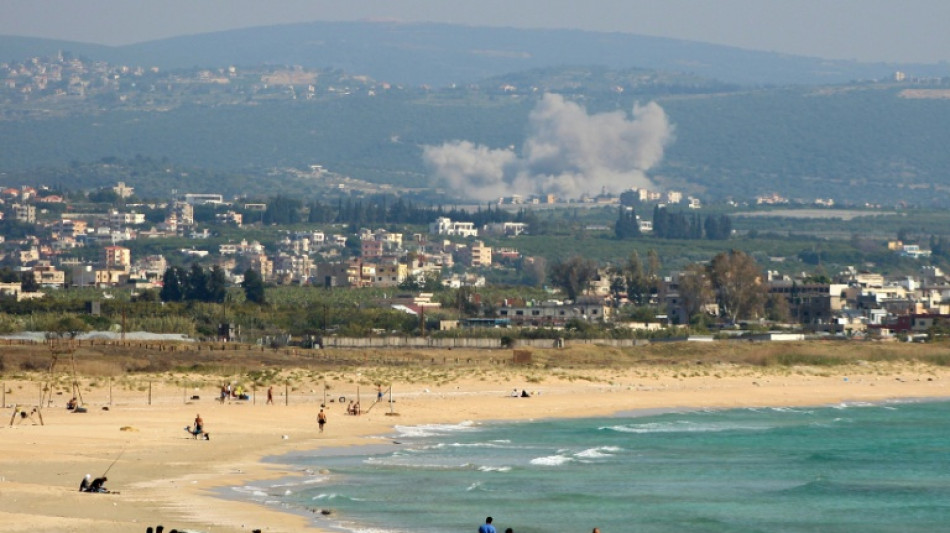
'Promised to us': The Israelis dreaming of settling south Lebanon / Photo: KAWANT HAJU - AFP/File
 Walter Koenig, who played original Chekov on 'Star Trek,' dies at 90

 Netanyahu, rivals trade attacks over Iran as clock counts down to Israel vote

 Townsend urges Scotland to use Nations Championship as World Cup springboard

 Microsoft offers voluntary exit packages to 60,000 staff
 S.Africa ambassador calls for talks with US over 'tense' ties

 'Smells of freedom': Serbians hopeful after landmark election

 South Africa select 'enforcer' Coetzee for Australia decider

 Botanists comb Gabon's rich rainforests with nature on the line

 New levy on non-EU parcels kicks in Sunday

 Stocks climb ahead of tech earnings, central bank calls

 Part of London's Oxford Street pedestrianised 'forever'

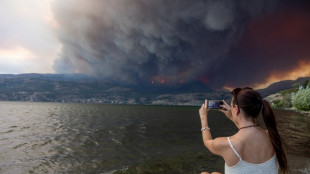 Canadian youth seek climate action in landmark trial

 Trump blasts Norway over Nobel Peace Prize snub

 Japan PM vows swift response to wave of cyberattacks

 Stocks mostly rise before tech earnings, central bank calls

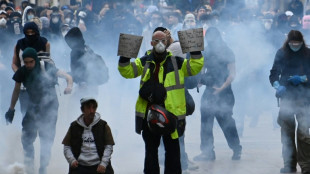 France's Macron to visit Marseille after protest violence

 German union slams Audi boss's appearance at Trump rally

 UK set for 'limited' budget giveaways as borrowing costs surge

 Anthropic's AI model accessed US voter data: Axios

 Malaysia's Johor reopens schools as haze eases

 Carragher says Fernandes benching was intended as public punishment

 Canada-EU summit seeks deepened alliance as US ties fray

 Senegal to host Youth Games, Africa's first ever Olympics

 ITV drama Adultery examines temptation, class and family consequences

 New levy on non-EU parcels kicks in November 1

From her home in an Israeli settlement in the occupied West Bank, Anna Sloutskin yearns to expand her country's borders and one day move to southern Lebanon. And she is not alone.
With fighting between Israel and Hezbollah displacing more than a million Lebanese, a far-right fringe of Israel's settler movement is turning its gaze northwards.
Uri Tzafon, or "Awake, North Wind", comprises dozens of families, according to Sloutskin, a 37-year-old research biologist who says the movement has seen growing traction since she co-founded it in 2024.
The group envisages Israel's northern border extending to at least the Litani river, which runs some 30 kilometres (19 miles) deep into Lebanese territory, and aims to establish a permanent Israeli civilian presence in the area.
"The idea is that most of the population flees, we move the border, and we do not let that population return, and it remains a part of the State of Israel by declaration," said Sloutskin, who formed the movement in memory of her brother Israel Sokol, an Israeli soldier killed in Gaza in 2024.
"He dreamed of settling in Lebanon," she told AFP from a hilltop lookout dedicated to Sokol near the settlement of Karnei Shomron in the northern West Bank.
"He said he wanted to live in a place that is green in the summer and white in the winter."
The Israeli government has given no public political support to the movement to settle southern Lebanon.
In the occupied West Bank, the government has greenlit a major expansion of Israeli settlements and far-right ministers have openly called for the territory's annexation.
Excluding east Jerusalem, more than 500,000 Israelis live in the occupied West Bank in settlements that are illegal under international law, among some three million Palestinians.
Sloutskin insisted that Jewish settlement in southern Lebanon was key to Israel's security and ending the cycle of conflict with Iran-backed Hezbollah.
"What the IDF is doing right now is the first stage," Sloutskin said, referring to the Israeli military.
"The IDF goes in, conquers, and clears. And afterwards we must not withdraw, but settle."
Following its invasion of parts of southern Lebanon, the Israeli military said forces may have to remain in the area without specifying for how long.
A ceasefire has been in place since mid-April, and Israeli and Lebanese negotiators are holding a new round of talks in Washington.
- 'Nile to the Euphrates' -
On a WhatsApp channel with more than 600 members, Uri Tzafon posts invites to online meetings and maps showing supposedly ancient Jewish settlements in southern Lebanon.
On Telegram, their number of followers sits at over 900.
Contract farmworker, Ori Plasse, joined the group in its early days after being actively involved in settlements in both the West Bank and Gaza.
The 51-year-old, who emigrated from Manhattan in the 1990s, told AFP that he and a group of others drove into Lebanon through an open border gate a year and a half ago.
The intention, he said, was to set up a tent, plant trees and "start something that would pick up momentum."
He was soon escorted out by Israeli soldiers but described the experience as "amazing".
"You feel like you're home, you feel it's your country," he said from his house in Moshav Sde Yaakov in northern Israel.
In February, Uri Tzafon organised another tree-planting trip to the border, publishing photos of children smiling alongside Israeli flags and placards erected next to the wall.
The Israeli military condemned the incident in which it said two civilians crossed the fence, constituting a criminal offence endangering civilians and troops.
In his garden, Plasse enthusiastically opened an old shipping container holding supplies to build settlements -- including mattresses, sleeping bags and plastic sheets.
Inside, he flicked through a book with maps showing Israel's borders spanning from parts of modern-day Egypt to Iraq.
"Anybody who follows the Old Testament... should know that the land of Israel is promised to us from, basically most people say it's the Nile and to the Euphrates River," said Plasse.
- 'Under the table' support -
Ahead of elections due later this year, Plasse said Uri Tzafon would try to get support from politicians, but admitted their responses had so far been "vague".
Sloutskin, however, insisted there was backing from some lawmakers and even ministers.
"Some say it openly, some say it under the table, but there is definitely support," she said.
Last month, Uri Tzafon published a photo of Sloutskin meeting with Environmental Protection Minister Idit Silman, captioned: "During the meeting with the minister, the issue of taking the territory was raised."
The dream of settling Lebanon sits on the ultra-nationalist margins of Israeli society, but both Sloutskin and Plasse were certain their views would become more mainstream with time.
In his sparsely decorated home, Plasse proudly displayed a certificate of appreciation for Gaza settlement activists, signed by far-right National Security Minister Itamar Ben Gvir and deputy speaker of the Israeli parliament Limor Son Har-Melech.
"Ultimately, it has to be the people who want it," Sloutskin said. "The people must lead."
A.Rodriguezv--AMWN