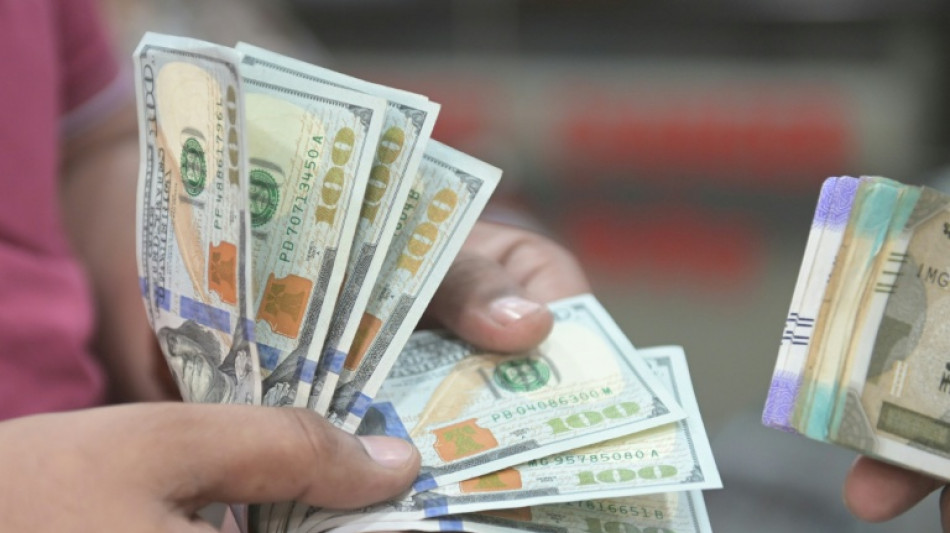
Mideast war drives up bond yields, budget risk / Photo: Narinder NANU - AFP
 Top-ranked Rybakina crushes Fernandez to win fourth title of season

 UK PM calls for 'honest discussion' about EU free movement

 Far-right leader Le Pen kicks off tilt at French presidency amid nationwide protests

 Naomi Osaka could quit tennis if daughter asks her to

 Last MotoGP race at Phillip Island cancelled due to weather in Marquez setback

 Sri Lanka seeks faster green energy shift after oil shocks

 Riyadh airport resumes flights following Houthi attacks

 'Call of Duty' North Korea invasion edition tops sales charts in South

 Musk accuses Ukraine of violating Starlink's terms of service

 Fed expected to hold rates steady days ahead of US midterms

 More Lula, or back to the Bolsonaros? Brazil votes in cliffhanger

 7 Creative Things to Do With Your Backyard

 HKA Enterprises is Powering the Skilled Trades That Are Moving the U.S. Economy Forward

 Obama blasts Trump's 'chaos and cruelty' while campaigning for Democrats

 Bolsonaro leads Lula in final Brazil election polls

 Antonelli storms to pole for US Grand Prix

 Alvarez fires Atletico to win against Deportivo

 Japan's Nakai wins Grand Prix de France for second straight year

 Ronaldinho to make comeback in Italian third tier

 Israeli forces displace Hebron families after deadly attack

 Hamilton on top with Antonelli fourth in final practice at US Grand Prix

 Beier late show sends Dortmund top of Bundesliga

 Police and protesters clash again at Albanian anti-government rally

 Arteta hails mentality as Arsenal go level with Man City

 Clashes break out in Paris, other cities amid fresh protests
The Middle East war is driving up the cost of public debt in rich countries which could jam state budgets and push governments to unfold austerity policies, economists warn.
The yields demanded by investors to lend to governments by buying their bonds have peaked in recent days, indicating weakening confidence in their economies and inflation fears.
The yield on the 30-year US Treasury bond touched on Tuesday its highest level since 2007 at 5.18 percent. Japanese and British 30-year bonds have hit records going back to 1999 and 1998 respectively, while benchmark 10-year yields have also surged.
The war has driven up energy prices and inflation, and put central banks in a tricky position -- all this is "blowing a perfect storm through the public debt market", Vincent Juvyns, an analyst at ING bank, told AFP.
- Inflation surge -
After the US and Israel launched strikes in Iran on February 28, Iran effectively closed the Strait of Hormuz, a key oil export route.
This drove up energy prices, fuelling inflation -- which in turn caused sovereign bond yields to climb since March as investors demanded higher returns to hold government debt.
"The trigger was the publication of several price indicators, which showed that inflation is becoming embedded in the global economy," said Juvyns.
Investors demand higher yields on government bonds to maintain their value in the face of inflation.
"Equity markets remain resilient despite the high level of uncertainty," but the debt market "is taking the full measure of the situation", Antoine Andreani, an analyst at trading platform XTB, told AFP.
- Political risks -
Political risks in key countries have also raised uncertainty among investors about their financial stability.
US President Donald Trump faces a challenge from Democrats in midterm elections in November.
Britain's Prime Minister Keir Starmer is resisting calls to resign after an election beating.
In France, which has a high public deficit, the far right is a major contender in a presidential election due in 2027.
Regarding the governments in such countries, there is "growing mistrust of their ability to rein in deficits", Kevin Thozet, a market analyst at French investment group Carmignac, told AFP.
Such is the mistrust that in some cases "we are now seeing companies borrowing more cheaply than countries," he added.
- Governments pressured -
As the pain of inflation from the war hits, leaders are under pressure to act, but face constraints.
"We expect governments to spend more to support households and businesses", Valentine Ainouz, head of rates at the Amundi Investment Institute, told AFP.
At the same time, "the economic stagnation looming as a result of the war's consequences will reduce tax revenues", she added.
Investors therefore see "more risk in lending to governments".
- Central banks strained -
The budgetary equation is all the more fraught because inflation is likely to push central banks to raise their benchmark rates, which underpin all interest rates, Juvyns said.
While the European Central Bank and the US Federal Reserve have not yet changed their rates, the pressure on them will mount as "inflation will become entrenched in the coming months even if an agreement were reached tomorrow" to end the conflict, he added.
In the short term, this "does not change much" for countries, Christophe Boucher, chief investment officer at ABN Amro bank, told AFP.
The rate increases would affect debt trading on the secondary market, where already-issued bonds are exchanged, he said.
But "when states issue new bonds, this will increase the cost of debt, which is already relatively high", he added.
- Debt dangers -
As government debt grows, it risks getting dangerously out of proportion to the size of the economy.
In France, the share of the state's budget allocated to paying down debt is already equivalent to spending on education.
Rising debt could push governments to roll out austerity policies by raising tax rates and cutting spending.
That would weigh on growth and "could also potentially weaken certain financial institutions", Boucher said.
These include banks "whose balance sheets are largely based on public debt", bringing a risk of instability in the banking system, he added.
A.Jones--AMWN