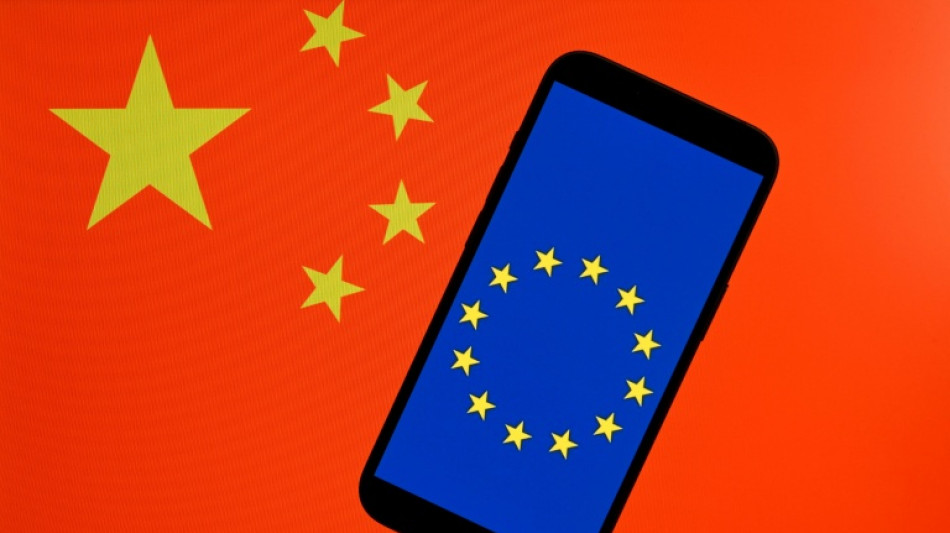
EU looks to bolster defences as China threatens key sectors / Photo: Nicolas TUCAT - AFP/File
 Ukraine says two soldiers died after arrested girl sent Russian poison

 New Greece law bans social media for under-15s
 Netanyahu orders West Bank closure as attack wounds Israelis before election
 Asian stocks mixed ahead of weekend as tech recovers early losses

 How five Boeing 777s linked Madagascar's power elite to Iran
 South Korea proposes holding border talks with North

 Ukraine's young figure skaters twizzle on despite Russian threat

 Asian football endorses Infantino re-election as FIFA president
 Complete Kane hopes for 'special night' as Ballon d'Or rumours swirl

 Rooney calls United squad 'selfish babies' after Fernandes criticism

 Teddy Wilson, son of World Cup-winner David, gets Wallabies call-up

 New Zealand military chief resigns over 'inappropriate relationship'

 Man Utd's Carrick on borrowed time, free-scoring Brighton face Liverpool
 Asian stocks head into weekend on a low as tech extends losses

 'Generational rage': Young Europeans fight to be heard

 Lula, Bolsonaro to clash once more before Brazil vote

 Dressed to kill: Haircuts cap menacing look of Japan's yakuza

 Napa Valley's wineries feel Trump's tariff squeeze
 Venezuela protests demand return of Nobel winning leader Machado

 Marquez tops incident-packed opening practice for Australian MotoGP

 New York votes to ban Central Park horse carriages after decades of debate

 Why Regular Boat Maintenance Saves You Money Over Time

 InterContinental Hotels Group PLC Announces Transaction in Own Shares - October 23
 Australia face selection headaches after 'shambolic' South Africa defeat

 Around 150,000 rally in Belgrade as Serbia heads to pivotal poll

The EU executive is set for much-heralded talks Friday on ramping up Europe's trade defences to shield critical industries from Chinese rivals -- with a growing chorus pressing for a crackdown.
As tensions come back down a notch with the United States, after Europe got approval of a 2025 trade agreement over the line, the bloc is turning its focus to China.
And it's not alone.
Experts and governments are increasingly warning of a "China shock 2.0", with a glut of cheap goods made in the Asian powerhouse threatening manufacturers not just in Europe but around the world as trade deficits widen with China.
Of rising concern in Europe is the yawning trade gap between China and the 27-nation EU, as the flow of cheap Chinese imports keeps rising.
The bloc's goods trade deficit with China hit some 360 billion euros ($420 billion) last year, meaning Chinese exports exceeded EU imports significantly.
"China's industrial dominance is not accidental. It is the result of decades of state subsidies and non-reciprocal market access," EU industry chief Stephane Sejourne told European Union ministers in Brussels on Thursday.
He later told reporters that 29 million jobs were "at very high risk in the coming months due to the trade deficit", citing the European Central Bank.
But the EU's trade worries over China are nothing new.
Since 2023, European Commission President Ursula von der Leyen has pushed a "de-risk, not decouple" approach that balances concerns over relying too much on China with keeping ties.
On Friday, she will lead a debate with her team of European commissioners on what the EU should do to defend the continent's companies from what Brussels describes as unfair competition from Chinese rivals.
Europe is also simultaneously seeking to diversify its trading partners, especially for rare earths, an industry dominated by China, after Beijing's stringent export controls last year revealed just how vulnerable the bloc is.
The EU also hopes new rules set to be unveiled next week will bolster local manufacturing of chips, used in various electronic products.
- More tariffs? -
Without naming China, four major EU economies -- France, Italy, the Netherlands and Spain -- circulated a document at the weekend pointing to the need for tougher measures to combat the "rise of unfair trade practices".
But their push pits them against Europe's biggest economy, Germany, which exports many goods like cars and factory machinery. Berlin is more cautious, fearful of upsetting Beijing and the painful consequences that could bring.
Quoted by the Financial Times newspaper on Thursday, Sejourne said the EU would step up its use of import quotas and tariffs on China to protect certain sectors including chemicals, metals and clean technology.
An EU official also told AFP commissioners would discuss whether new kinds of measures were needed to address the imbalance.
In response to Sejourne's comments, foreign ministry spokeswoman Mao Ning warned China "will take all necessary measures" to safeguard its legitimate rights and interests.
The EU in recent years has tried to tackle the imbalance through higher tariffs and a wave of anti-subsidy probes in the clean tech sector, leading to increased trade frictions between Brussels and Beijing.
Chinese attempts to invest in Europe have also increasingly met resistance.
The latest example came on Thursday when the EU kickstarted a probe into Chinese e-commerce giant JD.com's bid for major German electronics retail group Ceconomy on suspicion it was boosted by state subsidies.
burs-raz/ec/ach/hol
Ch.Kahalev--AMWN