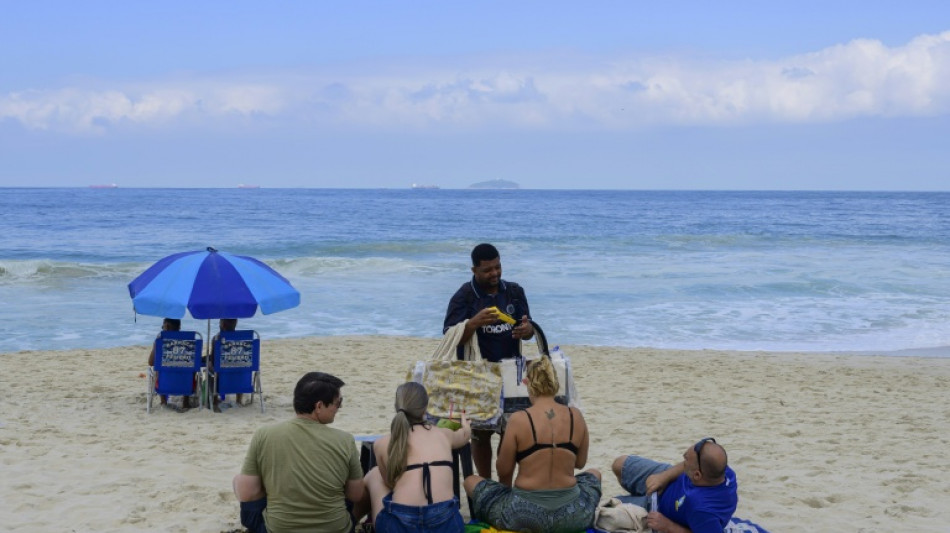
Why does Brazil's PIX payment system bother Donald Trump? / Photo: Pablo PORCIUNCULA - AFP
 Hurricane Isaias makes landfall in Florida
 Brazil prosecutors sue Shell for $108 mn over deadly 2024 floods

 Major earthquake destroys buildings, roads in Panama

 Anthropic AI model sent fake murder tip to Philadelphia police
 7.7-magnitude quake rocks Panama, triggers tsunami warning

 Prince Harry booed at English rugby match

 Kiplimo and Feysa seek repeat Chicago Marathon wins

 Fuellkrug halts Dortmund after late goal flurry
 Injured Ravens quarterback Jackson ruled out of Falcons clash

 Brewers aim to take down two-time defending champion Dodgers in NLCS rematch

 Tsunami alert after major earthquake rocks Panama

 Outer bands of Hurricane Isaias lash US Gulf Coast
 Hope, Rutherford fire West Indies to record T20 chase of 250

 Farhan leads Pakistan to T20 win over Sri Lanka
 Turkey sack coach Montella after Nations League woe

 US announces sanctions on ICC, hours after Nobel award to former judge

 Montenegro expels popular Russian war blogger wanted by US
 Rubio calls on all Venezuela opposition figures to join talks with govt
 Australia struggle against South Africa quicks in first Test

 Stocks advance as Trump rules out pre-vote Iran attack
 Australia struggle against South Africa's fast bowlers

 Massive debt puts France in a bind as investor doubts deepen

 Arteta urges 'respect' for process after Man City financial verdict
 'Human-authored' book labels gain ground amid AI scandals
 Man City whistleblower Pinto to stay under police protection

Whether buying a chilled coconut at the beach or paying rent, Brazil's free PIX system has become the dominant way of making payments in Latin America's largest economy, with just a smartphone.
US President Donald Trump does not like it one bit.
The payment system, launched in 2020 by the central bank, has become a bone of contention between Washington and the government of President Luiz Inacio Lula da Silva, who is seeking re-election in three months.
The United States argues that PIX amounts to unfair competition and hurts US credit card companies.
"You don't have to pay any fees for PIX; with banks, you have to pay credit card fees, annual fees, banking fees, fees for this and that," Paulo Ricardo Conceicao told AFP at his drinks kiosk on Copacabana beach.
The perceived unfairness of the PIX system and other alleged discriminatory trade practices has led the US to threaten a 25 percent tariff on some Brazilian exports.
A decision on this measure is expected in the coming days.
- What is PIX? -
According to the central bank, PIX accounts for 54 percent of all payment transactions in Brazil, with millions of transfers per day -- just six years after its launch.
Major financial institutions are obliged to offer the service to their clients, who simply open their banking app and send a payment in seconds using an identifier such as an identity number, key, or email address.
Payments can be even easier using a merchant's QR code.
PIX "successfully reached millions of Brazilians who were previously excluded from the traditional banking system," Brazilian Foreign Minister Mauro Vieira said in a letter to the Office of the United States Trade Representative (USTR).
The system is used by 80 percent of Brazil's 212 million people.
"Before, we had to carry cash and a bunch of stuff in our wallets. Now, you just grab your phone and make a PIX transfer. I think it’s made life a lot easier for everyone," Ingrid Ferreira, a 32-year-old civil servant, told AFP in Brasilia.
- What is the United States' complaint? -
Washington alleges that the central bank, as owner and regulator of PIX, faces a conflict of interest and puts US companies at a disadvantage.
The Trump administration complains about BCB requirements that banks feature PIX on the home screens of their apps and refrain from charging user fees.
The USTR said it was "forcing US providers to promote their Brazilian competitor, without compensation."
The Trump administration has rebuffed calls in the United States for it to create a similar electronic payment system.
A Brazilian government source told AFP that Washington's grievance stems from credit card companies, whose share of transactions in Brazil has dropped from 23 percent to 15 percent since 2020.
"A large part of the Brazilian population works in the informal service sector. They are small business owners who were largely at the mercy of those major credit card operators, paying fees," Professor Marco Sanfins of the Fluminense Federal University told AFP.
- What does Brazil say? -
Brasilia has rejected Washington's accusations, saying that PIX has expanded the entire digital payments system, which increases online activity and benefits US companies like Google.
And the central bank highlights that the number of card users has increased in Brazil since 2020.
Brazil believes that Washington sees PIX and other such payment systems as a potential threat to the international dominance of the dollar.
Kenya, Nigeria, India and Colombia have all developed similar systems.
- Why is this politically sensitive? -
Lula's main rival in the October presidential election is Flavio Bolsonaro, son of far-right former leader Jair Bolsonaro, who is serving a 27-year sentence for attempting a coup d'etat.
Trump imposed tariffs on Brazil last year over the trial against his ally, which the US president described as a "witch hunt". Most of those duties were later lifted.
While Jair Bolsonaro's sons had lobbied for those tariffs during their father's trial, Flavio Bolsonaro is now arguing against new ones, arguing they could boost Lula's electoral campaign.
"PIX is good for Brazil and, incredible as it may seem, it is also good for the United States," Flavio Bolsonaro said after a USTR hearing in Washington, defending the system.
jss-jiog/fb/dw
Th.Berger--AMWN