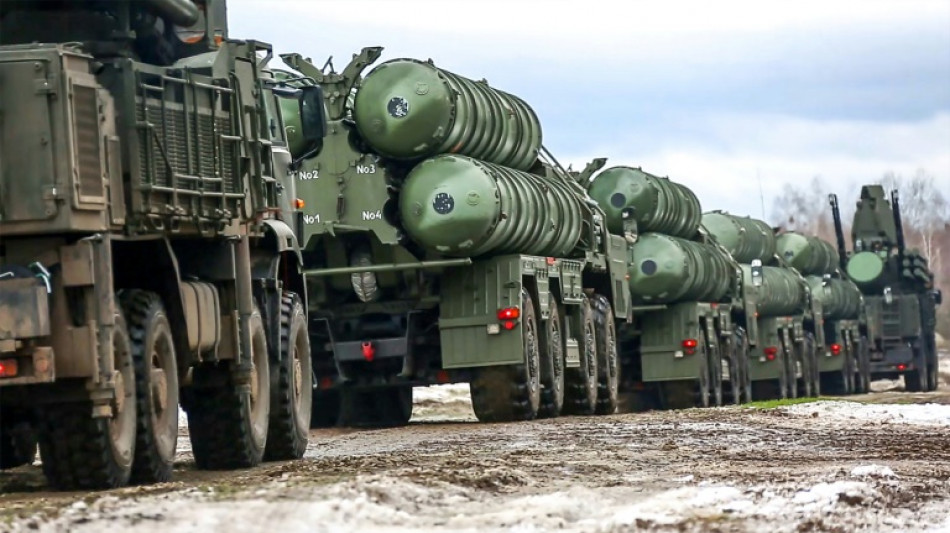
Russia launches Belarus drills, revving up fears of Ukraine invasion
 Europe's surging inflation spreads gloom in stock markets

 Truth commission demands compensation for Sweden's Sami people

 Japan win marathon penalty shootout to set up South Korea gold-medal clash

 Djokovic grinds out opening-round win at China Open

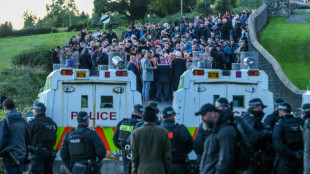 Northern Ireland police probe blockade of disputed parade
 UK PM Burnham reopens divisive debate on rejoining EU
 Man City future in doubt after guilty verdict
 'Do something,' begs Iranian woman after death sentence over protests
 China extends 52-year unbeaten record as Games organisers say sorry
 In Manchester, people say City scandal is 'shame for football'

 Stocks lacklustre as inflation data weighs on sentiment
 Israel-bound plane rerouted, pilots wounded in reported fight
 Truth commission on Sweden's Sami people seeks redress

 Energy costs spark inflation surges in France, Italy

 South Korea break China hearts to reach Asian Games football final

 Eala storms into Asian Games semi-finals to thrill adoring fans

 Turkey freezes ex-minister's assets as fund crisis grows

 What we know about the North Korean POW dispute
 Most equities rise after oil price plunge, US data in focus
 Polar oceans transformed as warming melts ice habitats: research

 Lost shark becomes viral star in South Korea
 Dangote to launch $16bn refinery in Kenya
 North Korean leader 'extremely obese': Seoul spy agency
 Yankees and pope-backed White Sox start MLB playoffs with wins

 Malaysia's ex-PM Mahathir in hospital for observation
Russia rolled its tanks across Belarus on Thursday for live-fire drills that drew an ominous warning from NATO and added urgency to Western efforts to avert a feared invasion of Ukraine.
NATO said Russia's deployment of missiles, heavy armour and machine-gun toting soldiers marked a "dangerous moment" for Europe some three decades after the Soviet Union's collapse.
German Chancellor Olaf Scholz warned Russia against testing Western allies by mounting any further escalation.
"In this critical situation for all of us, Russia should not underestimate our unity and determination as a partner in the EU and as an ally in NATO," Scholz warned.
"We take the concerns of our allies very seriously," he added alongside Baltics leaders who were in Berlin for talks.
Russia's war games -- set to run until February 20 -- followed a gradual Russian military buildup around Ukraine that some US estimates say has reached 130,000 soldiers grouped in dozens of combat brigades.
Western leaders have been shuttling to Moscow in an effort to keep the lines of communication open, giving Russia a chance to air its grievances about NATO's expansion into eastern Europe and ex-Soviet states.
British Foreign Secretary Liz Truss took a tough message to Moscow on Thursday, accusing Russia of adopting a "threatening posture" and urging the Kremlin to withdraw its forces to prove it had no plans to mount an attack.
Kyiv denounced the war games as "psychological pressure" while French Foreign Minister Jean-Yves Le Drian called the exercises "a very violent gesture".
In a bid to "reduce chances of miscalculation" during the drills, US and Belarusian defence chiefs held rare telephone talks, the Pentagon said Thursday.
Russia has also sent six warships through the Bosphorus for naval drills on the Black Sea and the neighbouring Sea of Azov.
Kyiv condemned their presence as an "unprecedented" attempt to cut off Ukraine from both seas.
Moscow and Minsk have not disclosed how many troops are participating, but the United States has said around 30,000 soldiers were being dispatched to Belarus from locations including Russia's Far East.
- 'Disappointed' -
Russia's defence ministry said the exercises would centre around "suppressing and repelling external aggression".
The Kremlin has insisted that the troops will go home after the exercises.
But Ukraine's President Volodymyr Zelensky said "the accumulation of forces at the border is psychological pressure from our neighbours".
Kyiv has launched its own military drills expected to mirror Russia's games, but officials have said little about them out of apparent fear of escalating tensions.
"All the (Russian) talk about some mythical threat from NATO or Ukraine is nonsense," Ukrainian Foreign Minster Dmytro Kuleba said.
Russia wants to secure written guarantees that NATO will withdraw its presence from eastern Europe and never expand into Ukraine.
The United States and NATO have officially rejected Russia's demands.
But Washington has floated the idea of the sides striking a new disarmament agreement for Europe -- an offer viewed as useful but dramatically insufficient by Moscow.
Truss was the latest Western diplomat to travel to Moscow, where she reported receiving promises from her Russian counterpart Sergei Lavrov that the Kremlin had no plans to invade Ukraine.
"We need to see those words followed up by actions," she told reporters after the talks.
But Lavrov said he was "disappointed" by the talks, saying the military drills and the movement of troops across Russia's own territory had spurred "incomprehensible alarm and quite strong emotions from our British counterparts and other Western representatives".
- 'Warning time going down' -
Truss's trip came just days after French President Emmanuel Macron conducted a round of shuttle diplomacy between Moscow and Kyiv, and then briefed Scholz about his progress in Berlin.
The German chancellor will travel to Kyiv and Moscow next week for separate meetings with the Ukrainian and Russian leaders -- including his first in-person meeting with Putin.
His position on the new Nord Stream 2 natural gas pipeline from Russia to Germany will be under particularly close scrutiny.
In Washington this week, Scholz had been largely evasive about US President Joe Biden's pledge to "bring an end" to the energy link should Russia invade Ukraine.
The chancellor later said it was a conscious decision "not to publish the entire catalogue (of sanctions) ... because we can gain a little bit of power" by remaining vague.
The flurry of diplomatic activity included a meeting between British Prime Minister Boris Johnson and NATO Secretary General Jens Stoltenberg.
"The number of Russian forces is going up. The warning time for a possible attack is going down," Stoltenberg said at a news conference with Johnson.
"Renewed Russian aggression will lead to more NATO presence, not less," he added.
Following Stoltenberg's remarks, NATO member Denmark said it was ready to allow US military troops on its soil as part of a new bilateral defence agreement.
But Johnson stressed after a meeting with Polish President Andrzej Duda -- one of Ukraine's strongest allies in Europe -- that Western states must "tirelessly pursue the path of diplomacy".
Y.Nakamura--AMWN