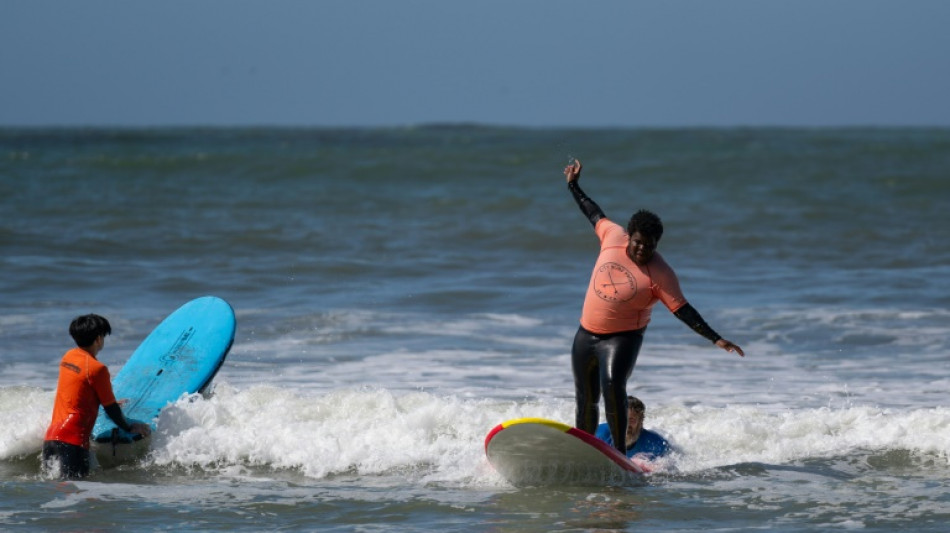
Catching a break: Inner city Californians try surfing / Photo: Loren Elliott - AFP
 What we know about Spain's deadly train crash

 ECB chief Lagarde to step down early, triggering succession race

 'Horrific' Russian drone strike kills 14 at Ukraine train station: Kyiv

 VW says 'no time to lose' to slash costs after 5.8 billion euro loss

 Australia lead by 100 after Inglis century

 Martin to ride with broken wrist in Malaysian MotoGP practice

 England forward Toney to stand trial for alleged assault in June 2028

 Warrican's five-wicket haul leads West Indies fightback in Bangladesh Test

 Oil majors reap bumper profits as Mideast war drives prices

 Christine Lagarde: unifying ECB chief in turbulent times

 Rybakina secures year-end top rank with Tokyo win

 Rains bring relief to Indonesian city weary of fire haze

 Osaka vows to return stronger after Tokyo exit

 Hello Kitty firm apologises, scraps Japan TV tie-up after China anger

 Taiwan says Pakistan briefly closed airspace to Taiwanese flights

 'My blood was spilled here': a year on, Tanzania unable to mourn election violence

 Afghanistan opium poppy cultivation surges despite Taliban govt ban: UN

 No World Series miracle for weary Rays

 Miami Heat earn first win of NBA season with Antetokounmpo

 Brewers beat Rays 4-1 to capture first World Series title

 Philippine island fights rising seas with nature, not concrete

 Bangladesh presses India before Ganges water treaty expires

 Trump accuses Alaska Democrats of fraud over same-name scandal

 Spain mourns after latest train tragedy kills 68

 Trump's border: quiet, but few people are happy

As Dianne Finez helps her Latino and African American students through their first surf lesson, she remembers the time she first took to the waves, trying out a sport she barely even knew existed.
The 20-year-old of Filipino descent grew up 30 minutes' drive from the beach in a working class neighborhood of San Francisco.
"I never knew surfing was an actual thing," she told AFP.
"It was also hard to get into the sport just because there's mostly white males."
Finez is one of more than 2,000 young people who have been introduced to the waves by City Surf Project over the last decade.
The association works with schools in working-class neighborhoods of San Francisco, where the bulk of the student population is Hispanic or African American.
- Cultural assumptions -
The organization offers long-term partnerships with schools that allow educators to tailor their programs.
But it also provides necessary practical help, like free use of equipment and transport to get students to and from the beach.
Unlike in the Hawaiian societies of yesteryear where surfing originated, the California coast today is largely the preserve of the wealthy -- the result of segregation and expropriation of minorities.
"When you look at who lives on the coast, it's usually affluent, white communities," says Andrew Perry, the City Surf Project's program manager.
"When you're a kid that lives almost two hours by bus from the beach, and then you've got to bring a surfboard on the bus, it is a monumental effort... as opposed to the person that lives two blocks from the beach and grew up there."
The cost of the sport is a limiting factor for many -- $300 for a wetsuit, $800 for a new board, and $200-a-day lessons.
That's where the organization's equipment loans come in handy, says Perry.
But it's not just the practical obstacles -- there are also cultural assumptions within the communities they are trying to reach, with what Perry calls a "generational stigma around swimming in the ocean" for working class families who live inland.
"A lot of the times kids are growing up viewing it as a really scary place," he said.
- 'Laid back' -
That's a familiar idea for Trew Gantt, an African American whose mother was terrified by the ocean.
"I was allowed to go to pools on my own, but not to the beach," he said.
"Everybody around me was telling me the ocean is cold and dangerous. Surfing just seemed unrealistic, unless you lived someplace tropical."
But after his first taste of life on a surfboard with the program, he was bitten, and now he works as an instructor, delighting in showing his young charges they should not be afraid of the water.
He credits the sport with keeping him out of trouble during his teenage years, and helping him remain on an even keel.
"Surfing taught me to be a lot more laid back and made me understand that I didn't need to impress anybody," he said.
And that's something that educators have noticed as well.
The ocean "is this force beyond measure that is good for us," says high school teacher Sara Kosoff.
"And so I think that students of color need access to that equally, if not more than white students."
F.Bennett--AMWN