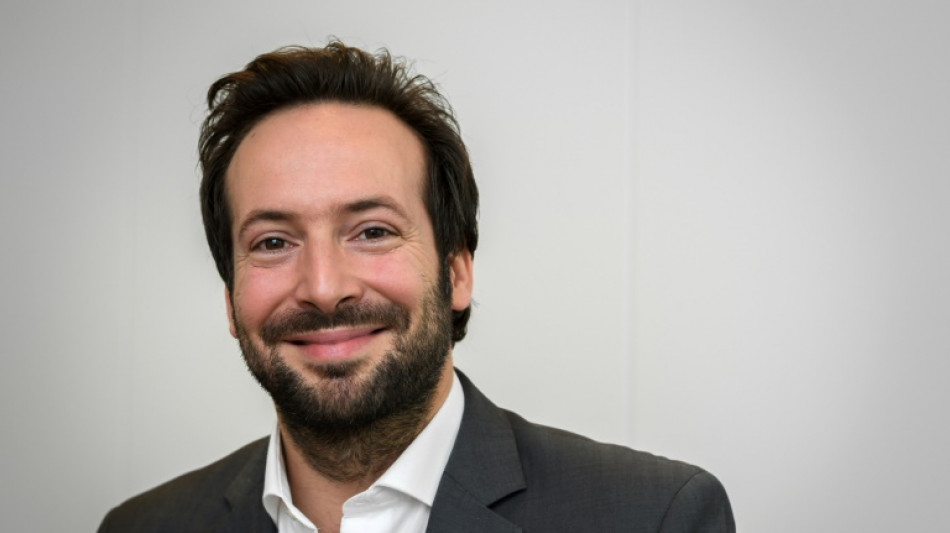
Anti-doping agency sharpens its tools for Paris Olympics / Photo: Fabrice COFFRINI - AFP/File
 Demonstrations backing France's protesting students gather strength

 Trump says US Senate as hard to defend as House in midterms

 Suspected Russian drones hit two ships off Bulgaria, 11 missing

 Tech stocks slide on AI jitters
 Trump asks Greece ambassador to resign amid ethics scandal
 New White House spokeswoman heavy on Trump praise, light on questions in debut

 Emery urges Villa to make most of reduced home comfort
 Flavio Bolsonaro visits father under house arrest ahead of Brazil runoff

 France, Eq. Guinea in standoff over luxury Paris mansion
 'Holding our ground': Israel demolishes dozens of Bedouin homes
 Hazlewood takes six as Australia beat South Africa in 1st Test

 Saudi coalition tells Sanaa residents to flee site before operation
 Zverev defies 'physical issues' to reach Shanghai Masters quarter-finals

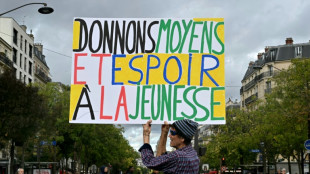 'We're not giving up': Activist Thunberg joins France student protests

 Man City captain Dias defends celebrations after Liverpool win
 B2PRIME Expands Tier-1 Access and Liquidity Architecture for Sophisticated Institutional Flow

 STARTRADER Adds 48 US Stock CFDs with 24-Hour Weekday Trading

 'Ink' director Danny Boyle slams Trump's Truth Social 'lies'

 Coach Kovac extends contract at Dortmund until 2029
 Activist Thunberg joins France student rally after violence at protests

 Archer and Bethell in England squad for Australia ODI series

 Formula One to return to Africa in 'early 2030s' in Rwanda

 US actor Selma Blair charged with assault after alleged flight altercation

 Hungary cuts anti-LGBTQ legislation from Orban-era law

 'Our future is being robbed': Greta Thunberg joins France student protests

In the battle against drug use at the Paris Olympics, the International Testing Agency (ITA) plans to deploy a more streamlined, high-tech approach to identify and target potential cheats.
In an interview with AFP, Benjamin Cohen, Director General of the ITA, said potential tools as its disposal included biological and performance passports as well as a mountain of other data.
Upgraded software, possibly using artificial intelligence, could also help; an investigative unit aided by whistleblowers was making inroads; and increased cooperation with sports bodies and police was bearing fruit.
ITA, which was founded in 2018, runs the anti-doping programme for the Olympics, the Tour de France and "more than 65 international organisations", said Cohen.
The challenge was to refine the "risk analysis" and identify athletes to monitor using as little time and resources as possible, said Cohen, a Swiss lawyer who has headed the agency since its creation.
The problem is accentuated in the run-up to the Paris Games.
"We still have 30,000 potentially qualifying athletes and we cannot wait to have the final list to focus on the 11,000 participants," Cohen said.
"Certain doping practices enable athletes to achieve results very quickly," he said. "Traditionally the pre-Olympic period is high-risk time...the last moment to make a difference. Athletes know that they will be very closely monitored at the Olympics, so I would hope that very few, if any, will be tempted to take drugs in the Olympic Village in Paris."
At the Games, only medallists are automatically tested, but ITA wants to find ways to target potential dopers before the finish.
Cohen said ITA tries to identify patterns. They look at the demands of each discipline and the substances it might tempt athletes to use. Then ITA looks at delegations and "the history of doping in that country". Finally, it scrutinises each individual athlete and "the development of his or her performances, any suspicious biological passport profiles, suspicious anti-doping tests, and so on."
"That's hundreds of thousands of pieces of data."
- 'Risk analysis' -
"Today we have our own software, and the next stage" will involve "programming computers to extract this data, because we still do a lot of this work manually."
After that, the ITA hopes to "seize all the opportunities offered by artificial intelligence", provided "we use these new tools ethically."
"If it's done properly," he said. "AI will enable us to go much further in risk analysis and prediction."
ITA is developing a "performance passport" as a counterpart to the long-established biological passport.
The objective is to "predict results on the basis of what an athlete has done over the last four years", said Cohen.
"Artificial intelligence will enable us to say: 'this is really an unusual result, which could suggest doping'," he said. "It could help us flag them."
The performance passport project was initially tested in swimming and weightlifting, two indoor sports where athletes compete in identical environments each time.
Weightlifting also happens to be one of the two sports, along with athletics, that have returned, between them, the vast majority of positive tests at Summer Olympics.
In 2021, ITA carried out "a major investigation into weightlifting" and that enabled them to set up a specialised unit in cooperation with the sport.
- Focus on cycling -
It now has more than ten such units. "Cycling is a particular focus" but "other sports are beginning to understand the benefits of gathering intelligence, having anonymous sources and promoting whistleblowers.
"It's a new method that complements traditional testing."
Cohen said ITA has been working to build links with law enforcement and exploit 'synergies'.
"They are bearing fruit," he said, referring to the case of 23-year-old Italian cyclist Andrea Piccolo, arrested on June 21 by the Italian Carabinieri who caught him returning to the country with growth hormones.
"ITA asked the Italian authorities to open his luggage, which would not have been possible six years ago," Cohen said.
"We carry out the controls, we monitor the performances of these athletes, we know the networks, the doctors involved and the drugs they are taking. And they can seize and open suitcases and enter hotel rooms."
P.Mathewson--AMWN